
Community Organizations Need Support to Provide Veteran-Centric Suicide Prevention Programming


Background: Veteran suicide prevention programming varies within community organizations. Organizations that implement suicide prevention are most likely to follow the Zero Suicide framework. However, program guidelines do not identify veterans as a specific subpopulation with particular suicide prevention needs. They also do not establish components as broad or comprehensive as the Veterans Health Administration (VHA) suicide prevention program, which provides competent care to address the needs of veterans at all risk levels.
Methods: Twelve community organizations—5 that provide mental health services and 7 that provide nonclinical services—were surveyed in 2020 as part of a pilot project using a modified Zero Suicide framework to assess their veteran suicide prevention practices compared with VHA standard practices. The survey assessed leadership commitment to reducing veteran suicide, suicide risk screening for veterans, suicide care management practices and policies, quality improvement activities, and training offerings.
Results: No clinical or nonclinical community organizations surveyed met the VHA recommended standard of care for veteran suicide prevention on all assessed suicide prevention programming components. The results highlight an opportunity to implement support and program standards to improve veteran-centric suicide prevention services outside the VHA.
Conclusions: Collaborating with community organizations focused on veteran suicide prevention efforts is an important component of public health. This quality improvement survey identified formal leadership commitment to veteran suicide prevention programming and care processes, additional staff training on suicide care for veterans, root cause analysis for deaths by suicide and suicide attempts, and additional measures as means to promote patient safety and implement novel approaches to prevent veteran suicide.
An estimated 17.6 veterans died by suicide daily in 2022, accounting for 6407 deaths. The age-adjusted suicide rate among veterans without recent use of Veterans Health Administration (VHA) services was 59.9% compared with 40.1% among those enrolled in VHA care. From 2020 to 2022, unadjusted veteran suicide rates were highest among veterans using any VHA-authorized community care in the year of or preceding suicide, followed by those who used any VHA care, those who used both VHA and community care, and those who used neither VHA nor community care.1
While all groups included veteran populations engaging with health care, VHA is positioned to manage care for high-risk veterans via its integrated behavioral health care system focused on suicide prevention programming.2-5 The VHA Suicide Prevention Program seeks to reach veterans at all risk levels and is the broadest and most comprehensive program when compared with other prominent frameworks, such as Zero Suicide, the US Department of Veterans Affairs (VA)/Department of Defense (DoD), and the Centers for Disease Control and Prevention technical package.1,2,5-8
Many veterans who died by suicide in 2022 received mental and physical health care services or social services from community organizations.9,10 Veterans have unique physical health, mental health, and psychosocial needs requiring culturally competent care to adequately address those needs and reduce suicide risk.11-17 The VA 10-year National Strategy for Preventing Veteran Suicide and the VHA public health approach call on community organizations to implement veteran-centric suicide prevention programming, as these organizations serve as a resource and offer a critical role in suicide prevention.5,18 Such organizations include veteran-serving community health care organizations, VHA-purchased community care systems, and organizations that employ or provide social services to veterans (ie, fire and police departments, public libraries, and homeless shelters). However, community organizations may not be adequately resourced or trained to provide veteran-centric suicide prevention services that effectively address their complex needs.19
Veteran-serving organizations can meet this public health call to action by implementing veteran-centric suicide prevention programming.18 While program components for each organization vary according to services offered (ie, clinical or nonclinical), they all should provide culturally competent care that considers veterans' military experience, exposures, and needs. Clinical organizations (eg, mental health) may provide these services, as well as individual level, evidence-based suicide prevention interventions offered in the integrated behavioral health VHA system and outlined in the 10-year National Strategy for Preventing Veteran Suicide and the VA/DoD Clinical Practice Guideline for Assessment and Management of Patients at Risk for Suicide.1,5
Nonclinical organizations may encounter veterans at high risk for suicide (eg, veterans experiencing homelessness) and can provide suicide risk screening, referrals to services, and suicide prevention educational materials. However, no practice standards or required programming exist for veteran suicide prevention in community organizations. The first step in cultivating and implementing these standards is to understand the landscape of veteran suicide prevention across clinical and nonclinical community organizations.
The Zero Suicide framework is a primary source of guidance for community health care systems.20-22 It provides a comprehensive approach to preventing suicide by focusing on patient safety, quality improvement, and eliminating fragmented suicide care by implementing system level changes.21,22 Health care organizations that have implemented Zero Suicide have reported reductions in suicide.23-26 Although this framework is not required, organizations can secure grants and have dedicated staff to implement Zero Suicide. A limitation of Zero Suicide is that programming is not tailored for veterans, a population that experiences a higher risk of suicide than nonveterans and has certain exposures that contribute to a potential gap in providing veteran-centric services.1,11-17
Zero Suicide is formatted for health care systems, whereas nonclinical community organizations may benefit from veteran suicide prevention quality improvement. The Zero Suicide framework has fewer veteran suicide prevention program components and is not as comprehensive in its ability to reach veterans at all risk levels, unlike the VHA program.2
While community organizations provide services to veterans at risk of suicide, the extent to which their suicide prevention programming is tailored to veterans is largely unknown. A RAND survey of New York clinicians found that only 2.3% were effectively serving veterans based on criteria including screening for service-connected medical conditions, screening for veteran status, and access to timely care.27 This study sought to examine veteran suicide prevention practice standards among clinical and nonclinical community organizations as a baseline measure for a quality improvement pilot and compare reported practice standards to those used within VHA.1,5-8
Methods
This quality improvement project was reviewed and approved by the Colorado Multiple Institutional Review Board prior to data collection. To examine suicide prevention practices and programming in community health care, public safety, and social service organizations, 12 community organizations in the Denver and Colorado Springs regions were recruited to participate in a veteran suicide prevention pilot project, with a recruitment goal of 10 to 12 organizations. Local organizations were recruited using snowball recruitment methods, through connections from professional colleagues, internet searches, and contact with attendees at local suicide prevention meetings. Organizational representatives were invited via email to schedule a meeting about the project. No monetary incentives were provided for participation. In 2020, a link to an online survey was distributed and collected with representatives of 5 community clinical organizations (ie, organizations that provided mental health services to veterans) and 7 nonclinical organizations (eg, veterans court; fire, police, and sheriff departments, library; and housing). Responses were used to evaluate each organization’s veteran suicide prevention practices and compare them with VHA standard practices.1,5
Zero Suicide developed an assessment to understand organizational-based suicide prevention programming and measure fidelity of implementation, with high internal consistency (α = 0.90) and concurrent validity.24,28 It examines suicide prevention programming in community organizations. This survey was modified to focus on veteran-specific suicide prevention. After using this survey in this quality improvement project, the measure was revised by the Zero Suicide Institute at the Educational Development Center.28
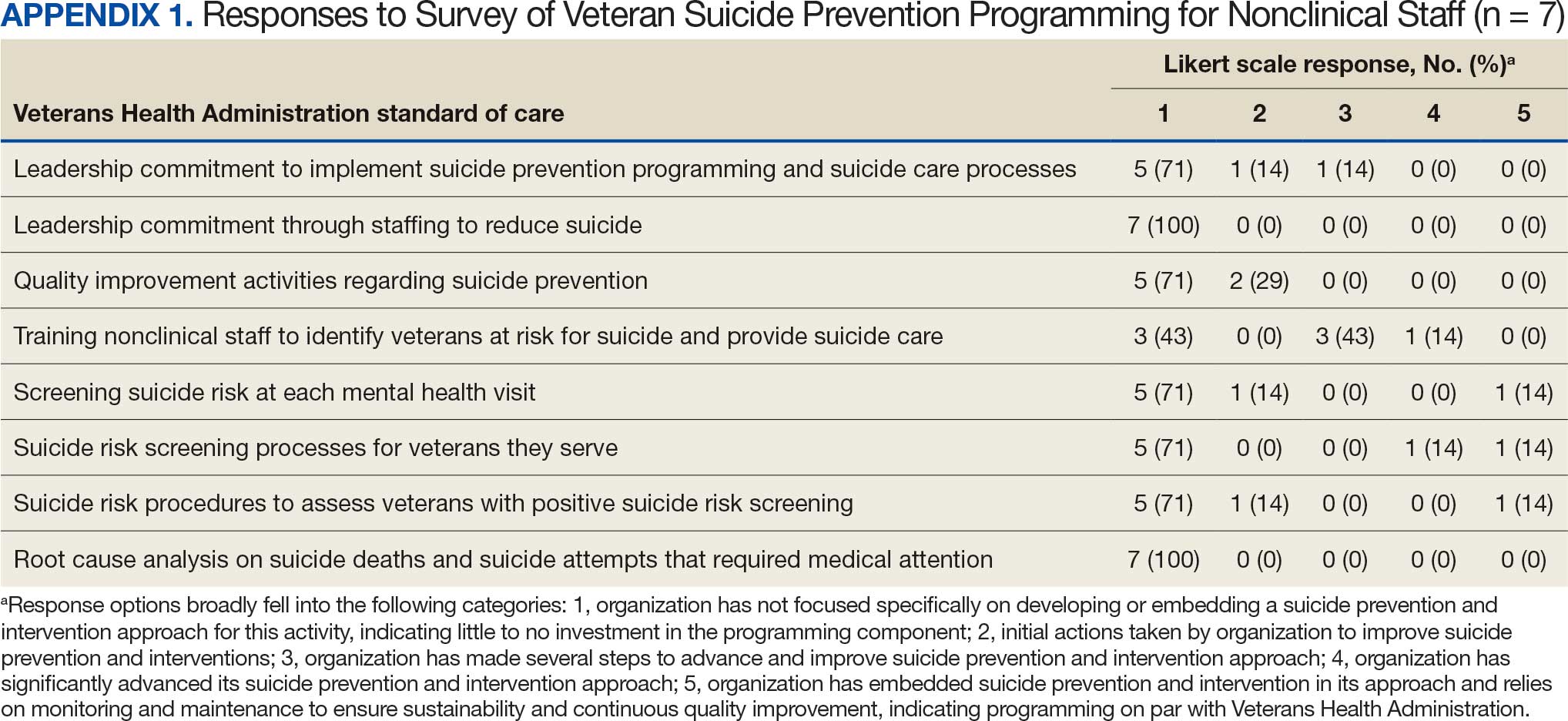
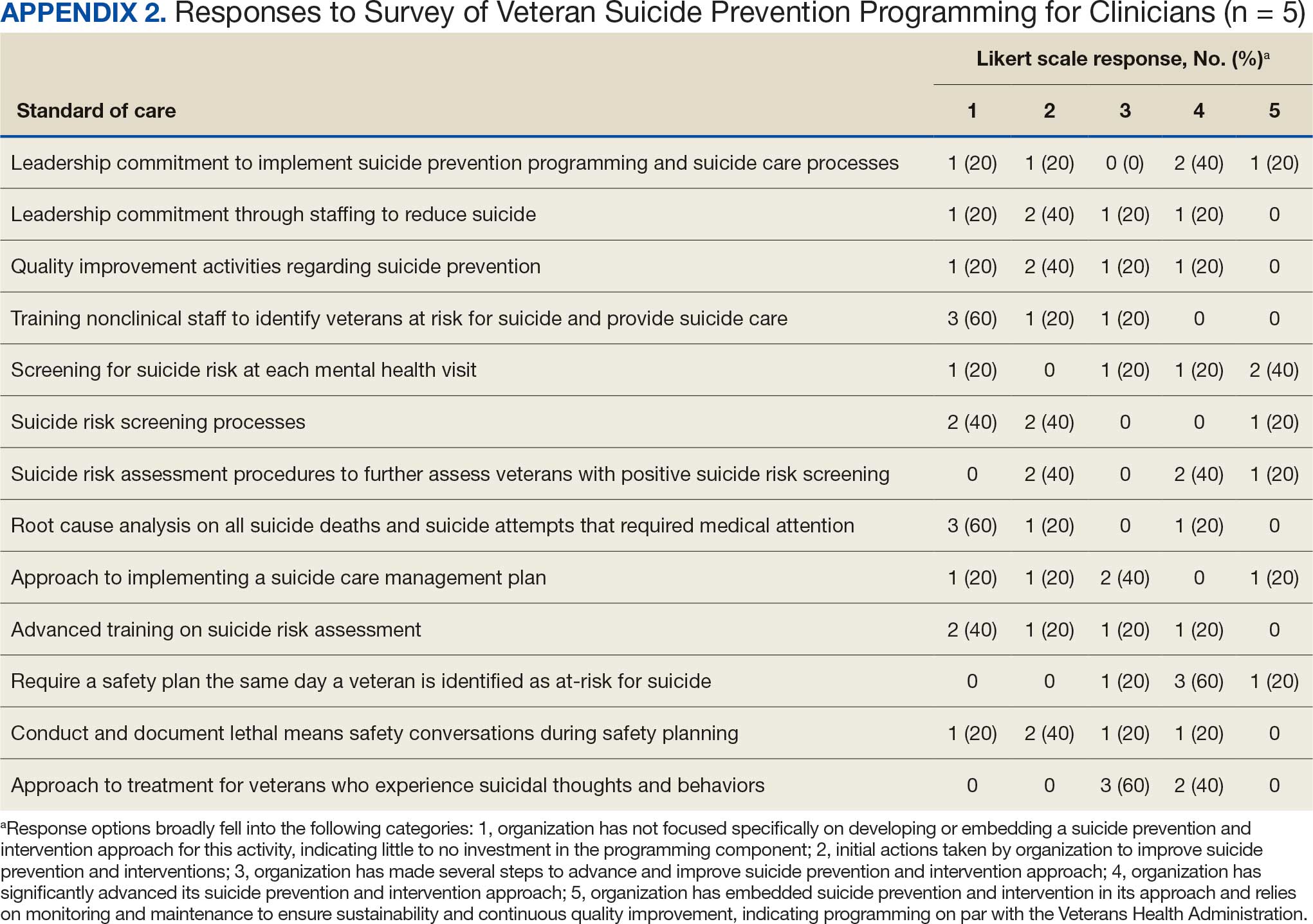
Data were collected via an online survey platform administered by Visible Network Labs. Clinical organizations answered 13 questions and nonclinical organizations answered 8 questions about their use of veteran suicide prevention program components (Appendices 1 and 2). Each question was rated on a 5-point Likert scale ranging from 1 (little to no investment in developing or embedding a suicide prevention or intervention approach into their programming) to 5 (the organization has embedded comprehensive suicide prevention and intervention in its operations and ensures sustainability and continuous quality improvement, indicating programming on par with VHA). Overall results compared clinical and nonclinical organizations with VHA standards.1,5-8
Results
VHA standard of care is a commitment to veteran suicide prevention programming and suicide care and its processes.1,5-8 Among clinical organizations surveyed, 3 (60%) reported ≥ 4 processes, while none of the nonclinical organizations reported implementing widespread veteran suicide prevention processes.
VHA employs a multidisciplinary team that convenes to implement and modify veteran suicide prevention policies and review data and staff feedback, a standard that all clinical and nonclinical community organizations in this sample failed to meet.1,5-8 Of the clinical organizations surveyed, 1 (20%) did not task staff with instituting and overseeing veteran suicide prevention processes, while 2 (40%) dedicated 1 staff member to developing veteran-specific suicide prevention processes and expectations for care; however, that individual was not authorized to make policy changes. Further, 1 clinical organization (20%) surveyed had an implementation team aimed at recommending changes to its suicide care processes on an as-needed basis, and another (20%) had a formal veteran suicide prevention implementation team responsible for developing internal policies and procedures that met regularly. In contrast, none of the nonclinical organizations surveyed tasked staff with building and managing veteran suicide prevention processes.
No organization established routine quality improvement activities with a designated team regularly tracking suicide prevention data (at least every 2 months) to ensure suicide care policies were followed, assess reductions in suicide deaths, and routinely update suicide prevention procedures (the VA standard).1,5-8 One clinical organization (20%) and 5 nonclinical organizations (71%) focused only on providing veterans with the same care afforded to nonveterans and had not engaged in veteran-specific suicide prevention quality improvement activities. Among the remainder of clinical organizations surveyed, only 1 (20%) reported discussions about record keeping to track veteran suicide care, and 1 (20%) had a designated team to examine veteran suicide care data for fidelity of organizational policies.
In comparing clinical and nonclinical training of nonclinical staff on identifying veterans at risk for suicide and providing suicide care to veterans, no organizations required routine, annual, all-staff suicide risk assessment training, as is required for VHA staff. In fact, 3 (60%) clinical and 3 (43%) nonclinical organizations did not offer opportunities for any such training and had no suicide prevention training requirements for nonclinical staff. No clinical organizations and 1 (14%) nonclinical organization required training on veteran suicide risk identification and care for nonclinical staff.
Screening veterans for suicide risk during mental health visits is standard VHA care. Among clinical organizations, 1 (20%) had no systemic screening, compared with 5 (71%) nonclinical organizations. Screening for high-risk individuals (eg, crisis calls) was not reported by any clinical organizations and 1 nonclinical organization (14%), while veterans with a suspected mental health disorder were screened at intake at 1 (20%) clinical and no nonclinical organizations. More closely aligned with VHA practices, 2 clinical (40%) and 1 nonclinical organization (14%) screened veterans for suicide risk at intake or first contact, then reassessed risk at each visit and during a change in status, care level transitions, or emergence of new psychosocial risk factors.
Standard VHA care is to use a validated suicide risk screening tool. Organizations relied on the judgment of staff at 2 clinical organizations (40%) and 5 nonclinical organizations (71%). No clinical and 1 nonclinical organization (14%) required the use of a validated screening tool. One clinical (20%) and 1 nonclinical organization (14%) required the use of a validated screening tool and provided training in line with VHA practice. Among screening tools used, 3 clinical organizations (60%) reported using the Patient Health Questionnaire-9 and 2 (40%) used the Columbia-Suicide Severity Rating Scale, recognized as the gold standard for suicide screening in veterans and nonveterans.29
Organizations specified procedures to further assess veterans identified as at-risk for suicide at screening. VHA recommends a validated risk assessment tool that examines risk and protective factors, which 1 clinical organization (20%) and 1 nonclinical organization (14%) followed. Five nonclinical organizations (71%) either did not have a policy or had a policy established that sent veterans who screened positive for suicide risk to the emergency department; no clinical organizations reported this. Risk assessments were required for positive screens, but the process and tool used were determined by staff, or only psychiatrists could perform the assessment at 2 clinical (40%) and 1 nonclinical organization (14%). Two clinical organizations (40%) reported use of a validated tool and documentation of suicide risk assessment in records for all at-risk veterans; no nonclinical organizations reported this.
VHA conducts root cause analyses on veteran suicide deaths and suicide attempts requiring medical attention. When organizations were notified about a veteran they treated dying by suicide or experiencing an adverse event, 3 clinical (60%) and all 7 nonclinical organizations reported no root cause analysis procedure. One clinical organization (20%) conducted a root cause analysis on all veterans they treated, and 1 (20%) conducted root cause analyses of veteran suicide deaths and updated policies and training as indicated.
Only clinical organizations were asked questions related to suicide care management, treatment, and assessment. The VHA approach to implementing a suicide care management plan includes suicide risk screening, suicide risk assessment and risk formulation, safety plan/crisis response plan, lethal means safety counseling, evidence-based treatments, and supportive contacts with veterans who do not show up for appointments as well as during care transitions. Only 1 clinical organization surveyed (20%) provided no formal guidance, while another limited care plans to screening and providing clinical staff or external referrals. Two clinical organizations (40%) provided suicide care management guidance for veterans at different risk levels, while no organization had all records, policies, and protocols enhanced to include all suicide care management components. One organization (20%) incorporated all components required in VHA and held regular case conferences about patients placed on the suicide care management plan.
Advanced suicide risk assessment training is required for VHA clinical staff annually and during onboarding; it was not required by any surveyed organizations. Rather, 2 clinical organizations (40%) offered no organization supported training, and 1 (20%) reported that training was made available but not required. One (20%) required internal training of select staff, and another (20%) required externally developed training of all clinical staff.
VHA standard requires a same-day safety plan for at-risk veterans. Standardized safety plans were used in 1 organization (20%), yet safety plan quality varied by clinician. Of the remaining clinical organizations, 3 (60%) implemented safety plans for veterans at elevated risk, in line with VHA standards.
VHA requires documentation of lethal means safety conversations (LMSCs) during safety planning for all veterans.7 While no clinical organization met this standard, 1 (20%) expected to include LMSCs in safety planning, while another (20%) provided clinician trainings, but LMSC implementation requirements were left up to clinicians. Engaging in LMSCs was determined by the clinician and required no documentation at 2 organizations (40%). One organization (20%) offered no veteran LMSC training.
Clinical organizations shared evidence-based treatment approaches for veterans experiencing suicidal thoughts and behaviors. VHA standard is to provide veteran-specific evidence-based suicide prevention treatments and provide staff training on these treatments. While no organization in this sample invested in veteran-specific training, 2 (40%) regularly provided training access and required competency to deliver empirically supported treatments.
Discussion
While Zero Suicide has been instrumental in providing suicide prevention programming guidance to health care organizations, additional efforts are needed to tailor guidance to address veteran-specific needs in community-based organizations. Veterans have unique needs and are at greater risk for suicide.11-17 Based on results from this survey, community agencies frequently lacked veteran suicide prevention practices that met the standard of VHA care.1,5-8 Community organizations would benefit from assistance, guidance, and support to enhance their suicide prevention programming and address veteran-specific needs.
Surveyed organizations lacked commitment from leadership to implement suicide prevention programming for veterans. Organizations that have implemented Zero Suicide have shared similar findings, noting how a cultural shift across health care systems is necessary and outlining the importance of leadership prioritizing veteran suicide prevention.30,31 A lack of budget allocation to fund staff and programs to support veteran suicide prevention programming is a likely constraint.
Organizations may not lack the desire to implement veteran suicide prevention processes, but lack awareness that veterans have distinct qualities that put them at greater suicide risk than nonveterans and are unaware that veteran-centric suicide prevention programming options exist.19 Depending on the size of the organization, creating a team to implement veteran suicide programming and processes may be a strategy to address this issue. To optimize veteran suicide prevention programming, identifying a committed leader and creating staff buy-in to implement changes are necessary.32-34
There are 2 veteran suicide prevention gaps in Zero Suicide implementations. First, military and veteran cultural competence among staff is not addressed. Community organizations may employ, treat, or serve veterans and could benefit from suicide prevention training in the context of military and veteran culture, including risk and protective factors, drivers of risk, and additional considerations pertinent to veterans (eg, heightened ownership of firearms and use of firearms as a suicide method). Educating staff about the specific needs of veterans and how they are at greater risk for suicide may provide a deeper understanding of veteran suicide prevention and galvanize staff involvement as processes are created and implemented. Second, Zero Suicide has fewer suicide prevention program components with a narrower breadth of prevention compared with VHA.2
More than half of community organizations surveyed did not offer staff veteran suicide prevention training. In VHA, staff complete suicide prevention training to prepare them to respond to any at-risk veteran. Aligned with a public health approach to suicide prevention, training nonclinical staff is essential, as they may encounter veterans at risk for suicide and can respond by referring them for additional screening or services, providing a safety net for veterans served by community organizations.5,18
More than half of organizations surveyed lacked a policy or process for screening veterans for suicide risk. While evidence for universal risk screenings is mixed, best practice for evaluating veterans identified as having elevated risk for suicide is to adopt a protocol to conduct a full suicide risk assessment using a validated tool, including an evaluation of risk and protective factors.35 In addition to its robust screening policy and processes, the VHA uses a predictive analytics program known as Recovery Engagement and Coordination for Health–Veterans Enhanced Treatment (REACH VET) to identify those at the highest risk for suicide who may not be identified by universal screening and provides proactive outreach, further assessment, and connection to services.36,37
Engaging in veteran suicide prevention quality improvement activities is a best practice. This includes routine examination of suicide prevention care metrics by a designated team to ensure policies and procedures are followed, and the development and continued evaluation of veteran suicide prevention policies and procedures for sustainability.32-34 No organizations (clinical or nonclinical) engaged in this level of quality improvement. One surveyed clinical organization reported examining suicide care data to ensure policies were followed with fidelity. Because participating organizations lacked veteran suicide prevention policies and procedures, the lack of continuous quality improvement was expected.
Clinical Organizations
Veteran suicide prevention care should include advanced training on suicide risk assessment, suicide care management, safety planning, lethal means safety, and treatment of suicide-related thoughts and behaviors, including policy adoption to train staff at onboarding and annually. Notably, 40% of clinical organizations surveyed did not offer training in these areas; the remaining 60% offered some, but not to VHA standards.1,5
VHA standards and best practice include the implementation of a suicide care management plan embedded in the electronic health record.1,5-8 Organizations would benefit from the adoption of policies created by the veteran suicide prevention implementation team surrounding the plan, including when and how to place and remove veterans from the plan, and how to conduct case conferences. Although 20% of organizations surveyed reported following best practice procedures, 40% expected staff to provide care for at-risk veterans with only some guidance.
Creating a same-day crisis response plan (CRP) or safety plan for veterans at risk for suicide and reviewing and modifying it at each follow-up visit is also best practice.8,38-42 Safety plan quality influences effectiveness, with higher quality safety plans reducing the likelihood of future suicidal behavior.43 CRP/safety plans should include warning signs of suicide risk and coping strategies an individual can take in response. All organizations reported engaging in some level of safety planning for veterans with elevated suicide risk; however, only 20% of clinical organizations engaged in best practice.
Firearms are the most common lethal means of veteran death by suicide.1 Therefore, firearm LMSCs are paramount. Best practice is implementing an organizational policy incorporating LMSCs in all veteran CRP or safety plans, including contacting family, as well as regularly reviewing the plan.8
Providing evidence-based treatments for veterans’ suicide care (ie, collaborative assessment and management of suicidality, cognitive behavioral therapy for suicide prevention, brief cognitive behavioral therapy, or dialectical behavioral therapy) for individuals with recent self-directed violence or borderline personality disorder is best practice for clinical organizations.5,40,44-48 Organizations can benefit from offering and requiring ongoing training for clinical staff on evidence-based treatments.
Limitations
A small number of organizations from a limited geographical region were surveyed, which may limit the applicability of these results. This was a quality improvement project and not research, therefore, results are not necessarily generalizable to community organizations nationally. The timing of the survey may have impacted results, as it is possible a more recent survey would yield different findings. Future directions include VHA collaborating with community organizations to offer support for veteran suicide prevention programming, including lethal means safety implementation. Further, conducting a national survey of veteran-serving community organizations may identify current veteran suicide prevention programming, suicide prevention budget allocations, existing gaps, and growth opportunities.
Conclusions
Given the crucial role of community organizations in veteran suicide prevention, working with community organizations to develop and implement suicide prevention best practices and evidence-based care for veterans is critical to their safety. Findings from this piloted quality improvement project survey demonstrate that specific areas of need may include formal leadership commitment to veteran suicide prevention programming and suicide care processes through staffing and quality improvement activities, staff trainings on suicide care for veterans, processes for suicide risk screenings and suicide risk assessments, root cause analysis for suicide deaths and attempts, procedures and trainings for safety planning and lethal means safety conversations, and approaches to implement a suicide care management plan.
