
Shifting Culture Toward Age-Friendly Care: Lessons From VHA Early Adopters


Background: The need for a health care workforce with expanded skills in the care of older adults is increasingly evident as the US population ages. The evidence-based Age-Friendly Health Systems (AFHS) framework establishes a structure to reliably assess and deliver effective care of older adults with multiple chronic conditions: what matters, medication, mentation, and mobility (4Ms). Half of veterans receiving Veterans Health Administration (VHA) care are aged ≥ 65 years, driving its transformation into the largest AFHS in the US. In this article, we offer lessons on the challenges to AFHS delivery and suggest opportunities to sustaining age-friendly care.
Observations: Within 3 months of implementation, 85% to 100% of patients received 4M care in all care settings at our VA facilities. Key lessons learned include the importance of identifying, preparing, and supporting a champion to lead this effort; garnering facility and system leadership support at the outset; and integration with the electronic health record (EHR) for reliable and efficient data capture, reporting, and feedback. Although the goal is to establish AFHS in all care settings, we believe that initially including a geriatrics-focused care setting helped early adoption of 4Ms care in the sites described here.
Conclusions: Early adopters at 2 VHA health care systems demonstrated successful AFHS implementation spanning different VHA facilities and care settings. Successful growth and sustainability may require leveraging the EHR to reduce documentation burden, increase standardization in care, and automate feedback, tracking, and reporting. A coordinated effort is underway to integrate AFHS into VHA documentation, performance evaluation, and metrics in both the legacy and new Cerner EHRs.
Implementing 4Ms Care
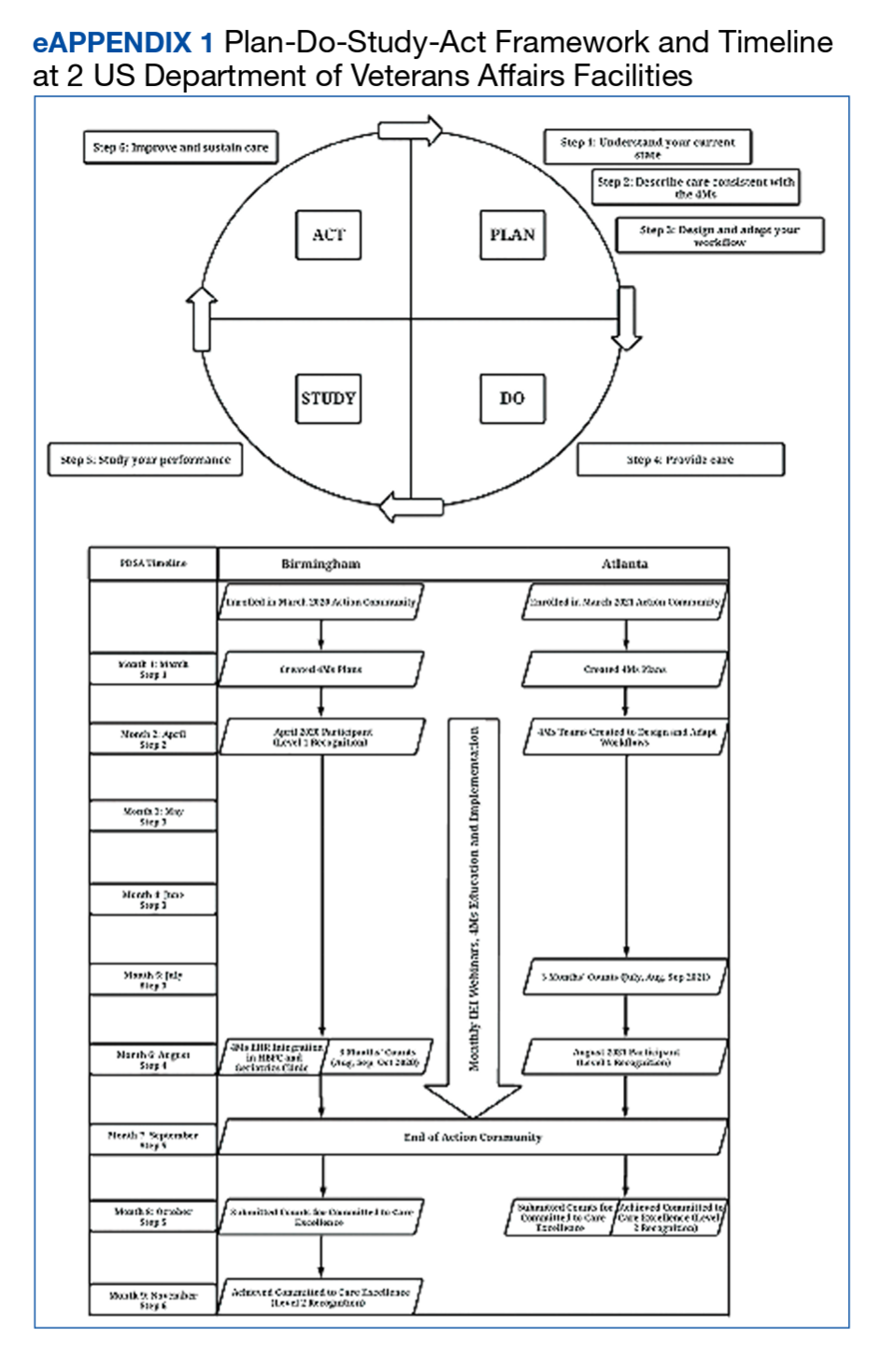
The IHI identifies 6 steps in the Plan-Do-Study-Act cycle to reliably practice the 4Ms. eAppendix 1 provides a side-by-side comparison of the steps over a 9-month timeline independently taken by BVAHCS and AVAMC to achieve both levels of AFHS recognition.
Step 1: Understand the Current State
In March 2020 the BVAHCS enrolled in the IHI Action Community. Three BVAHCS care settings were identified for the Action Community: the inpatient hospital, GAC (an outpatient clinic), and HBPC. The AVAMC HBPC enrolled in the IHI Action Community in March 2021.
Before joining the AFHS movement, the BVAHCS implemented a hospital-wide delirium standard operating procedure (SOP) whereby every veteran admitted to the 313-bed hospital is screened for delirium risk, with positive screens linked to nursing-led interventions. Nursing leadership supported AFHS due to its recognized value and an exemplary process in place to assess mentation/delirium and background understanding for screening and acting on medication, mobility, and what matters most to the veteran. The BVAHCS GAC, which was led by a single geriatrician, integrated the 4Ms into all geriatrics assessment appointments.
For the BVAHCS HBPC, the 4Ms supported key performance measures, such as fall prevention, patient satisfaction, decreasing medication errors, and identification of cognition and mood disorders. For the AVAMC HBPC, joining the AFHS movement represented an opportunity to improve performance measures, interdisciplinary teamwork, and care coordination for patients. For both HBPC sites, the shift to virtual meeting modalities due to the COVID-19 pandemic enabled HBPC team members to garner support for AFHS and collectively develop a 4Ms plan.
Step 2: Describe 4Ms Care
In March 2020 as guided by the Action Community, BVAHCS created a plan for each of its 3 care settings that described assessment tools, frequency, documentation, and responsible team members. All BVAHCS care settings achieved level 1 recognition in April 2020. Of the approximately 300 veterans served by the AVAMC HBPC, 83% are aged > 65 years. They achieved level 1 recognition in August 2021.
Step 3: Design and Adapt Workflows
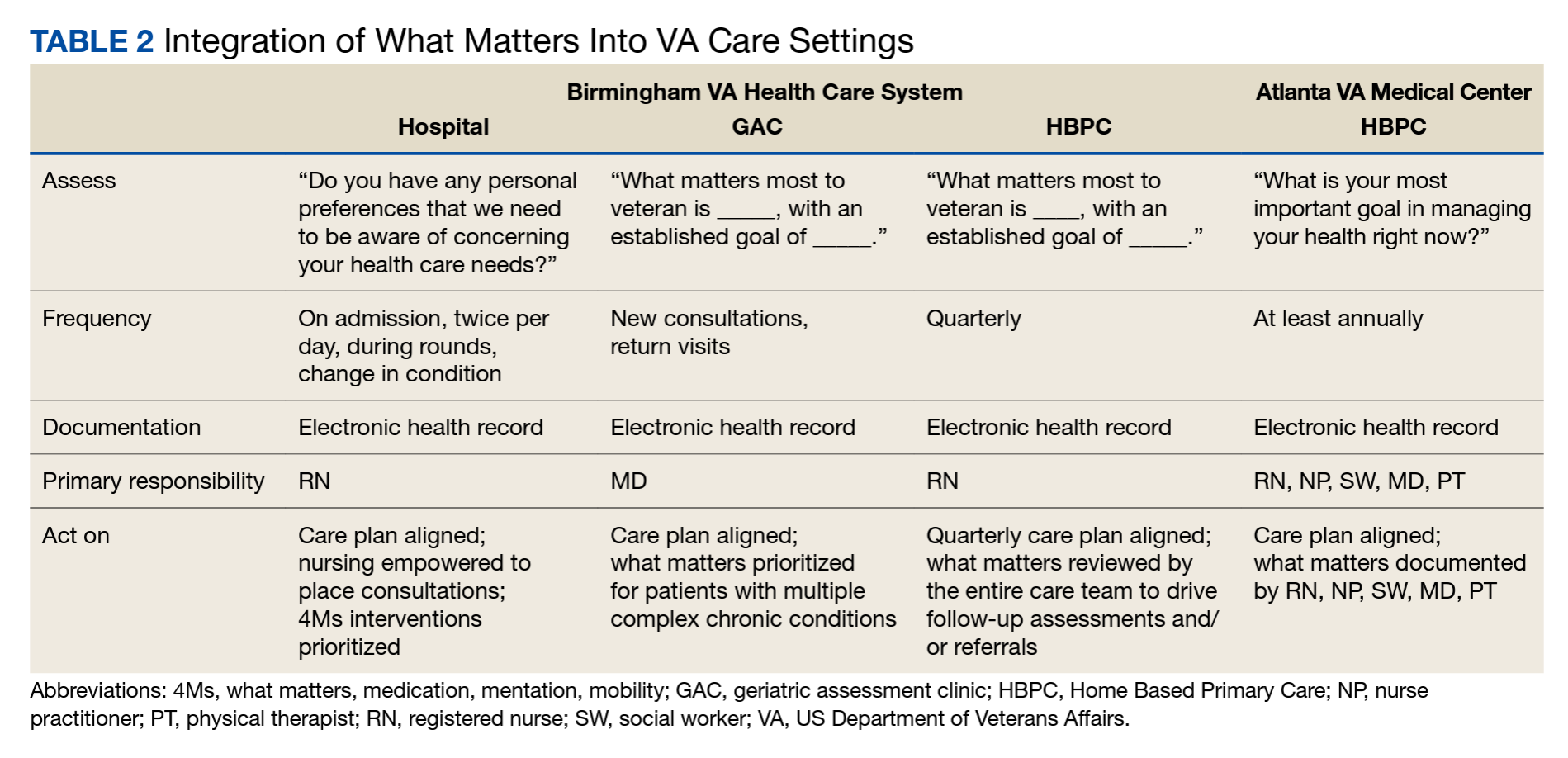
From April to August 2020, BVAHCS implemented its 4Ms plans. In the hospital, a 4Ms overview was provided with education on the delirium SOP at nursing meetings. Updates were requested to the electronic health record (EHR) templates for the GAC to streamline documentation. For the BVAHCS HBPC, 4Ms assessments were added to the EHR quarterly care plan template, which was updated by all team members (Table 2).
From April through June 2021, the AVAMC HBPC formed teams led by 4Ms champions: what matters was led by a nurse care manager, medication by a nurse practitioner and pharmacist, mentation by a social worker, and mobility by a physical therapist. The champions initially focused on a plan for each M, incorporating all 4Ms as a set for optimal effectiveness into their quarterly care plan meeting using what matters to drive the entire care plan.
Step 4: Provide Care
Each of the 4Ms was to be assessed, documented, and acted on for each veteran within a short period, such as a hospitalization or 1 or 2 outpatient visits. BVAHCS implemented 4Ms care in each care setting from August to October 2020. The AVAMC HBPC implemented 4Ms from July to September 2021.


