
Acute Painful Horner Syndrome as the First Presenting Sign of Carotid Artery Dissection


Background: Horner syndrome is a rare neurologic disorder that can arise from severe neurologic and systemic conditions, which may require immediate diagnosis with radiologic imaging and treatment with antiplatelet and anticoagulant therapy. Horner syndrome is often asymptomatic but can have distinct, easily identified characteristics seen with an ophthalmic examination.
Case Presentation: A 61-year-old woman presented with periorbital pain localized around and behind the right eye that she rated as 7 on a 10-point scale with onset 3 days prior. She reported light sensitivity, syncope, dizziness, and a recent history of transient ischemic attacks of unknown etiology. The patient had acute, slight ptosis with pathologic miosis and pain in the ipsilateral eye with no reports of exposure to miotic pharmaceutical agents and no history of trauma to the globe or orbit eliminated other differentials, leading to a diagnosis of right-sided Horner syndrome. She was referred for emergency department evaluation where radiography was indicative of an internal carotid artery dissection.
Conclusions: Due to possible life-threatening complications that can arise in patients with Horner syndrome, clinicians must have a thorough understanding of the condition, appropriate treatment, and management modalities. Determining the underlying etiology of Horner syndrome can help prevent a decrease in a patient’s vision or quality of life and in some cases prevent death. Magnetic resonance imaging and computed tomography should be used to rule out carotid artery dissection and other severe conditions.
CTA revealed a focal linear filling defect in the right midinternal carotid artery, likely related to an internal carotid artery vascular flap. There was no evidence of proximal intracranial occlusive disease. MRI revealed a linear area of high-intensity signal projecting over the mid and distal right internal carotid artery lumen (Figure 2A).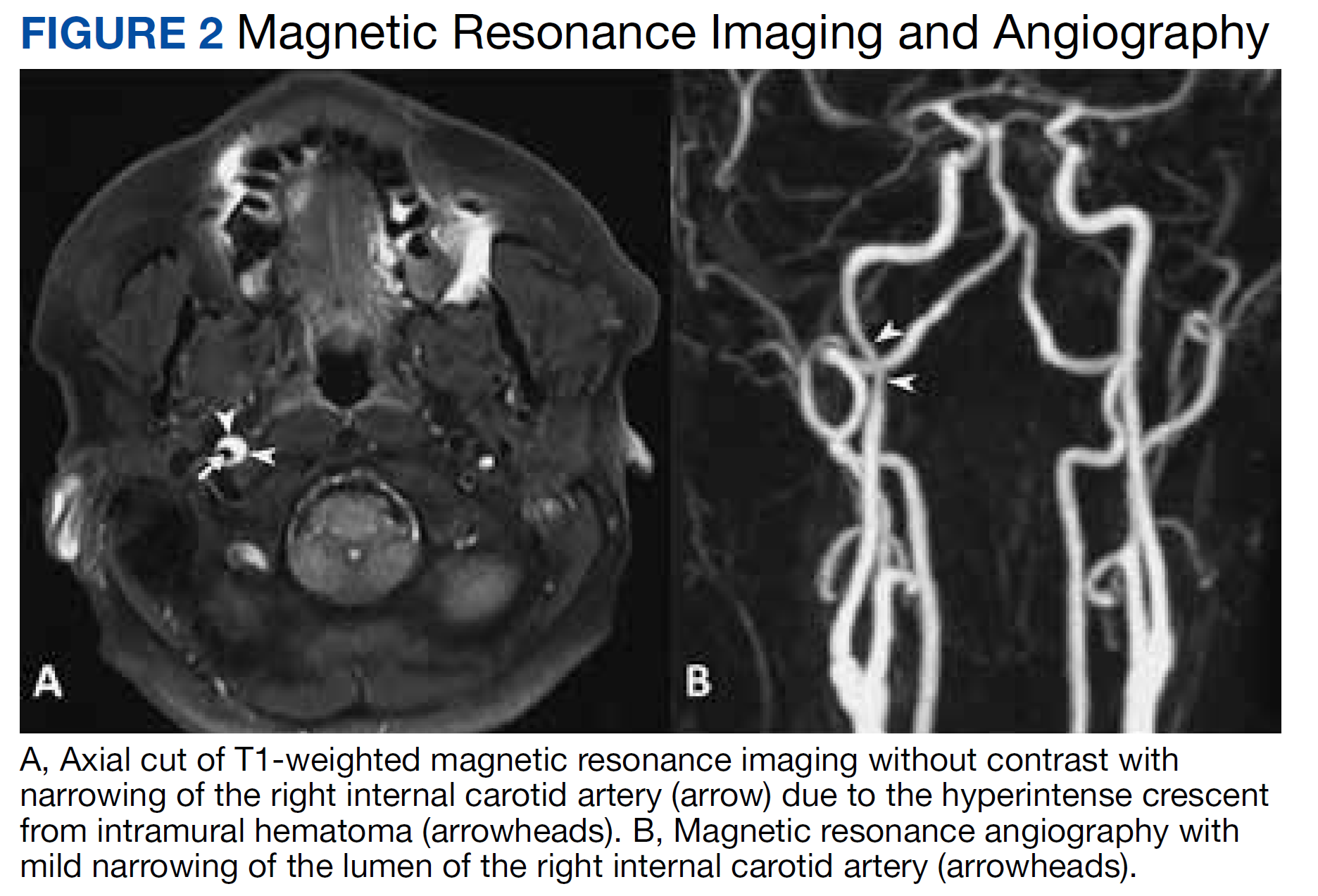
Imaging suggested an internal carotid artery dissection, and the patient was admitted to the hospital for observation for 4 days. During this time, the patient was instructed to continue taking 81mg aspirin daily and to begin taking 75 mg clopidogrel bisulfate daily to prevent a cerebrovascular accident. Once stability was established, the patient was discharged with instructions to follow up with neurology and neuro-ophthalmology.
Discussion
Anisocoria is defined as a difference in pupil sizes between the eyes.1 This difference can be physiologic with no underlying pathology as an etiology of the condition. If underlying pathology causes anisocoria, it can result in dysfunction with mydriasis, leading to a more miotic pupil, or it can result from issues with miosis, leading to a more mydriatic pupil.1
To determine whether anisocoria is physiologic or pathologic, one must assess the patient’s pupil sizes in dim and bright illumination. If the difference in the pupil size is the same in both room illuminations (ie, the anisocoria is 2 mm in both bright and dim illumination, pupillary constriction and dilation are functioning normally), then the patient has physiologic anisocoria.1 If anisocoria is different in bright and dim illumination (ie, the anisocoria is 1 mm in bright and 3 mm in dim settings or 3 mm in bright and 1 mm in dim settings), the condition is related to pathology. To determine the underlying pathology of anisocoria in cases that are not physiologic, it is important to first determine whether the anisocoria is related to miotic or mydriatic dysfunction.1
If the anisocoria is greater in dim illumination, this suggests mydriatic dysfunction and could be a result of damage to the sympathetic pupillary pathway.1 The smaller or more miotic pupil in this instance is the pathologic pupil. If the anisocoria is greater in bright illumination, this suggests miotic dysfunction and could be a result of damage to the parasympathetic pathway.1 The larger or more mydriatic pupil in this instance is the pathologic pupil. Congenital abnormalities, such as iris colobomas, aniridia, and ectopic pupils, can result in a wide range of pupil sizes and shapes, including miotic or mydriatic pupils.1


