
VA-Based Peritoneal Dialysis Program Feasibility Considerations and Process Outline


Background: Home dialysis utilization is lower among veterans than in the general US population. Several sociodemographic factors and comorbidities contribute to peritoneal dialysis (PD) underutilization. In 2019, the Veterans Health Administration (VHA) Kidney Disease Program Office convened a PD workgroup to address this concern.
Observations: The PD workgroup was explicitly concerned by the limited availability of PD within the VHA, which frequently requires veterans to transition kidney disease care from US Department of Veterans Affairs medical centers (VAMCs) to non-VHA facilities when they progress from chronic kidney disease to end-stage kidney disease, causing fragmentation of care. Since the administrative requirements and infrastructure of VAMCs vary, the workgroup focused its deliberations on synthesizing a standard process for evaluating the feasibility and establishing a new PD program within any individual VAMC. A 3-phased approach was envisioned, beginning with ascertainment of prerequisites, leading to an examination of the clinical and financial feasibility through the process of data gathering and synthesis, culminating in a business plan that translates the previous 2 steps into an administrative document necessary for obtaining VHA approvals.
Conclusions: VAMCs can use the guide presented here to improve therapeutic options for veterans with kidney failure by establishing a new or restructured PD program.
Step 3: proposal
There are no standardized formats for presenting a VHA business proposal; however, this outline provides a template. The business proposal should be designed to effectively communicate the collective data that describe the needs and requirements of a PD program to the local, regional, and national leadership. Not every rationale presented here will apply to an individual proposal and the local champion will need to tailor their rationale for their locale. A sample business plan is shown in eAppendix 3 (available online at doi:10.12788/fp.0356). VHA Handbook of dialysis requires that a PD nurse has a minimum of 12 months of nursing experience with at least 3 months of PD experience.25 Nursing training, education, and support should be discussed with nursing leadership and included in the business plan. Similarly, arrangements for laboratory, pharmacy, and prosthetics services and/or logistics to facilitate procurement of the needed devices, disposables, and supplies are essential and should be highlighted in the business plan.
Approval Process
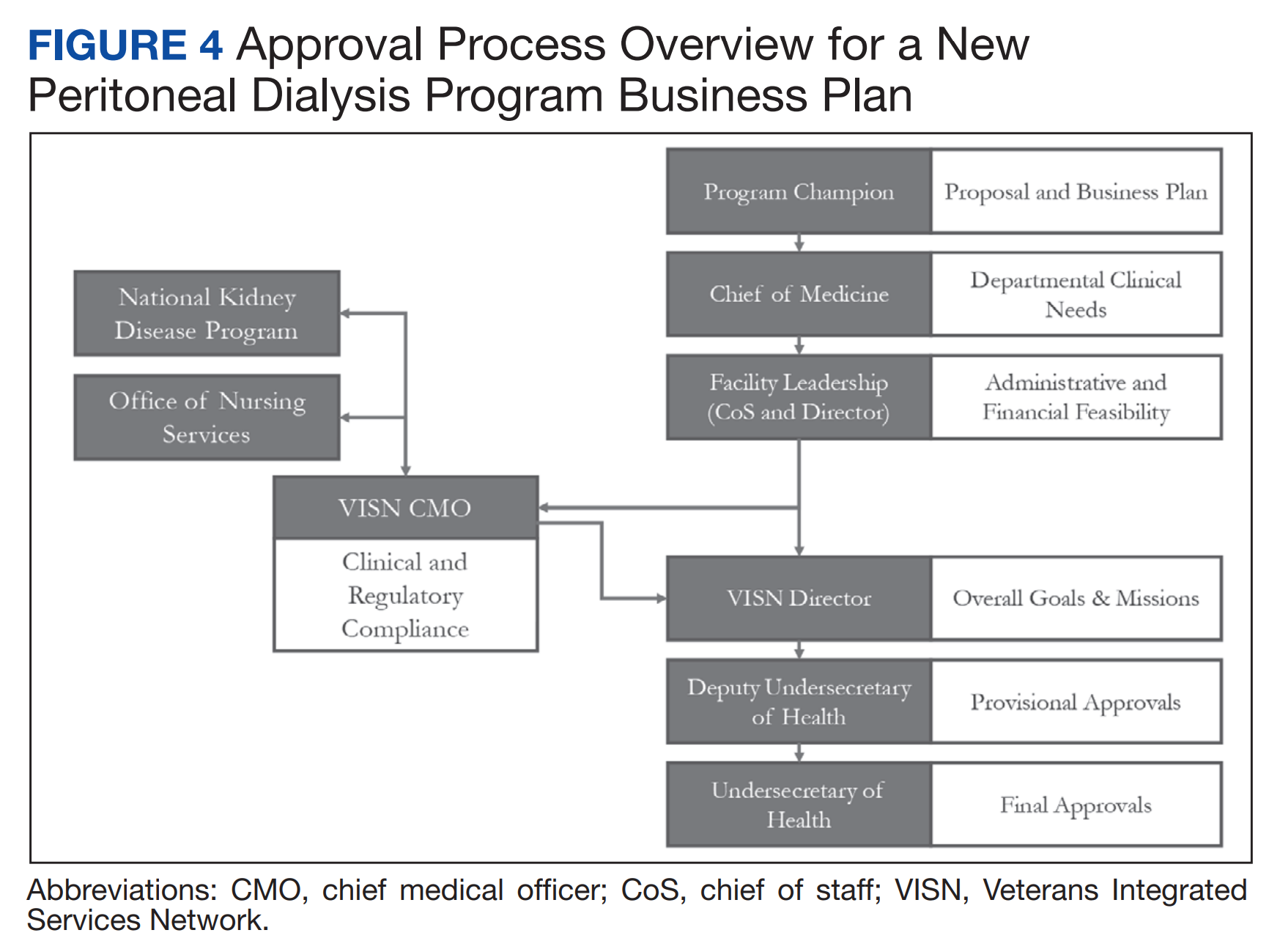
Postapproval Process
Once approved, the champion will need to work closely with various services and managers to oversee infrastructural renovations and execute the hiring plans, establish standard operating procedures (SOPs), standardize staff proficiencies and functional statements, and finalize quality assessment parameters. Home dialysis standards have been addressed by NKDP and The Joint Commission. While PD requires home visits to assess the appropriateness of the environment, the PD program is accredited under hospital-based therapy. Standards and performance metrics should be incorporated into all the VA PD programs for standardization and assessment. Based on guidance from the VHA Handbook, quality metrics, such as dialysis adequacy, and rates of infection should be monitored and reviewed. The dialysis director may need to consider more frequent program evaluations in the first year to ensure appropriate troubleshooting. The VA infrastructure has developed the resources for a central repository for the PD SOPs and quality metrics, which can be obtained and adapted for the local program. Similarly, veteran satisfaction can be assessed through existing resources. Finally, the dialysis director can join the National VHA Dialysis Director listserv for regular updates on the existing and new VHA policies and NKDP updates.
Conclusions
Establishing a new PD program within a local federal infrastructure can appear daunting, both in terms of planning as well as approvals. However, the provision of home-based dialysis therapies may be beneficial to those in rural settings with limited access to in-center dialysis modalities as well as to those who seek autonomy and lifestyle independence in their medical care. Collaborations with the VHA NKDP or PD workgroup can help overcome many of the procedural hurdles, provide guidance about infrastructure and resource allocation and utilization, and provide easy access to established SOPs and quality parameters.
Acknowledgments
We acknowledge the late Dr. Catherine Do for her significant contribution to this manuscript. We also extend our sincere thanks to Dr. Holly Mattix-Kramer (Edward Hines Jr. Veterans Affairs Hospital and Loyola University Medical Center) for her prompt and valuable feedback on this manuscript.


