
Amputation Care Quality and Satisfaction With Prosthetic Limb Services: A Longitudinal Study of Veterans With Upper Limb Amputation


Purpose: This study sought to measure and identify factors associated with satisfaction with care among veterans. The metrics were colelcted for those receiving prosthetic limb care at the US Department of Veterans Affairs (VA) and US Department of Defense (DoD) care settings and at community-based care providers.
Methods: A longitudinal cohort of veterans with major upper limb amputation receiving any VA care from 2010 to 2015 were interviewed by phone twice, 1 year apart. Care satisfaction was measured by the Orthotics and Prosthetics User’s Survey (OPUS) client satisfaction survey (CSS), and prosthesis satisfaction was measured by the OPUS client satisfaction with device (CSD), and the Trinity Amputation and Prosthetic Experience Scale satisfaction scales. The Quality of Care index, developed for this study, assessed care quality. Bivariate analyses and multivariable linear regressions identified factors associated with CSS. Wilcoxon Mann-Whitney rank tests and Fisher exact tests compared CSS and Quality of Care items at follow-up for those with care within and outside of the VA and DoD.
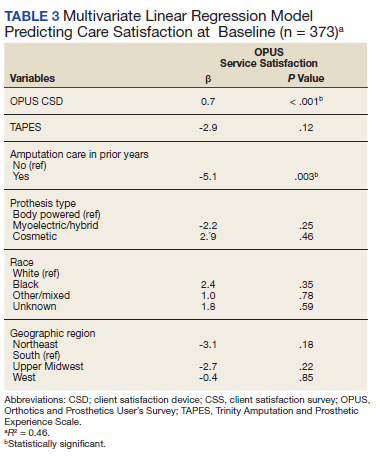
Results: The study included 808 baseline participants and 585 follow-up participants. Device satisfaction and receipt of amputation care in the prior year were associated with greater satisfaction with care quality. Persons with bilateral amputation were significantly less satisfied with wait times. Veterans who received amputation care in the VA or DoD had better, but not statistically different, mean (SD) CSS scores: 31.6 (22.6) vs 39.4 (16.9), when compared with those who received care outside the VA or DoD. Those with care inside the VA or DoD were also more likely to have a functional assessment in the prior year (33.7% vs 7.1%, P = .06), be contacted by providers (42.7% vs 18.8%, P = .07), and receive amputation care information (41.6% vs 0%, P =.002). No statistically significant differences in CSS, Quality of Care scores, or pain measures were observed between baseline and follow-up. In regression models, those with higher CSD scores and with prior year amputation care had higher satisfaction when compared to those who had not received care.
Conclusions : Satisfaction with prosthetic limb care is associated with device satisfaction and receipt of care within the prior year. Veterans receiving amputation care within the VA or DoD received better care quality scores than those receiving prosthetic care outside of the VA or DoD. Satisfaction with care and quality of care were stable over the 12 months of this study. Findings from this study can serve as benchmarks for future work on care satisfaction and quality of amputation rehabilitative care
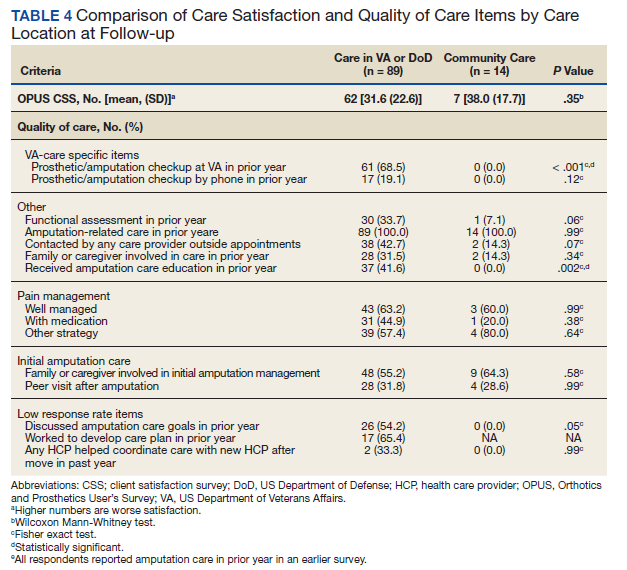
For participants who indicated that they received amputation care between baseline and follow-up, CSS mean (SD) scores were better, but not statistically different, for those who reported care in the VA or DoD vs private care, 31.6 (22.6) vs 38.0 (17.7) (Table 4). When compared with community-based care, more participants who received care in the VA or DoD in the prior year had a functional assessment in that time period (33.7% vs 7.1%, P = .06), were contacted by HCPs outside of appointments (42.7% vs 18.8%, P = .07), and received information about amputation care in the prior year (41.6% vs 0%, P =.002). There was no difference in the proportion whose family/caregivers were involved in care in the prior year.
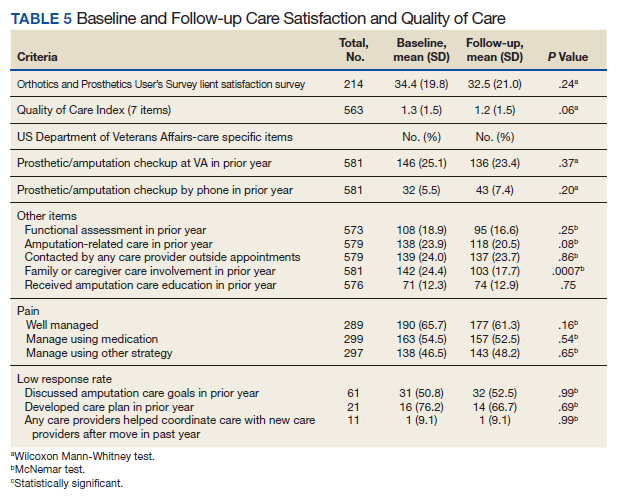
No statistically significant differences were observed in paired comparisons of the CSS and Quality of Care Index at baseline or follow-up for all participants with data at both time points (Table 5; eAppendix 3 available at doi:10.12788/fp.0096). Individual pain measures did not differ significantly between timepoints. Quality Index mean (SD) scores were 1.3 (1.5) and 1.2 (1.5) at baseline and follow-up, respectively (P = .07). For the 214 prosthesis users with longitudinal data, baseline CSS mean (SD) scores were generally worse at baseline than at follow-up: 34.4 (19.8) vs 32.5 (21.0) (P = .23). Family/caregiver involvement in amputation care was significantly higher in the year before baseline when compared with the year prior to follow-up (24.4% vs 17.7%, P = .001). There were no other statistically significant differences in Quality of Care items between baseline and follow-up.
Discussion
Our longitudinal study provides insights into the experiences of veterans with major ULA related to satisfaction with prosthetic limb care services and receipt of amputation-related care. We reported on the development and use of a new summary measure of amputation care quality, which we designed to capture some of the key elements of care quality as provided in the VA/DoD CPG.2


