
Amputation Care Quality and Satisfaction With Prosthetic Limb Services: A Longitudinal Study of Veterans With Upper Limb Amputation


Purpose: This study sought to measure and identify factors associated with satisfaction with care among veterans. The metrics were colelcted for those receiving prosthetic limb care at the US Department of Veterans Affairs (VA) and US Department of Defense (DoD) care settings and at community-based care providers.
Methods: A longitudinal cohort of veterans with major upper limb amputation receiving any VA care from 2010 to 2015 were interviewed by phone twice, 1 year apart. Care satisfaction was measured by the Orthotics and Prosthetics User’s Survey (OPUS) client satisfaction survey (CSS), and prosthesis satisfaction was measured by the OPUS client satisfaction with device (CSD), and the Trinity Amputation and Prosthetic Experience Scale satisfaction scales. The Quality of Care index, developed for this study, assessed care quality. Bivariate analyses and multivariable linear regressions identified factors associated with CSS. Wilcoxon Mann-Whitney rank tests and Fisher exact tests compared CSS and Quality of Care items at follow-up for those with care within and outside of the VA and DoD.
Results: The study included 808 baseline participants and 585 follow-up participants. Device satisfaction and receipt of amputation care in the prior year were associated with greater satisfaction with care quality. Persons with bilateral amputation were significantly less satisfied with wait times. Veterans who received amputation care in the VA or DoD had better, but not statistically different, mean (SD) CSS scores: 31.6 (22.6) vs 39.4 (16.9), when compared with those who received care outside the VA or DoD. Those with care inside the VA or DoD were also more likely to have a functional assessment in the prior year (33.7% vs 7.1%, P = .06), be contacted by providers (42.7% vs 18.8%, P = .07), and receive amputation care information (41.6% vs 0%, P =.002). No statistically significant differences in CSS, Quality of Care scores, or pain measures were observed between baseline and follow-up. In regression models, those with higher CSD scores and with prior year amputation care had higher satisfaction when compared to those who had not received care.
Conclusions : Satisfaction with prosthetic limb care is associated with device satisfaction and receipt of care within the prior year. Veterans receiving amputation care within the VA or DoD received better care quality scores than those receiving prosthetic care outside of the VA or DoD. Satisfaction with care and quality of care were stable over the 12 months of this study. Findings from this study can serve as benchmarks for future work on care satisfaction and quality of amputation rehabilitative care
Methods
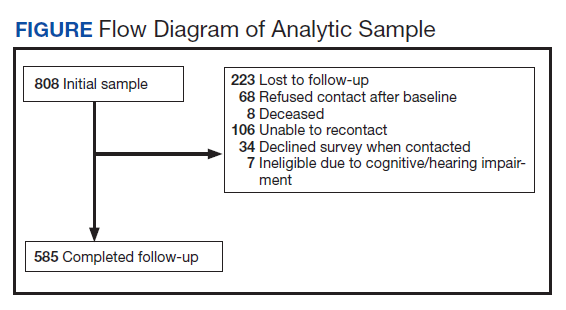
The study was approved by the VA Central Institutional Review Board (IRB) (Study #16-20) and Human Research Protection Office, U.S. Army Medical Research and Development Command. The sampling frame consisted of veterans with major ULA who received care in the VA between 2010 and 2015 identified in VA Corporate Data Warehouse. We sent recruitment packages to nondeceased veterans who had current addresses and phone numbers. Those who did not opt out or inform us that they did not meet eligibility criteria were contacted by study interviewers. A waiver of documentation of written informed consent was obtained from the VA Central IRB. When reached by the study interviewer, Veterans provided oral informed consent. At baseline, 808 veterans were interviewed for a response rate of 47.7% as calculated by the American Association for Public Opinion Research (AAPOR) methodology.9 Follow-up interviews approximately 1 year later (mean [SD] 367 [16.8] days), were conducted with 585 respondents for a 72.4% response rate (Figure).
Survey Content
Development and pilot testing of the survey instrument previously was reported.1 The content of the survey drew from existing survey items and metrics, and included new items specifically designed to address patterns of amputation care, based on care goals within the CPG. All new and modified items were tested and refined through cognitive interviews with 10 participants, and tested with an additional 13 participants.
The survey collected data on demographics, amputation characteristics (year of amputation, level, laterality, and etiology), current prosthesis use, and type of prosthesis. This article focused on the sections of the survey pertaining to satisfaction with prosthetic care and indicators of quality of care. A description of the content of the full survey and a synopsis of overall findings are reported in a prior publication.1 The key independent, dependent, and other variables utilized in the analyses reported in this manuscript are described below.
Primary Independent Variables
In the follow-up survey, we asked respondents whether they had any amputation care in the prior 12 months, and if so to indicate where they had gone for care. We categorized respondents as having received VA/DoD care if they reported any care at the VA or DoD, and as having received non-VA/DoD care if they did not report care at the VA or DoD but indicated that they had received amputation care between baseline and follow-up.
Two primary outcomes were utilized; the Orthotics and Prosthetics User’s Survey (OPUS), client satisfaction with services scale (CSS), and a measure of care quality specifically developed for this study. The CSS is a measure developed specifically for orthotic and prosthesis users.10 This 11-item scale measures satisfaction with prosthetic limb services and contains items evaluating facets of care such as courtesy received from prosthetists and clinical staff, care coordination, appointment wait time, willingness of the prosthetist to listen to participant concerns, and satisfaction with prosthesis training. Items are rated on a 4-point scale (strongly agree [1] to strongly disagree [4]), thus higher CSS scores indicate worse satisfaction with services. The CSS was administered only to prosthesis users.
The Quality of Care assessment developed for this study contained items pertaining to amputation related care receipt and care quality. These items were generated by the study team in consultation with representatives from the VA/DoD Extremity Amputation Center of Excellence after review of the ULA rehabilitation CPG. Survey questions asked respondents about the clinicians visited for amputation related care in the past 12 months, whether they had an annual amputation-related checkup, whether any clinician had assessed their function, worked with them to identify goals, and/or to develop an amputation-related care plan. Respondents were also asked whether there had been family/caregiver involvement in their care and care coordination, whether a peer visitor was involved in their initial care, whether they had received information about amputation management in the prior year, and whether they had amputation-related pain. Those that indicated that they had amputation-related pain were subsequently asked whether their pain was well managed, whether they used medication for pain management, and whether they used any nonpharmaceutical strategies.
Quality of Care Index
We initially developed 15 indicator items of quality of care. We selected 7 of the items to create a summary index. We omitted 3 items about pain management, since these items were completed only by participants who indicated that they had experienced pain; however, we examined the 3 pain items individually given the importance of this topic. We omitted an additional 2 items from the summary index because they would not be sensitive to change because they pertained to the care in the year after initial amputation. One of these items asked whether caregivers were involved in initial amputation management and the other asked whether a peer visit occurred after amputation. Another 3 items were omitted because they only were completed by small subsamples due to intentional skip patterns in the survey. These items addressed whether clinical HCPs discussed amputation care goals in the prior year, worked to develop a care plan in the prior year, or helped to coordinate care after a move. Completion rates for all items considered for the index are shown in eAppendix 1 (Available at doi:10.12788/fp.0096). After item selection, we generated an index score, which was the number of reported “yes” responses to the seven relevant items.


