
Outcomes in Patients With Curative Malignancies Receiving Filgrastim as Primary Prophylaxis


Background: Granulocyte colony-stimulating factor prophylaxis has been shown to reduce the risk and duration of chemotherapy-induced neutropenia and febrile neutropenia and is recommended for at-risk patients receiving chemotherapy. Within the South Texas Veterans Health Care System, daily filgrastim injections remain the preferred formulation of granulocyte colony-stimulating factor for primary prophylaxis of febrile neutropenia.
Methods: This retrospective, single-center cohort study included 59 patients who received daily filgrastim as primary prophylaxis with a curative cancer diagnosis and a chemotherapy regimen at the South Texas Veterans Health Care System from September 1, 2015 to September 24, 2020. Patients had either a high risk for febrile neutropenia or a chemotherapy regimen with an intermediate risk for febrile neutropenia and additional risk factors. The primary outcome was the incidence of neutropenia/febrile neutropenia leading to treatment delays. Secondary outcomes included chemotherapy dose decreases or discontinuations, hospitalizations, days of hospitalization, infections, extended duration of filgrastim, and transitions to pegfilgrastim due to neutropenia/febrile neutropenia.
Results: Patients received a median (IQR) of 7 (5-10) doses of filgrastim for primary prophylaxis. Overall, 10 patients (17%) experienced treatment delays due to neutropenia/febrile neutropenia. Fifteen patients (25%) were hospitalized with a median (IQR) length of stay of 5 (4-7) days, 9 patients (15%) had documented infections, and 2 patients (3%) required a chemotherapy dose reduction. Additionally, 9 patients (15%) required an additional median (IQR) of 2 (2-5) doses of filgrastim, and 9 (15%) patients were transitioned to pegfilgrastim.
Conclusions: These results suggest that additional measures such as tracking postnadir absolute neutrophil counts should be performed to ensure patients receive an appropriate number of filgrastim doses to prevent complications associated with neutropenia/febrile neutropenia.
Descriptive statistics were used to summarize the study population and their health outcomes. Fisher exact test was used to compare FN incidence for high- and intermediate-risk FN groups.
RESULTS
Between September 1, 2015, and September 24, 2020, 381 patients received filgrastim. Of these patients, 59 met the inclusion criteria. Patients receiving filgrastim were excluded due to stem cell transplant mobilization/engraftment (n = 145), a noncurative cancer diagnosis (n = 134), use as a secondary prophylaxis (n = 33), and nononcologic neutropenia (n = 8). Additionally, 2 patients initially received pegfilgrastim and were not included in this data set.
The median (IQR) age was 64 (55-70) years and 42 patients (71%) were male (Table 1). 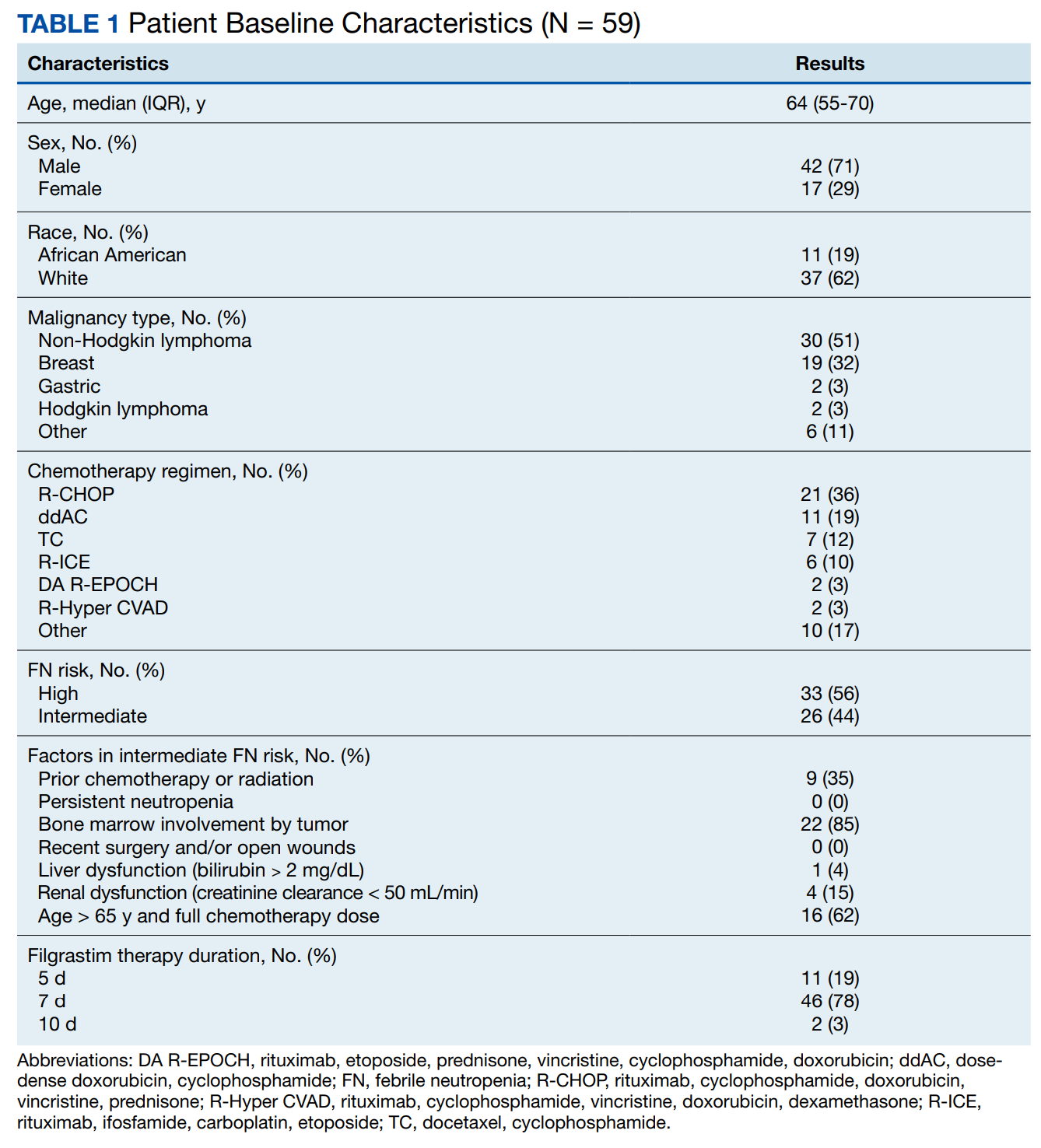
Ten patients (17%) experienced dose delays despite filgrastim use (Table 2). 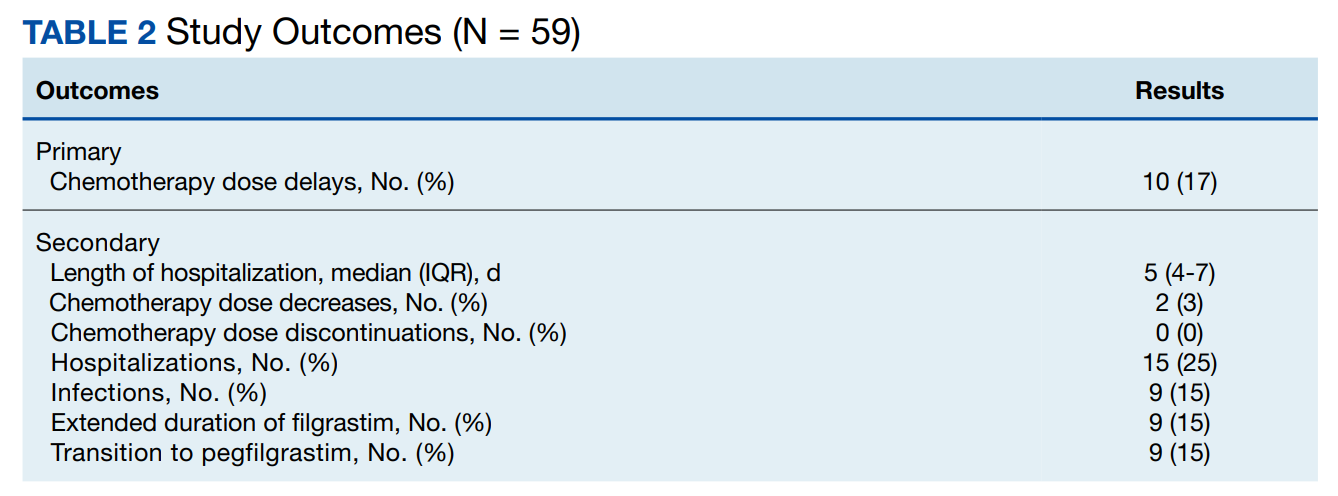
Nine patients (15%) had the number of filgrastim injections per chemotherapy cycle extended due to various reasons. Five patients required extended days after hospitalization for FN, 3 patients for dose delays due to neutropenia with the previous cycle, and 1 patient with an undocumented reason outside of the prespecified outcomes. Two of these patients experienced continued neutropenia and dose delays after extending filgrastim from 5 to 7 days or 7 to 10 days. One patient who experienced continued neutropenia after extending filgrastim to 10 days was subsequently transitioned to pegfilgrastim without further episodes of neutropenia. The other patient who still experienced neutropenia after extending filgrastim to 7 days was receiving the last chemotherapy cycle and did not require subsequent doses of filgrastim.
Two additional patients were not included in the hospitalizations. The first was a patient on a chemotherapy regimen with a high risk for FN who presented to the emergency department with documented FN but was never admitted since the patient elected to not be hospitalized. This patient developed oral, anal, and vaginal candidiasis, and it was noted by the oncologist at the next clinic visit that this was likely secondary to grade 4 neutropenia (ANC < 500 neutrophils/μL). The second was a patient on a chemotherapy regimen with an intermediate risk for FN who was already hospitalized but had developed FN and sepsis despite filgrastim use.
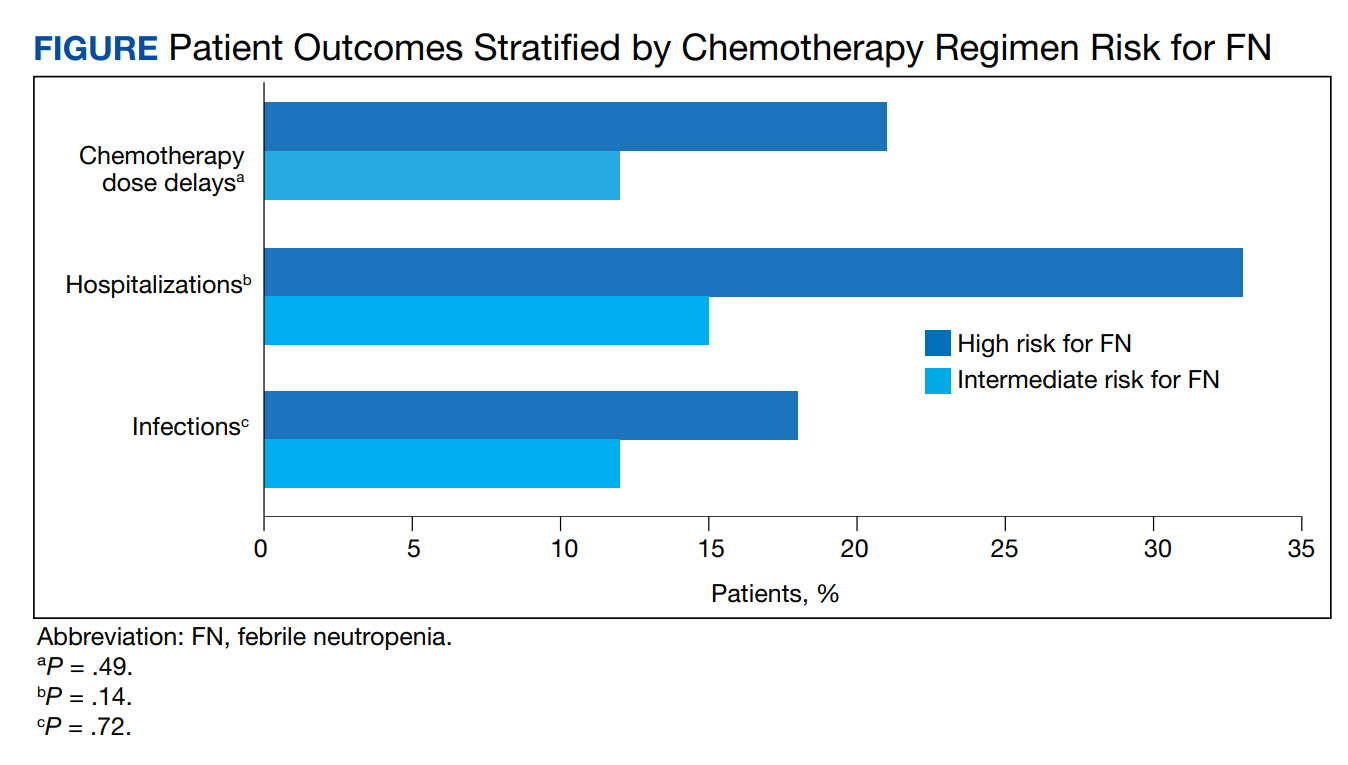
Finally, out of the hospitalized patients, 9 (15%) had infections. This included 6 patients (18%) in the high risk for FN group and 3 patients (12%) in the intermediate risk for FN group (P = .72). Six patients transitioned to pegfilgrastim for hospitalization, 2 for neutropenia, and 1 for an unspecified reason. Nine patients (15%) who received filgrastim ended up transitioning to pegfilgrastim; 6 (67%) of these patients were transitioned due to hospitalization for FN. Of all the patients who transitioned to pegfilgrastim, 1 patient on a high risk for FN regimen developed sepsis due to herpes zoster in the setting of neutropenia after the previous cycle of chemotherapy.


