
Practical strategies for acute and recurrent vaginitis



Self-diagnosis and treatment are out, and meticulous, in-office diagnosis is in—and there is new hope for women with chronic candidiasis: maintenance fluconazole.
Non-albicans species less likely to respond to standard azole therapy. Candida glabrata is the second leading cause of VVC, but is less responsive to standard therapies. For example, cure rates of perhaps 50% can be expected with a 7-day course of terconazole cream.12
When azole therapy is ineffective, intravaginal boric acid in 600-mg capsules can be used every night for at least 14 days and will be effective in about two thirds of patients.13 However, some patients have accidently ingested these boric acid capsules and died (apparently this dose of boric acid is lethal when taken orally). Thus, it is crucial that patients be warned specifically about this hazard.
In a series of 30 patients with no response to azole therapy and subsequent boric acid, Sobel and colleagues achieved a cure rate of 90% with a 14-day course of flucytosine cream 17%, given in 5-g nightly doses.13
Watch for false negatives in women on azole therapy. In general, the C albicans organism tends to be sensitive to azole therapy. Thus, if a woman with C albicans infection is cultured while on therapy, the odds are very high that she will have a negative yeast culture.
Maintenance fluconazole
Maintenance therapy with ketoconazole for recurrent VVC was first proposed in 1986, but was never widely adopted due to concerns about liver toxicity.
More recently, maintenance fluconazole was found to be effective in a doubleblind, placebo-controlled study.14 After treating the initial infection with 3 doses of fluconazole (150 mg every 3 days), researchers randomized women to a 6-month course of weekly fluconazole (150 mg) or placebo. During the 6-month treatment phase, relapse was noted in 9% of the fluconazole group and 64% of the placebo group. However, of the 126 fluconazole-treated women who were disease-free at the end of the treatment phase, 72 (57%) experienced relapse during the next 6 months.
Fluconazole for 6 months. Although about 50% of women have a relapse after stopping treatment, most can at least successfully control and prevent symptomatic episodes as long as they are using fluconazole in maintenance doses. Most experts recommend a 6-month course of maintenance therapy.
Alternatives to fluconazole. Extensive clinical experience has shown fluconazole to be safe and well tolerated in most women. However, women who are unable or unwilling to take it may benefit from repeated dosing of topical azoles, which also appear to be effective (although reported experience is less extensive than with fluconazole).
Vaginal trichomoniasis
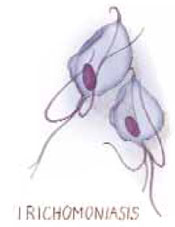
This common STD has an estimated annual incidence of 3 million cases in the United States alone. Symptomatic women may complain of abnormal discharge, itching, burning, and/or postcoital bleeding. Physicians evaluating these women should be aware that microscopy has much lower sensitivity than many would expect, and that further testing may be necessary to establish a clear diagnosis (ie, cultures or the OSOM Trichomonas Rapid Test).
Treating uncomplicated infection
In the United States, trichomoniasis treatment consists of metronidazole or tinidazole; either may be given as a single 2-g dose. Although tinidazole has a somewhat longer half-life and slightly better activity against T vaginalis, both drugs appear to be effective and metronidazole is substantially cheaper. They also have similar side effects, including a possible disulfiram-like effect, although the incidence of adverse gastrointestinal (GI) effects may be lower with tinidazole.
Metronidazole allergy or resistance
Though rare, either can occur with trichomoniasis. Allergic patients should be referred for desensitization and later treated with metronidazole; both intravenous (IV) and oral regimens have been used successfully. We lack data on crossreactivity between tinidazole and metronidazole. Metronidazole resistance is thought to occur in 1 in 2,000 to 3,000 cases.15 If resistance is suspected, interview the patient carefully to exclude medication noncompliance and reinfection from an untreated partner. In a series of 33 cases, high-dose tinidazole (at least 1 g twice daily for 14 days) was well tolerated and effective in more than 90% of resistant cases.16 Susceptibility testing of the resistant isolate by a reference laboratory may help guide drug choice and dosing.
Other options, such as topical paromomycin cream, which has been studied only in small series, may have local side effects such as vulvovaginal ulceration, and should be considered a last resort.16
New approaches to BV
BV is a polymicrobial infection marked by a lack of hydrogen-peroxide–producing lactobacilli and an overgrowth of facultative anaerobic organisms. Organisms found with greater frequency and numbers include Gardnerella vaginalis, Mycoplasma hominis, Bacteroides spp, Peptostreptococcus spp, Fusobacterium spp, Prevotella spp, Mobiluncus spp, and other anaerobes.17
Diagnostic criteria
Women with symptomatic vaginosis complain of abnormal vaginal discharge and a fishy odor.


