Practical strategies for acute and recurrent vaginitis



Self-diagnosis and treatment are out, and meticulous, in-office diagnosis is in—and there is new hope for women with chronic candidiasis: maintenance fluconazole.
Trichomonas cultures. Because a wet mount has low sensitivity in diagnosing trichomoniasis, Trichomonas cultures are useful in selected patients (with >90% sensitivity), such as women with a previous diagnosis of trichomoniasis, those at risk for sexually transmitted disease (STD), or those with microscopy showing BV or leukorrhea.
When Trichomonas cultures are unavailable, the OSOM Trichomonas Rapid Test (Genzyme Diagnostics, Cambridge, Mass) has better sensitivity than microscopy to detect Trichomonas vaginalis.
Herpes cultures and antibodies. Because genital herpes often presents with mild or nonspecific symptoms, a herpes simplex virus (HSV) culture and type-specific immunoglobulin-G HSV antibodies should be ordered when the patient presents with fissures or ulcers of the vulva.
Forget the gram stain. Given the relatively high sensitivity (92%) of Amsel criteria to diagnose bacterial vaginosis and the difficulty of obtaining Nugent scores on gram stains of vaginal secretions, the value of gram stains outside of research settings for women with suspected bacterial vaginosis is unclear.
Vulvar biopsies. Many women who complain of vaginitis actually have vulvar disorders.
Be prepared to obtain vulvar biopsies if necessary.
High-dose treatment (and maybe condoms) improved cure rate
Although metronidazole gel 0.75% is a standard BV therapy in the United States, much higher doses in combination with nystatin are common in other countries such as Peru. They proved more effective in a recent randomized trial, suggesting that high doses or more prolonged courses of therapy may be beneficial when standard treatment fails.
In the single-blind trial, Sanchez and colleagues24 compared 5 nights of metronidazole gel 0.75% (37.5 mg per dose) to the same duration of treatment with intravaginal ovules containing 500 mg metronidazole and 100,000 U nystatin.
Patients were asked to return 14, 42, and 104 days after treatment; 138 (91%) of 151 women returned at least once.
At every follow-up, the women treated with the ovules had significantly lower recurrence rates (4%, 17%, and 33% for the ovules, compared with 20%, 38%, and 52% for the gel).
Was use of condoms related? Although participants were not randomized for condom use, recurrent infection was more likely among women whose partners did not use them.
The trial’s strengths and limitations
This study is notable for its long follow-up, blinding of the evaluator and biostatistician, and diagnostic methods (both Amsel and Nugent criteria).
The trial addressed the question of whether early recurrence is due to persistent pathogenic flora or failure to repopulate the vagina with hydrogen-peroxide–producing lactobacilli.The improved cure rate with the higher dose of intravaginal metronidazole ovules suggests that it more effectively eradicated abnormal flora than the lower dose.
However, the condom finding suggests that exposure to some factor associated with the partner also plays an important role.
The main limitation was the variability of elapsed time for follow-up visits. For example, the range for the first visit was 10 to 132 days; as a result, some women had a first evaluation that was much later than others.
Further, because participants were Peruvian, the applicability to a US population with potentially different demographics or sex practices is unclear.
Watch for complicated VVC
Women who harbor Candida organisms in their vaginas have VVC. At one end of the spectrum are women who are asymptomatically colonized. It is not necessary to treat these women or make an effort to identify the organisms. At the other end of the spectrum are symptomatic women, who have been traditionally treated with a variety of antifungal therapies, now available in multiple formulations.
Many experts now believe VVC should be classified as complicated or uncomplicated (TABLE 1) to help identify women in whom therapy is likely to fail. Uncomplicated VVC has cure rates of 80% to 90%.10 In contrast, several studies suggest that women with complicated VVC have lower short-term cure rates with either topical clotrimazole or oral fluconazole.10,11
Most women with recurrent VVC fall into the complicated category. For the most part, these are normal, healthy women who experience substantial discomfort and disruption of their daily well-being and sexuality because of recurrent infections. Self-treatment permits rapid initiation of antimycotic therapy, but does nothing to prevent the next symptomatic episode.
TABLE 1
Criteria for candidiasis diagnosis
| UNCOMPLICATED (meets all criteria) |
| Cure rate of 80% to 90% |
| Sporadic or infrequent episodes |
| Mild to moderate symptoms or findings |
| Suspected Candida albicans infection |
| Normal, nonpregnant woman |
| COMPLICATED (meets 1 or more criteria) |
| Cure rates vary widely |
| Recurrent (4 or more episodes per year) |
| Severe symptoms or findings |
| Suspected or proven non-albicans Candida infection |
Abnormal host
|
| Pregnancy |
| Adapted from Sobel JD, et al.26 |
Which Candida sp is it?
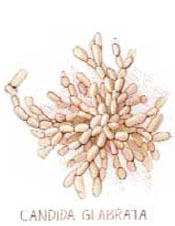
When standard antimycotic therapy fails, the species of infecting organism seems to be particularly important. Women with Candida glabrata colonization have markedly lower cure rates than women colonized with C albicans.11 Thus, a crucial first step in treating women who have complicated VVC is obtaining a yeast culture. A positive culture helps corroborate the diagnosis, increases the sensitivity of the evaluation, and allows speciation of the organism and proper selection of therapy.