
Are your COPD patients benefiting from best practices?


Spirometry makes the diagnosis and determines therapy choices, yet it is vastly underused.
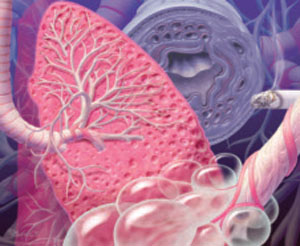
Reserve chest radiographs and CT scans to rule out other disorders. Patients with COPD usually have elements of both chronic bronchitis (productive cough for 3 months in 2 consecutive years) and emphysema (defined anatomically as abnormal enlargement of airways distal to terminal bronchioles and destruction of alveolar walls). Radiographic tests may reveal the telltale signs of emphysema (flattened diaphragms, blebs, and bullous changes), but they are not necessary to make the diagnosis. They may be used, however, to exclude other causes of dyspnea, including congestive heart failure, pulmonary emboli, and interstitial lung disease (TABLE).
Recommendation 1 With patients who have respiratory symptoms, particularly dyspnea, perform spirometry to diagnose airflow obstruction. Spirometry should not be used to screen for airflow obstruction in asymptomatic individuals. (Grade: strong recommendation, moderate-quality evidence.)
Recommendation 2 Reserve treatment for patients who have respiratory symptoms and an FEV1 <60% predicted, as documented by spirometry. (Grade: strong recommendation, moderate-quality evidence.)
Recommendation 3 Prescribe 1 of the following maintenance monotherapies for symptomatic patients with COPD and an FEV1 <60% predicted: long-acting inhaled beta-agonists, long-acting inhaled anticholinergics, or inhaled corticosteroids. (Grade: strong recommendation, high-quality evidence.)
Recommendation 4 You may want to consider combination inhaled therapies for symptomatic patients with COPD and an FEV1 <60% predicted. (Grade: weak recommendation, moderate-quality evidence.)
Recommendation 5 Prescribe oxygen therapy for patients with COPD and resting hypoxemia (PaO2 ≤55 mm Hg). (Grade: strong recommendation, moderate-quality evidence.)
Recommendation 6 Consider prescribing pulmonary rehabilitation for symptomatic individuals with COPD who have an FEV1 <50% predicted. (Grade: weak recommendation, moderate-quality evidence.)
* Modified from Qaseem A et al. Diagnosis and management of stable chronic obstructive pulmonary disease: a clinical practice guideline from the American College of Physicians. Ann Intern Med. 2007;147:633-638.
TABLE
Suspect COPD? Rule out these disorders
| DISORDER | NOTABLE CHARACTERISTICS |
|---|---|
| Asthma | Usually begins in childhood. Can be associated with cough only. Airflow obstruction is usually reversible with bronchodilator (may coexist with COPD) |
| Cystic fibrosis | Symptoms usually begin in early childhood. Associated with sinus disease, GI disturbances, and infertility. Bronchiectasis noted on chest x-ray. Order sweat chloride test if suspected. Genetic testing is also available |
| Interstitial lung disease | Interstitial pattern on chest x-ray and thin-cut CT scan of lungs |
| Pneumonia | Fever, chills, cough, and infiltrate on chest x-ray |
| Congestive heart failure | Orthopnea, paroxysmal nocturnal dyspnea, and characteristic chest x-ray findings |
| Pulmonary embolism | Breathing difficulty and chest pain usually of sudden onset. CT angiography is diagnostic |
| Anxiety | Hyperventilation, panic attacks, increased stress |
CASE: Spirometry reveals airflow obstruction, FEV1 <50%
Mr. Jones underwent spirometry, which revealed airflow obstruction and an FEV1 <50%. We gave him a short-acting betaagonist to be used as needed. Two weeks later, he returned to the office with increasing cough and purulent sputum production, as well as worsening dyspnea.
The patient’s condition is consistent with an acute exacerbation of baseline COPD symptoms. Worsening dyspnea, cough, and sputum production—sometimes with purulence—are often accompanied by fever, fatigue, and anorexia.7
Match antibiotic therapy to sputum culture results or disease severity. Exacerbations are usually triggered by infection. Although an offending organism cannot be identified in one third of cases, common bacterial pathogens include Hemophilus influenza, Streptococcus pneumoniae, and Moraxella catarrhalis. Antibiotics have been shown to decrease mortality in patients with COPD exacerbations1,5,7,14,15 (GOLD Evidence B). For mild-to-moderate exacerbations, older antibiotics such as trimethoprim/sulfamethoxazole or doxycycline are often appropriate. For more severe exacerbations, and for patients with chronic, comorbid conditions such as diabetes mellitus, a second- or third-generation cephalosporin or fluoroquinolone may be preferable.
Use steroids and beta-agonists. Oral steroids are also effective in treating exacerbations (GOLD Evidence A), although the dose of steroids required has not been adequately studied. Prednisone, 40 mg/d for 7 to 10 days, is reasonable and safe.1 Also prescribe an inhaled short-acting beta-agonist for symptom control (GOLD Evidence A).1
CASE: Doxycycline 100 mg bid, and prednisone 40 mg/d for 7 days
Mr. Jones returned to the office 2 weeks after the acute exacerbation, feeling much better after receiving doxycycline 100 mg bid and prednisone 40 mg/d for 7 days. He was no longer coughing up purulent sputum, but he still felt short of breath walking to his mailbox and while doing household chores. He wondered what else could be done to improve his quality of life.
The airflow obstruction associated with COPD, unlike that of asthma, is irreversible and varies little,16 and its progression is persistent. That is why prevention is an important goal for physicians and their patients. However, treatment can lessen the frequency of exacerbations and severity of symptoms, particularly dyspnea on exertion.


