FIRSTConsult: A useful point-of-care clinical reference


Despite the evidence and reference citations, there were times we took issue with FC-Web. For example, FC-Web indicates the dosage of amoxicillin for otitis media in children older than 3 months is “25–45 mg/kg/day orally in divided doses (maximum dose 80 mg/kg/day).” In response to the rapid dissemination of drugresistant Streptococcus pneumoniae, the Centers for Disease Control has recommended, in general, that “the initial dose of amoxicillin should be increased from 40 to 45 mg/kg/day to 80 to 90 mg/kg/day.” Also, there are occasional disconnects within monographs. Under “Tinea Infections” in both the Summary and Diagnosis sections is a “Key! Don’t Miss Points” that says: “Patients with HIV infection may have severe onychomycosis and Malassezia folliculitis (pustular hair follicle infection).” However, no mention is made of how to treat Malassezia folliculitis.
Head-to-head with UpToDate. Compared with UpToDate [see “UpToDate: A comprehensive clinical database,” J Fam Pract 2003; 52(9):706–710], FC-Web obviously has been designed from a point-of-care focus. With UpToDate it is often laborious to cull key clinical information at the point-of-care. FC-Web is much less encyclopedic, has a superb layout, and whiz-click access to such amenities as the “Summary of therapeutic options”—with hyperlinking to details if needed.
Although FC-Web has no “history” or “favorites” functions, it is seldom a problem relocating information because of the simplicity of its design (unlike the complex paths one often follows in UpToDate to locate information).
FC-Web’s patient education monographs are more accessible, shorter, and at the opposite literacy extreme from UpToDate’s.
FC-Palm
FIRSTConsult versions for handhelds are available for download with purchase. On the Palm, users must first download and install FC’s EReader, a 90K application. Both EReader and FC-Palm easily load to memory cards and function briskly on recommended versions of Palm OS devices. However, “crashes” are common (and, in some instances, fully reproducible), requiring soft resets of the handheld device.
Shortcomings of the FC-Palm
FC-Palm’s opening screen lists its 2 components, Differential Diagnosis and Medical Conditions. (The other sections are not included in the handheld versions).
One noteworthy peculiarity with EReader is that, if the user presses the Palm’s off button, it exits the application but does not turn off the Palm. The user must press the button a second time to turn off the Palm. Similarly, at the user’s set “time out” (eg, after 2 minutes of inactivity), first FC-Palm/EReader times out, and only then does the countdown begin for the Palm to time out and turn off. Once users are forewarned, this is unlikely to be a problem, but we are not familiar with any other Palm application that exhibits this behavior.
Another curiosity: when FC-Palm times out, it does not resume where it exited. Users must retrace their steps to continue.
Levels of evidence are not included in FC-Palm. Elsevier indicates FC-Palm is updated approximately weekly. Unfortunately, there is no auto-update feature. Updating the 10MB version is time-consuming, particularly hot-syncing to a Palm card (and, if using dial-up connection, downloading), making it unlikely users would update frequently.
FC-Palm has no search function, and, interestingly, Palm’s search feature appears nonfunctional with this program.
Many medical handheld applications, ePocrates for example, employ lists that scroll alphabetically as users enter successive letters, such that entering “c,” “o,” and “l” would automatically scroll to the first listing under “c,” then under “co,” then under “col,” and so on. FC-Palm does not have this feature. Instead, it must be navigated by selecting a letter of the alphabet from the top of the screen (eg, R for Restless Legs), and then scrolling to the entry (via slide bar or Palm buttons) (Figure 6).
There are no icons or shortcuts to frequently used features (eg, “T” to jump to Therapy). Once in an entry, FC-Palm users navigate with a drop-down list to the section of interest. Each section is separate and can be entered only with the drop-down list (Figure 7).
No user-defined preferences are available to select FC-Palm’s monographs’ opening section (eg, Therapeutics).
Conveniently, FC-Palm has forward and back browser-type navigation controls.
Generic drug names are used throughout.
Comparing handheld versions, FIRSTConsult weighs in at 10 MB as opposed to UpToDate’s 800 MB—which may reflect upon the ease and speed of finding information at the point-of-care.
FIGURE 6
Navigating the Palm version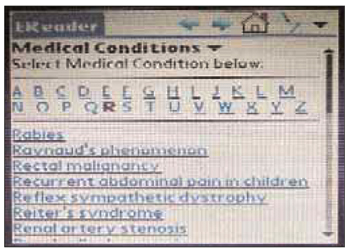
FIGURE 7
Selecting a topic in FC-Palm