
Development of a National Hematology Program: Advancing Classical Hematology Care for Veterans


Background: The US Department of Veterans Affairs (VA) National Oncology Program (NOP) has established a standard for veteran-focused cancer care across the Veterans Health Administration. This included the creation of uniform clinical pathways and promotion of equitable oncology care through VA National TeleOncology, Close to Me Care delivery models, and National Precision Oncology Programs. However, classical hematology—encompassing anemias, bleeding disorders, thromboembolism, and other nonmalignant hematologic conditions—lacks an equivalent program.
Observations: We call for a National Hematology Program (NHP), a virtual center of excellence for the specialty within VA. Like the NOP, we envision the NHP would develop hematology clinical pathways, guidance for precision genetic testing in hematology, telehematology consultation, and resources for hematology education, advocacy, and research. This initiative would address disparities in hematology care for veterans and direct congruent resource allocation for the hematology and oncology programs.
Conclusions: By applying lessons learned from the NOP, it is possible to establish a similar infrastructure for hematologic care. Implementation of a successful NHP will require coordinated effort and buy-in among stakeholders, as well as dedicated resources to ensure long-term sustainability.
Many classical (nonmalignant) hematologic disorders—including venous thromboembolism (VTE), sickle cell trait, bleeding or clotting disorders, G6PD deficiency, and others—have a propensity to manifest under physical stress or trauma. Thus, despite initial entry into the military as a healthy individual, service members may still be at increased risk of hematologic disease complications.1-3 For example, individuals with sickle cell trait can enlist in the US military but must be aware of heightened risks such as associated exertional rhabdomyolysis and exercise collapse, a preventable condition mitigated through hydration protocols, heat-injury prevention measures, and graduated physical training.4,5
Depending on the degree of symptoms, hematologic disorders may go undiagnosed or not manifest until later in life. This may be the case for inherited conditions such as hemophilia, thrombophilia disorders, porphyria, hemochromatosis, or other genetic conditions, as well as acquired conditions like immune-mediated thrombocytopenia, atypical hemolytic uremic syndrome, and aplastic anemia (Table).
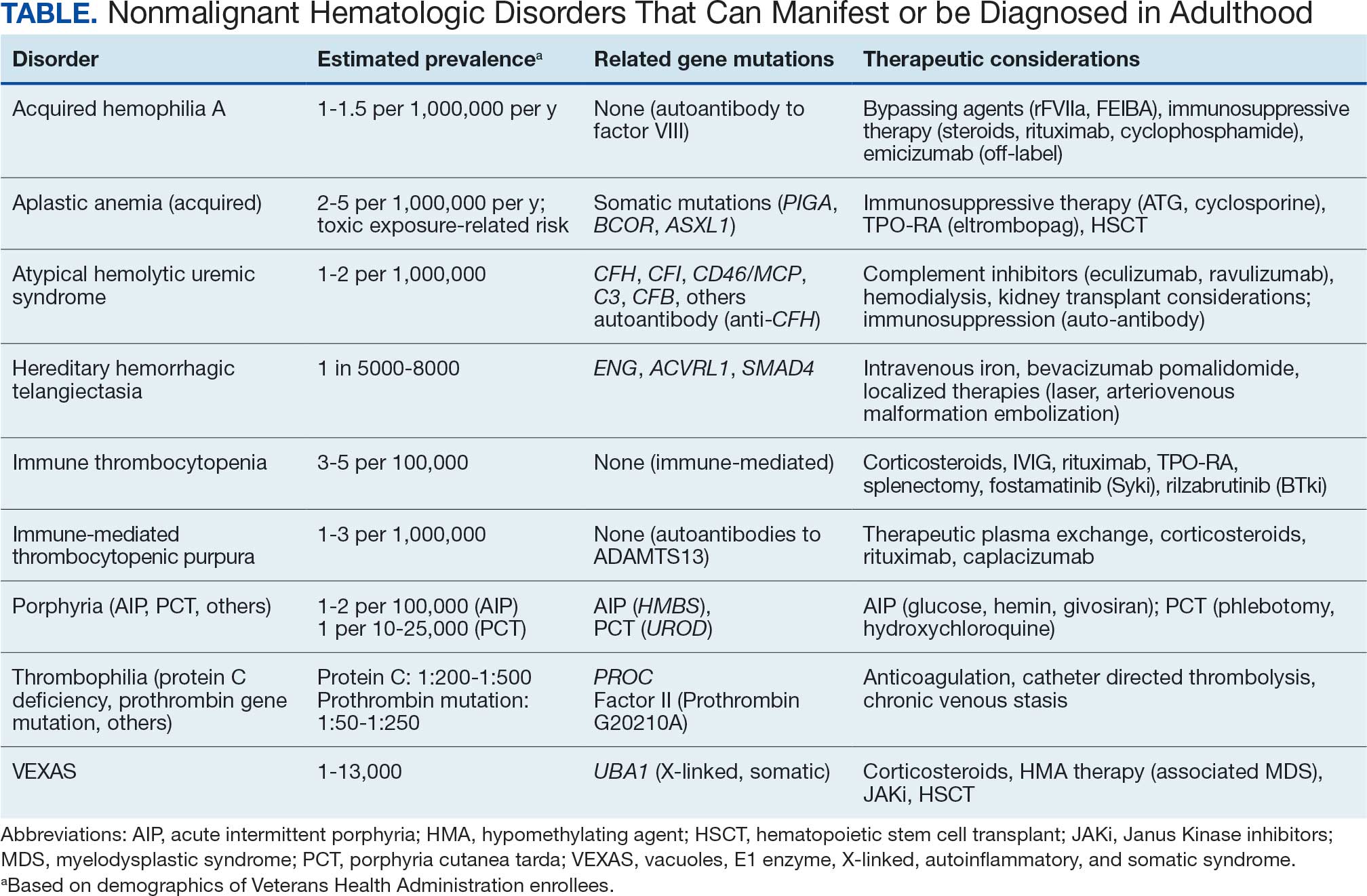
Guidance from the US Department of Veterans Affairs (VA) for the diagnosis and management of nonmalignant hematologic disorders lags behind guidance for malignant oncologic disorders (including hematopoietic neoplasms). This reflects the absence of hematology-focused clinical pathways currently integrated into the VA National Oncology Program (NOP). This contrasts with published, continuously updated, and public-facing VA oncology clinical pathways.6 For rare and ultrarare hematologic disorders that clinicians may be less familiar with, structured VA guidance at the national level may help foster consistent and equitable care for veterans.
VA National Hematology Program
Modeled after the success of NOP, we call for the development of a VA National Hematology Program (NHP). Core components of NHP would include the development of hematology clinical pathways to guide clinical decision-making; molecular testing tables to inform genetic testing for specific diagnoses; and a system of excellence in hematology, analogous to the NOP Breast and Gynecology program.7 The system of excellence would include a virtual hub for hematology specialty clinics, a virtual nonmalignant hematology case and teaching conference, and a virtual hub for decentralized clinical trials in hematology. This would allow for growth and promotion of hematology expertise within VA, reduce costly and time-consuming non-VA referrals for specialized hematology care, increase clinical trial opportunities for veterans with hematologic disorders, and provide career development for hematology-focused VA clinicians (Figure).
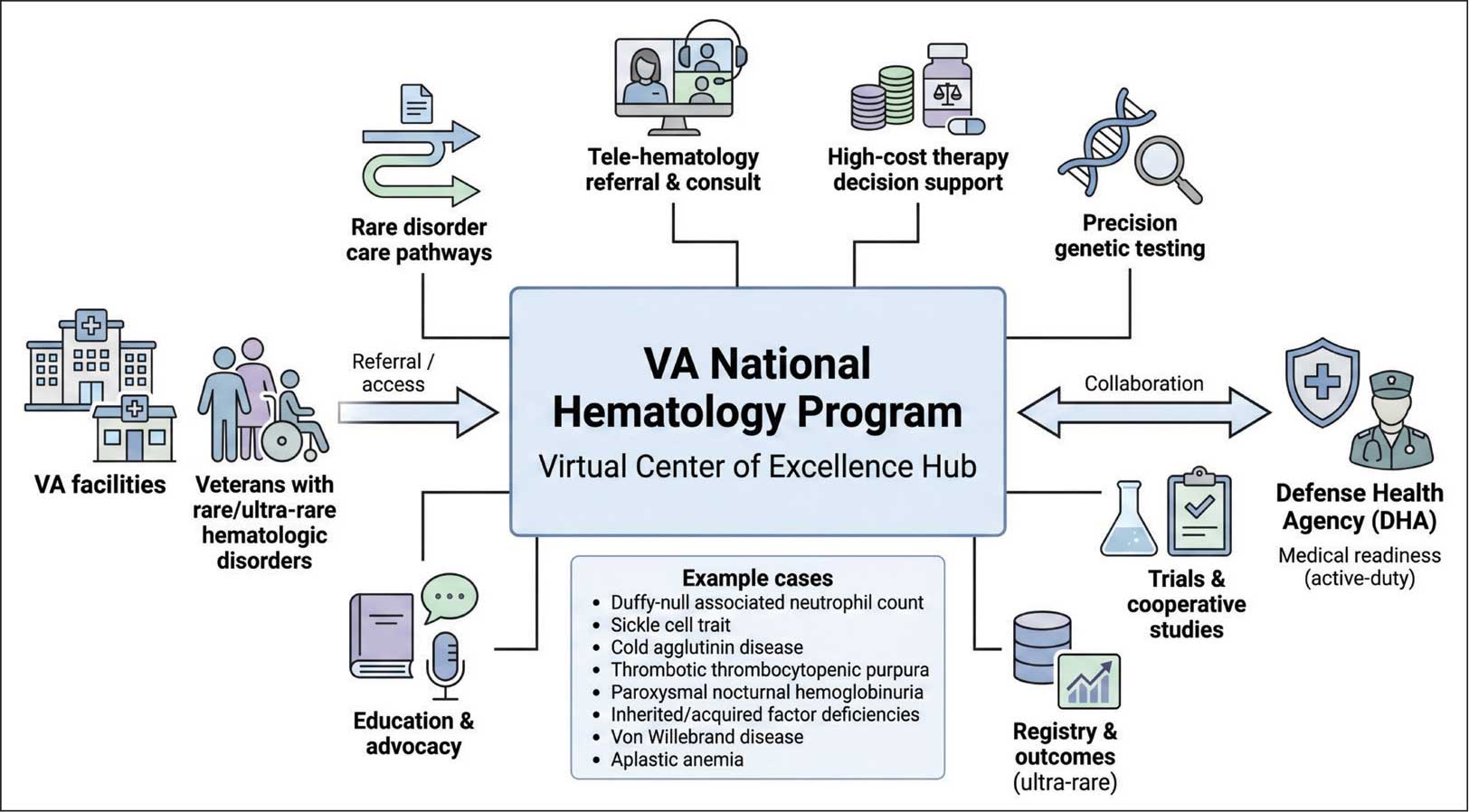
Abbreviation: VA, US Department of Veterans Affairs.
Source: Nicholas Burwick, MD. Reprinted with permission.
Hematology-focused VA clinical pathways would inform clinician decision-making when there is a lack of familiarity with a diagnosis, when multiple treatment options are available, or when an off-label therapeutic is being considered for treatment. Decision support integration into the electronic health record could mirror that being implemented in oncology. Information on toxic exposure risk or designated presumptive conditions for disability compensation based on specific hematologic diagnoses would be incorporated into VA clinical pathways based on established law or regulation. The NHP would include a registry to track initial and subsequent disease treatments as well as patient outcomes in rare and ultrarare hematologic disorders, modeled after successful initiatives like the VA Central Cancer Registry, which abstracts information on cancer diagnoses and treatments from > 100 VA medical centers (VAMCs).8
A robust NHP would support the efforts of VA National TeleOncology (NTO) in providing hematology telehealth services to remote and underresourced facilities, aligning with the Veterans Health Administration priority to improve access to care in rural areas.9,10 In many such instances, the request for hematology care is not to identify “zebras,” but instead to assist with the diagnosis and management of common hematologic conditions.11 This could include consultations for leukopenia, polycythemia, hemochromatosis, anemia due to iron deficiency, or other diagnoses. Intravenous iron is among the most common hematology therapeutics delivered at VA community-based outpatient clinics through the Close to Me program (5035 doses as of April 2026, courtesy private communication with J Shields), highlighting the demand for basic hematology services for veterans who live far from VAMCs.
While outside the scope of this commentary, we strongly believe that the launch of a successful NHP would galvanize interest in VA clinical research, with a renewed focus on the study of hematologic disorders. By leveraging existing VA clinical cancer research networks, VA Cooperative Studies Program infrastructure for multisite coordination, and NTO decentralized clinical trial frameworks for remote trial access, ample opportunity exists and the foundation is in place.12
We acknowledge the importance of hematology stewardship and view this as a potential future core component of NHP (eg, stewardship over inpatient VTE prevention, laboratory testing, and management of heparin-induced thrombocytopenia). Hematology care navigation will be required to support patients, address barriers to care, and ensure safe transitions for patients returning home following bone marrow transplantation or other specialized treatments. Successful implementation of NHP will require time and patience, skilled personnel, and funded mechanisms to support both short-term build and long-term success of this VA initiative.
Conclusions
When a veteran with a rare hematologic disorder presents to a VAMC, a lack of local hematology expertise or limited resources at the facility may lead to delayed diagnoses, inconsistencies in management, or referral to community or academic partners—if such specialists or facilities are available. Potential benefits of a centralized NHP include increased access to hematology expertise, shortened time to diagnosis and treatment of common and uncommon hematologic conditions, improved patient outcomes, cost savings through standardization and appropriate testing/therapy, and equitable care for rural and underserved veterans.
