
CONTRACEPTION



Subcutaneous depot medroxyprogesterone acetate for birth control and endometriosis pain.
When the manufacturer changed its application, the agency declined to make a decision by the legal deadline, last January. Proponents of OTC sales of Plan B objected, citing the agency’s own staff endorsement, and that of an independent panel.
In a series of interactions between the Senate and the administration in early July, the U.S. secretary of health and human services promised a Sept. 1 decision on Barr’s application. Media reports related that announcement to the July 18 Senate confirmation of Dr. Lester Crawford to head the Food and Drug Administration.
Both sides of the controversy met with some surprises in the BMJ and JAMA reports of research on the effects of Plan B access. Opponents of OTC availability in the United States have predicted that such access might increase unprotected sex, especially in young women and girls. Advocates have predicted that it would reduce the number of unintended pregnancies and abortions.
Public health impact may be negligible”
The report in the British Medical Journal concluded, “Making emergency hormonal contraception available over the counter does not seem to have led to an increase in its use, to an increase in unprotected sex, or to a decrease in the use of more reliable methods of contraception.” The study used an Omnibus Survey of 7,600 adults (an annual multipurpose survey in Great Britain) to examine contraception use after OTC emergency contraception was legalized in 2001. Women aged 16 to 49 were surveyed.
Although the lack of any increase in use of emergency hormone contraception suggests that the predicted rise in unsafe sex has been overstated, so too have the predicted effects on unwanted pregnancy, the authors observed.Similarly, the January JAMA report of a US study found: “While removing the requirement to go through pharmacists or clinics to obtain emergency contraception increases use, the public health impact may be negligible because of high rates of unprotected intercourse and relative underutilization of the method.”
Barr requests OTC access of Plan B for women 16 and older. Prescriptions would still be required for younger women.
Plan B is often called the “morning-after pill,” but in fact the method can be used any time after intercourse for up to 72 hours. It is best used as soon as possible, but can even be used after 72 hours, although at reduced efficacy.
Kuyoh MA, Toroitich-Ruto C, Grimes DA, Schulz KF, Gallo MF. Sponge versus diaphragm for contraception: a Cochrane review. Contraception. 2003;67:15–18.
When the Today sponge was pulled off the market by its maker in 1995, the popular Jerry Seinfeld TV show aired an episode showing the character Elaine dashing from store to store, in search of the last few sponges on the shelves. She ultimately found a neighborhood pharmacy with 1 remaining case of 60 sponges. “Just give me the whole case and I’ll be on my way,” she tells the pharmacist. In the show, Elaine used the term “sponge-worthy” to characterize a potential date, and the term became a household word overnight. When it was available in the United States, the Today sponge was the most widely used form of OTC contraception, selling approximately 250 million sponges.
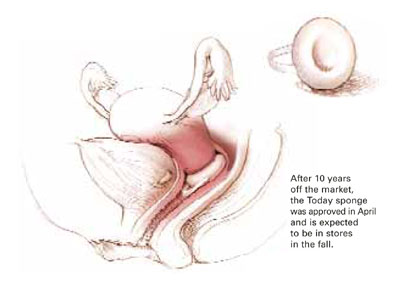
The sponge, which contains the spermicide nonoxynol-9, was sold from 1983 to 1995, when it was voluntarily withdrawn for safety reasons. The FDA found that water at the manufacturing plant was contaminated, and American Home Products, (now Wyeth), decided it was too costly to upgrade its plant, and voluntarily withdrew the Today sponge from the market. Allendale Pharmaceuticals bought the rights for the sponge in 1998, and has been working to secure approval for marketing. The new version has been available in Canada since 2003. According to the manufacturer, it should be in US drug stores sometime this fall, for about $2.50 to $3 per sponge.
The sponge is best compared to a diaphragm. Its failure rate is frequently quoted as approximately 9% to 11% per year, very comparable to condoms.
Efficacy. However, in a Cochrane review of sponges versus the diaphragm, the sponge failure rate was 17.4% in a US trial and 24.5% in a British trial. The rates for a diaphragm were 12.8% and 10.9%, respectively. Unlike a diaphragm, the sponge does not have to be fitted and had equal efficacy in multiparous as nulliparous women, in the 2 studies reviewed. The main advantage of the sponge over a diaphragm is its ready availability over-the-counter.
According the manufacturer, the sponge can be inserted up to 24 hours prior to intercourse, and provides continuous protection throughout that period, for as many acts of intercourse as desired. Although it is not necessary to keep the sponge inserted for a full 24 hours, it must be left in place for 6 hours after the last act of intercourse. It should not be worn for more than 30 consecutive hours. The women in the 2 studies included in the Cochrane review, however, left the sponge in place for 48 hours.


