LAURA M. SNELL, MPH RUTH P. WILSON, PHD KEVIN C. OEFFINGER, MD CAROLYN SARGENT, PHD OLIVE CHEN, PHD KRISTEN M. COREY, MA Dallas, Texas, and San Jose, California From the Department of Family Practice and Community Medicine, The University of Texas Southwestern Medical Center at Dallas (L.M.S., K.C.O., O.C.) and the Department of Anthropology, Southern Methodist University (C.S., K.M.C.), Dallas, TX; and the Department of African-American Studies, College of Social Work, San Jose State University, San Jose, CA (R.P.W). Support for this study was provided through the Joint American Academy of Family Physicians/American Academy of Family Physicians Foundation. Address reprint requests to Laura M. Snell, MPH, Department of Family Practice and Community Medicine, The University of Texas Southwestern Medical Center at Dallas, 6263 Harry Hines Boulevard, Dallas, TX 75390-9067. E-mail: laura.snell@utsouthwestern.edu.
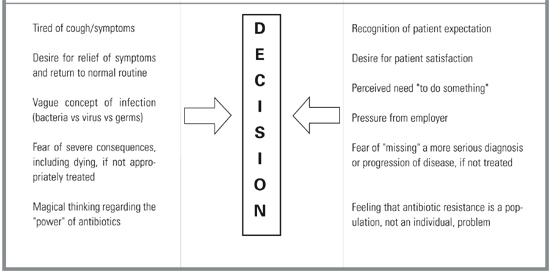
In summary, if, as a medical community, we hope to develop new strategies to decrease unwarranted antibiotic usage, we need to educate patients and health care professionals regarding the causation and natural history of respiratory infections. Gonzales and associates reported impressive results with office-based interventions targeting physicians and patients, and this work needs to be generalized.19,20 However, until there is a major public health emphasis on education at the community level regarding respiratory infections concurrent with an educational effort targeted for health care professionals to dispel the “myth” that characteristics of sputum and nasal discharge are good predictors of clinical outcomes, progress will be slow. To enhance communication between patient and physician, it is important that we elicit and appropriately address patient fears and concerns regarding the natural course of illness with an episode of bronchitis.