
Stop shingles in its tracks



Herpes zoster and its sequelae are painful, debilitating—and largely preventable. So why isn’t vaccination more widespread?
Which agent? What the research reveals
For most people with HZ, any of the 3 antiviral agents can be used, based on physician and patient preference. (See TABLE for treatment guidelines.) Here’s a look at the evidence for each.
Oral ACV has long been the mainstay of treatment for HZ, but its poor bioavailability and the need for 5 daily doses has led to the development of newer antiviral agents.12 When initiated within 48 to 72 hours of the onset of the rash, ACV has demonstrated clinical benefit. (The value of starting ACV therapy beyond the 72-hour mark has not been established, though treatment should be considered if new lesions are still appearing.)
In 1 meta-analysis of 4 placebo-controlled trials, ACV accelerated resolution of acute pain, with the greatest effect in those older than 50 years.13 In a second meta-analysis, treatment with ACV reduced the incidence of PHN at 3 months by 46% (number needed to treat [NNT]=3.2-8).12
VCV is well absorbed in the gastrointestinal tract, providing 3- to 5-fold greater bioavailability compared with ACV.13 VCV’s efficacy was demonstrated in an RCT in which the researchers conducted an intent-to-treat analysis: Compared with ACV therapy for 7 to 14 days, VCV significantly accelerated the resolution of acute pain, reduced the duration of PHN, and decreased the proportion of patients with pain persisting for more than 6 months (19% vs 26%). The incidence of adverse events was similar in both groups.14
FCV has broad activity against varicella-zoster virus.15 In an RCT that evaluated oral FCV in 419 immunocompetent adults (mean age 50 years) with uncomplicated HZ, FCV was well tolerated and accelerated lesion healing compared with placebo. Among those who developed PHN, the pain resolved twice as fast for patients in the FCV group compared with the controls, and the median duration of PHN was reduced by 2 months.15
TABLE
Antiviral therapy dosing guidelines*
| Dosage adjusted for creatinine clearance† (mL/min) | ||||
|---|---|---|---|---|
| Drug | Standard dose | <10 | 10-25 | Duration |
| ACV | 800 mg 5x/d | 1600 mg/d | 2400 mg/d | 7-10 days |
| VCV | 1000 mg tid | 1000 mg/d | 2000 mg/d | 7 days |
| FCV | 750 mg/d or 250 mg tid | 250 mg/d | 500 mg/d | 7 days |
| *All 3 drugs reduce acute pain and development of postherpetic neuralgia, and are most effective when started within 72 hours of onset of rash. | ||||
| †Patients with creatinine clearance >25 mL/min receive the standard dose. | ||||
| ACV, acyclovir; FCV, famciclovir; VCV, valacyclovir. | ||||
Analgesics and other drugs: What to consider
While antiviral therapy helps to relieve the pain of HZ, several trials have shown that none of the available agents completely alleviates it or routinely prevents the development of PHN. As a result, adjunctive therapy, including pain medication, is often required. But prescribing analgesics to frail elderly patients and those who have comorbidities and take multiple medications is not without risk.
The ability of a tricyclic antidepressant to alleviate pain and prevent PHN when therapy is initiated within 48 hours of the eruption of lesions was tested in a double-blind trial in which 72 patients 60 years of age or older were randomized to amitriptyline 25 mg daily for 90 days or placebo.16 Antiviral agents were administered according to the preference of the primary physician. At 6 weeks, the pain prevalence—the primary outcome measure—was reduced by about 50% in the amitriptyline group.16 There is no other evidence to support the use of tricyclics in the acute phase of HZ, however, and concerns about orthostatic hypotension and anticholinergic side effects limit their use, particularly in older patients.
Corticosteroids are sometimes used, too, often in conjunction with antiviral therapy, but there are problems with this approach, as well. One RCT comparing an ACV-prednisone combination with ACV alone in HZ patients over the age of 50 found that patients who received both drugs had faster resolution of acute pain and earlier discontinuation of analgesics.17 But several serious adverse effects of prednisone were reported in patients in the combination therapy group, despite the fact that individuals with contraindications to corticosteroids were excluded from the study. Overall, there is little evidence to suggest that steroids can be safely used to reduce the incidence or severity of PHN. There is no specific recommendation regarding analgesic therapy for PHN, but physicians often adopt a stepwise approach.
Recommend the shingles vaccine
In view of the toll that shingles often takes, vaccination is the best way to prevent HZ and its complications. In a randomized, double-blind, placebo-controlled study involving 38,546 adults who were 60 years of age or older, researchers demonstrated that cell-mediated immunity to the varicella-zoster virus was boosted by the live attenuated HZ vaccine.18 The enhanced immunity was associated with a 51% reduction in the incidence of HZ (NNT=58 to prevent 1 case over 3 years), a 66% reduction in the incidence of PHN (NNT=364 to prevent 1 case of PHN over 3 years), and a 61% reduction in disease burden. The vaccine was well tolerated, and injection site reactions were generally mild.18 Accurate cost-effectiveness analyses of immunization are not available because the duration of vaccine protection is unknown.19
FIGURE
A unilateral vesicular rash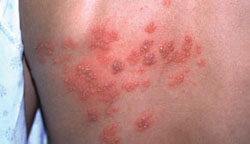
A shingles outbreak, like the rash shown on this patient’s back, usually appears as a patch or band of blisters on 1 side of the body.


