
Do family physicians fail to provide triptans for patients with migraine?



We think not. Though improved prescribing is always desirable, the real challenge is patient adherence to regimens.
Although surveys were returned directly to the researchers without identifying information and patients were assured that information would not be shared with participating physicians, the study design could have inhibited negative comments about medical care. Conversely, patients who were angry, upset, or disappointed about migraine care could have been motivated to complete the survey.34 Migraine patients who consult physicians are reported to have more severe migraine, more comorbidities, decreased quality of life, and to consult significantly more frequently for multiple medical conditions than other patients.35,36
FIGURE
The MIDAS questionnaire is valid, reliable, and easy to use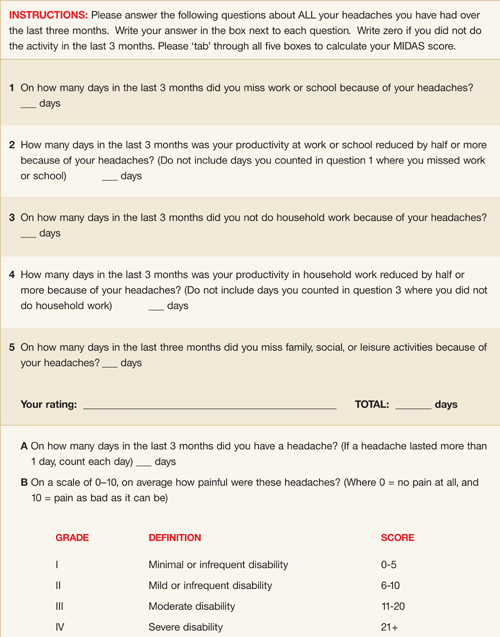
Acknowledgments
The authors acknowledge substantial assistance from Nolem Llong, Terry Ast, Nicole Rogers, and Mary Hursey in the conduct of the study and preparation of this manuscript and the assistance of the physicians of the Kansas Practice Research Network. The study was funded in part by the AAFP Practice Based Research Network Research Stimulation Grant.
CORRESPONDENCE
Anne Walling MB, ChB, FFPHM, University of Kansas School of Medicine–Wichita, Department of Family and Community Medicine, 1010 North Kansas, Wichita, KS 67214. E-mail: awalling@kumc.edu


