
Two-Toned Toes


Match the diagnosis to the photo by letter
a. Blue toe syndrome
b. Pernio (chilblains)
c. Subungual hematoma
d. Antiphospholipid syndrome
For answers, see next issue; for discussion, go to www.mdedge.com/clinicianreviews/picture
Answers to January “Picture This” (Clinician Reviews. 2018;28[1]:29): 1d, 2c, 3a, 4b
Photos and text for case 1 courtesy of Richard P. Usatine, MD; from Usatine R, Smith M, Mayeaux EJ, et al, eds. Color Atlas of Family Medicine. 2nd ed. New York, NY: McGraw-Hill; 2013:551-556.
To learn more about the Color Atlas of Family Medicine, see: www.amazon.com/Color-Family-Medicine-Richard-Usatine/dp/0071769641/
You can now get the second edition of the Color Atlas of Family Medicine as an app by clicking on this link: usatinemedia.com.
Case presentation and photograph for Cases 2, 3, and 4 courtesy of Cutis. Copyright 2017 Frontline Medical Communications Inc.
3. A 35-year-old woman presents in January with purplish toes that are markedly tender to pressure. Recurrent over three successive winters, the initial symptom is an itchy, burning sensation in her toes. The discoloration and other symptoms are constant, not episodic. The condition resolves each year in late spring. Her distal pulses are normal.
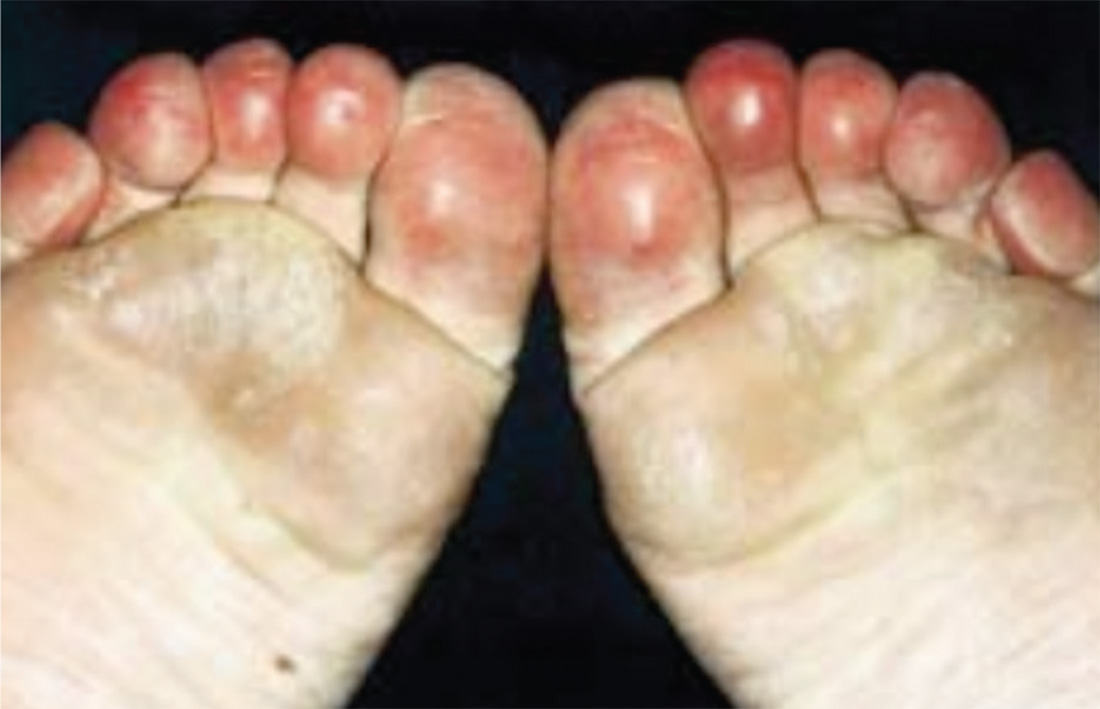
Diagnosis: Pernio—also called perniosis or chilblains—is a common dermatologic condition associated with a cold, humid climate. The inflammatory lesions of pernio may be pruritic, painful, erythematous to violaceous plaques, papules, or nodules, which may have overlying blisters or ulcerations. The condition is frequently misdiagnosed; proper diagnosis relies on patient history and clinical picture. Histologic examination is typically not needed or definitive. This patient had moderately disabling pernio, which responded promptly to therapy with a calcium channel blocker.
,For more information, see “Erythrocyanotic Discoloration of the Toes.” Cutis. 2000;65(4):223-226.


