
Common Conditions in Persons with Skin of Color


Match the diagnosis to the photo by letter
a. Pseudofolliculitis
b. Keloids
c. Dermatosis papulosa nigra
d. Acne keloidalis nuchae
For answers, see next issue; for discussion, go to www.mdedge.com/clinicianreviews/picture
Photo and case text credits: Case 1: 2009/Elsevier.
Case 2 courtesy of Richard P. Usatine, MD; from Usatine R, Smith M, Mayeaux EJ, et al, eds. Color Atlas of Family Medicine. 2nd ed. New York, NY: McGraw-Hill; 2013:551-556. To learn more about the Color Atlas of Family Medicine, see: www.amazon.com/Color-Family-Medicine-Richard-Usatine/dp/0071769641/. You can now get the second edition of the Color Atlas of Family Medicine as an app by clicking on this link: usatinemedia.com.
Case 3 adapted from J Fam Pract. 2014;63:739-740.
Case 4 reprinted with permission from Cosmetic Dermatology. 2012;25:318-325. ©2012, Frontline Medical Communications Inc.
Answers to last month’s “Picture This” (Clinician Reviews. 2017;27[5]:45): Figure 1b, Figure 2d, Figure 3c , Figure 4a
4. Several years after a motorcycle accident and resulting road rash, this 23-year-old Hispanic woman is left with complex scars. She experiences pruritus, pain, and hypersensitivity and is seeking relief.
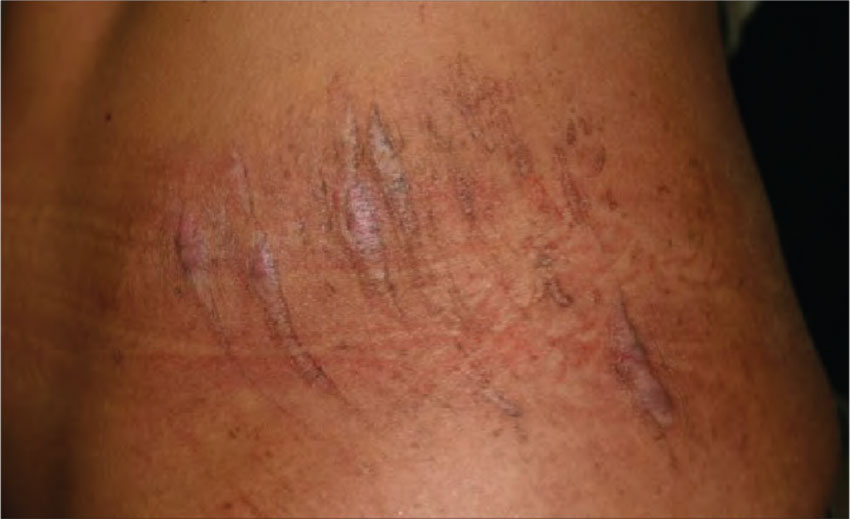
Diagnosis: Often confused with hypertrophic scars, keloids are benign overgrowths of scar tissue that can occur months to years after skin trauma. They are most common in those ages 10 to 30, with a higher incidence among blacks, Hispanics, and Asians. Although the exact etiology of keloids is unknown, they are related to aberrant collagen production and breakdown in wound healing.
For more information, see “Laser treatment of scars and keloids.” Cosmet Dermatol. 2012;25:318-325.


