
Common Conditions in Persons with Skin of Color


Match the diagnosis to the photo by letter
a. Pseudofolliculitis
b. Keloids
c. Dermatosis papulosa nigra
d. Acne keloidalis nuchae
For answers, see next issue; for discussion, go to www.mdedge.com/clinicianreviews/picture
Photo and case text credits: Case 1: 2009/Elsevier.
Case 2 courtesy of Richard P. Usatine, MD; from Usatine R, Smith M, Mayeaux EJ, et al, eds. Color Atlas of Family Medicine. 2nd ed. New York, NY: McGraw-Hill; 2013:551-556. To learn more about the Color Atlas of Family Medicine, see: www.amazon.com/Color-Family-Medicine-Richard-Usatine/dp/0071769641/. You can now get the second edition of the Color Atlas of Family Medicine as an app by clicking on this link: usatinemedia.com.
Case 3 adapted from J Fam Pract. 2014;63:739-740.
Case 4 reprinted with permission from Cosmetic Dermatology. 2012;25:318-325. ©2012, Frontline Medical Communications Inc.
Answers to last month’s “Picture This” (Clinician Reviews. 2017;27[5]:45): Figure 1b, Figure 2d, Figure 3c , Figure 4a
2. A 17-year-old African-American boy likes to keep his face clean-shaven, but his skin becomes irritated every time he shaves. He states that his father also has this problem, but doesn’t have a solution.
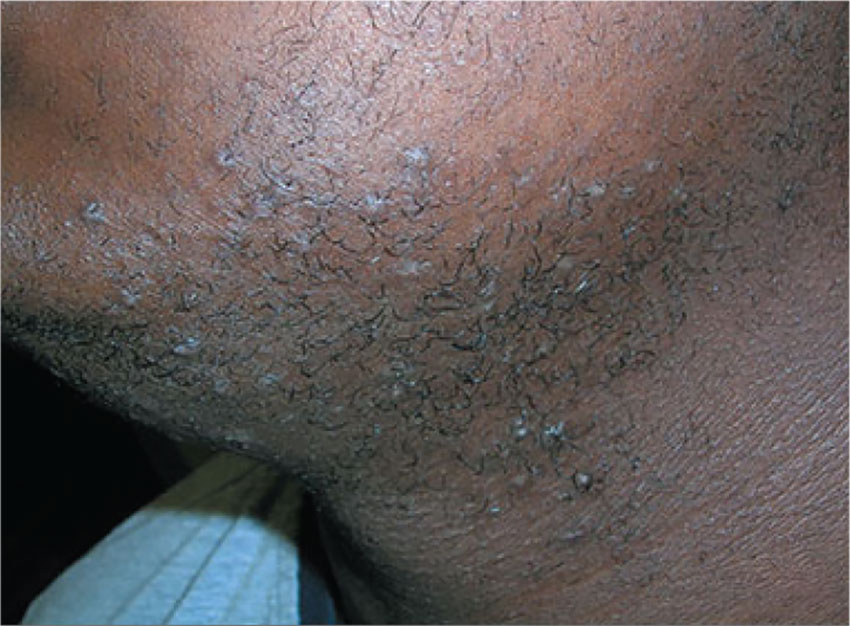
Diagnosis: Pseudofolliculitis is a common skin condition affecting hair-bearing areas of the body that are shaved. It develops when the free end of a tightly coiled hair reenters the skin after shaving, causing a foreign-body–like inflammatory reaction. Tightly curled hair has a greater tendency to pierce the follicle and the surface of the skin, explaining the relative predominance of pseudofolliculitis in patients of African descent; at least half of black men who shave develop the condition.
For more information, see “Bumps in beard area.” J Fam Pract. 2015 November;64(11).


