
Tinnitus: Patients do not have to ‘just live with it’


ABSTRACTTinnitus is distressing and affects the quality of life for many patients. Because primary care physicians may be the entry point for patients seeking help for tinnitus, we urge them to acknowledge this symptom and its potential negative impact on the patient’s health and quality of life. Physicians should actively listen to the patient and provide hope and encouragement, but also provide realistic expectations about the course of treatment. The patient must also understand that there may be no singular “cure” for tinnitus and that management may involve multidisciplinary assessment and treatment.
KEY POINTS
- The first step is to rule out underlying otologic disease.
- Nonotologic interventions range from minimal counseling in the office to referrals to specialists in one or more fields, including audiology, dentistry, neurology, physical therapy, psychology, and psychiatry.
- A simple algorithm can help determine if patient education is all that is required or if referral is needed.
AUDIOLOGY: TESTING, SOUND THERAPY
A patient referred to an audiologist may undergo traditional audiologic testing (pure tone and speech thresholds, word recognition), as well as a battery of special psychoacoustic tests. This includes pitch-matching and loudness-matching, evaluation of residual inhibition (suppression of tinnitus after an external masking stimulus has been turned off), and assessing the minimum masking level. These provide a quantitative estimate of the acoustic attributes of the perceived tinnitus. Questionnaires can be used to assess the impact of tinnitus on everyday life and can provide guidance for treatment.15
Real sounds mask the perceived ones
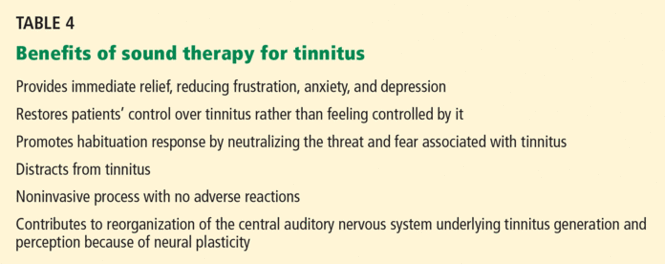
Environmental enrichment devices such as portable machines that generate pleasant sounds (eg, rain, waterfalls, ocean waves), tabletop water fountains, fans, or even televisions or radios can be used to promote relief, provide distraction, and decrease the patient’s awareness of tinnitus.
Hearing aids amplify ambient sounds, reducing the perception of tinnitus.16,17 They also improve communication.
Sound generators, worn in the ear, produce a stable broadband signal (“white noise”). These devices may be used by patients who have normal or near-normal hearing sensitivity and therefore neither benefit from nor require amplification.
Combination instruments are both hearing aids and white-noise generators. These allow patients who have both hearing loss and tinnitus to use a single device.
Music can distract from the tinnitus and help patients relax. Patients may find benefit listening to their preferred music on a personal listening device such as an MP3 or CD player.
Neuromonics Inc. (Bethlehem, PA) makes a sophisticated device for tinnitus treatment. Resembling an MP3 player, it is used with headphones and plays soothing music (baroque or new age) that contains a tinnitus-masking noise. The music is modified to compensate for the patient’s hearing loss, if present. After approximately 2 months of use, the embedded noise is removed to help desensitize the patient to the tinnitus. Results of small trials have been promising.18,19
DENTISTRY: TREATING TINNITUS BY TREATING TMD
Temporomandibular disorder (TMD), involving the temporomandibular joints, the muscles of mastication, and the teeth, is associated with tinnitus.20,21 The prevalence of tinnitus in a Cleveland Clinic study of 109 patients with TMD was 36%.22
There is also an association between cervical muscle disorders and masticatory muscle function. For example, patients who grind their teeth at night must contract the sternocleidomastoid muscles of the neck to stabilize the head during grinding. Correcting cervical posture, changing the sleep position, and controlling conscious parafunctional habits (eg, clenching the teeth, grinding the teeth together) can decrease many of the symptoms of TMD.
The dental examination for tinnitus patients
The dentist looks for a history of TMD symptoms, use of orthotic devices, and head and neck trauma, and performs a clinical examination.
The clinical examination includes mandibular range of motion, auscultation and palpation of the temporomandibular joints, palpation of masticatory and cervical muscles, and cervical range of motion. The intraoral examination includes identifying occlusal attrition patterns, “load testing” of the temporomandibular joints, and identifying premature tooth contacts. Additionally, attempts to restrict jaw opening and lateral movements may modulate the patient’s tinnitus, thus confirming the role of TMD in the patient’s tinnitus.
How tinnitus is treated by managing TMD
Tinnitus can be treated by managing TMD, specifically through the use of dental orthotics (splints, nightguards) to improve abnormal jaw mechanics and tracking.23–25
Tullberg and Ernberg26 treated patients with TMD and tinnitus using a variety of methods, including occlusal splinting, jaw muscle exercises, and relaxation. They reported that 43% of the patients experienced an improvement in their tinnitus after these interventions.
A home exercise program may help patients maintain muscle strength and harmony. Self-help therapies provide patients with a protocol to recognize daytime parafunctional habits and provide suggestions to decrease clenching and other overloading of the masticatory system.
In addition, management of TMD-related tinnitus often involves physical therapy, which can include soft-tissue mobilization, deep heat, ultrasound, low-current electrical stimulation, myofascial trigger-point release techniques, and posture retraining. Occlusal correction procedures (bite correction) can often provide long-term stability to the masticatory system.


