
Using biochemical markers of bone turnover in clinical practice


ABSTRACTBiochemical markers of bone turnover provide clinically useful evidence of the normal and pathologic processes that reflect bone cell activity in the skeleton. Understanding the behavior of markers of bone formation and bone resorption should aid in managing patients with a variety of skeletal disorders.
KEY POINTS
- Biomarkers of bone formation and resorption reflect the overall osteoblastic and osteoclastic activity in the skeleton and in some situations may serve as surrogates for histologic examination of bone.
- Biomarkers of bone turnover can be used to document the effects of therapeutic agents in some patients with osteoporosis and possibly reduce the need for frequent bone density testing.
- In cancer patients with bone metastases, biomarkers of bone resorption provide evidence of the efficacy of antiresorptive therapy. The baseline levels also have prognostic value: patients with the highest levels have the worst prognosis.
CLINICAL APPLICATIONS OF BONE TURNOVER MARKERS
In postmenopausal osteoporosis
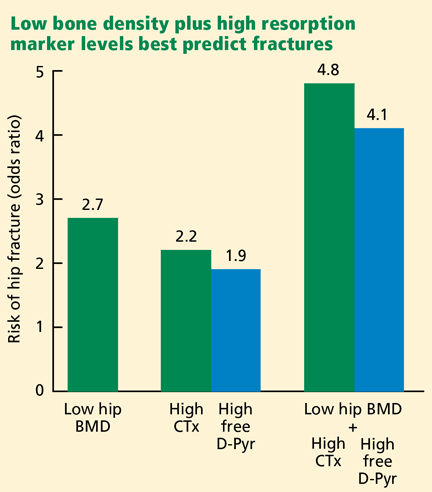
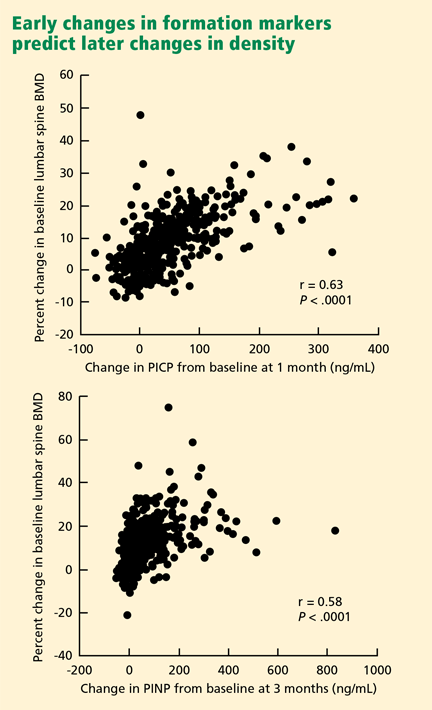
Markers of bone formation are somewhat less likely to be elevated than markers of bone resorption, and if they are elevated, they decrease as expected in response to therapy that inhibits bone resorption, though more gradually and to a lesser extent than the resorption markers.31–35
To monitor bisphosphonate therapy. Antiresorptive drugs such as bisphosphonates reduce the risk of fracture, as they increase bone density and decrease the rate of bone resorption, as shown in many clinical trials.31–35 Because the rate of bone resorption reaches a nadir within 3 to 6 months of starting bisphosphonate therapy and because the increase in bone density after 1 year is quite modest (about 3%–4%), most of the decrease in vertebral fracture incidence, which becomes apparent during the first year of treatment, probably can be attributed more to normalization of bone resorption (and a less perforated structure) than to the increase in bone density.36 This would suggest that it is more appropriate to document that bone resorption has been inhibited than to measure bone density every year when following patients taking antiresorptive agents.
Furthermore, effective antiresorptive therapy reduces the levels of resorption markers by 50% to 70%,32–35 whereas after 1 year bone density has generally not increased more than the error of the bone density measurement. This observation has led to the suggestion that bone density measurements generally should not be done more often than every 2 years when following the effects of antiresorptive therapy. Even with a 20% to 30% day-to-day variation in levels of bone resorption markers, it is easier to document the efficacy of therapy with resorption biomarkers than with bone density.
To document compliance. Another reason to consider measuring a resorption marker (after 3 months of therapy) is to document compliance, a considerable problem in the treatment of an asymptomatic disorder.
To help decide when to restart bisphosphonate therapy. After long-term treatment with a bisphosphonate, the drug may be retained in the skeleton for years. This seems particularly true of alendronate (Fosamax).37 After 5 years of continuous alendronate treatment, bone resorption continues to be suppressed near the maximal level, in some patients for years after they stop taking the drug.38
Once the bone resorption marker begins to approach the pretreatment level, it would signal a possible need to restart the therapy. If a pretreatment level was not measured, an estimate of significant bone resorption would be signaled when the resorption marker is more than 20% above the mean premenopausal level. For urinary NTx this would be more than 42 nmol bone collagen equivalents/mmol creatinine.
In glucocorticoid-induced osteoporosis
Glucocorticoid therapy causes bone loss and an increased incidence of fractures when given in high doses or for prolonged periods by the oral, parenteral, or inhaled routes.41
The pathogenesis of the bone loss has been explored by measurements of bone turnover markers. During glucocorticoid therapy, levels of bone formation markers are generally low and those of bone resorption markers are either normal or low.42–44 Presumably, the reduction in bone resorption is not enough to overcome the reduction in bone formation, and bone loss ensues. In children, the effects on bone formation are particularly profound, as linear growth may be retarded.44
Giving a bisphosphonate during glucocorticoid therapy is quite effective in increasing bone density and preventing fractures.45–47 Patients who receive alendronate have lower levels of bone formation and resorption markers than do untreated subjects.45 Presumably, bone resorption is inhibited more than bone formation, accounting for the skeletal benefits.
In a recent study in patients with glucocorticoid-induced osteoporosis, bone mineral density of the lumbar spine increased more than twice as much with teriparatide than with alendronate over an 18-month period.48 As would be expected from the results of teriparatide therapy in postmenopausal osteoporosis, indices of both bone formation and resorption rose to a peak at 6 months, with formation greater than resorption.
In immobilization-induced osteoporosis
Studies of normal volunteers placed on bed rest indicate that urinary CTx and NTx excretion increase significantly after 24 hours, no doubt reflecting a rapid increase in osteoclast activity.49 In a 16-week study of bed rest in volunteers, markers of bone formation were reduced and markers of bone resorption increased, demonstrating the mechanisms for the profound and rapid loss of bone in immobilized patients.50
In a long-term cross-sectional study of paraplegic men with spinal cord injuries, bone turnover patterns changed over time.51 During the first year after injury, urinary deoxypyridinoline excretion was markedly elevated, whereas blood total alkaline phosphatase and osteocalcin levels were normal to slightly elevated. Over a 30-year period after injury, the bone resorption marker returned to normal levels in most patients and the bone formation markers were normal. Fracture incidence rose but leveled off after 20 years.
Bisphosphonate therapy in spinal cord injury patients reduces urinary NTx and prevents bone loss.52,53 These agents have also proven effective in reversing hypercalcemia in immobilized patients.54


