
Resident International Elective Awards



It is clear to almost everyone involved in pediatric resident recruitment and to those of us involved in global health that there is an ever-growing interest among pediatric residents to spend some time working abroad during residency training.
This life-changing experience needs to be preceded by extensive preparations: careful planning, obtaining approval from one’s residency program director and hospital administration, learning about host institutions as well as the host country and its cultures, connecting with the host preceptor(s), and securing housing. The resident often needs to obtain visas and sometimes temporary work permits or medical licensure, not to mention additional immunizations and travel insurance. Looming above all this is a significant financial burden for international-rotation travel.
The American Academy of Pediatrics Section on International Child Heath (SOICH) – in collaboration with the Section on Medical Students, Residents and Fellowship Trainees (SOMSRFT) – has been offering some financial help to a few of these residents through the Resident International Elective Award program.
In the last 13 years, 116 residents were selected from more than 900 applications to receive this award. Those of us who serve as the reviewers for this program continue to be amazed at the creativity of applications year after year.
One of the 11 winners in 2011 was Dr. Nikolaus Glomb, a resident at Levine Children’s Hospital, part of the Carolinas Medical Center (CMC) in Charlotte, N.C. Nick spent his international elective at Tanzania’s Muhimbili National Hospital located in Dar es Salaam. The CMC has coordinated efforts with the University of California, San Francisco, and the University of Chicago in developing a sister emergency medicine residency program there.
He wrote in his report that "this intense experience was one of the most rewarding of my life, and [it is] where I truly came to understand why I am meant to become a pediatric emergency medicine physician. On a daily basis, the Muhimbili clinical staff is faced with an onslaught of high acuity cases. The care they provide in a resource limited setting is excellent. It was not uncommon for 8-10 children to present at the same time, simply because ambulances would only transport once full. Out of necessity, this gave me the opportunity to refine my triage skills and clinical acumen, and at the same time to hone my ability to quickly develop rapport with medical staff, patients, and their parents."
Nick is returning to Tanzania in January 2012 to begin a research project on the diagnosis and treatment of febrile infants that will help develop clinical protocols to improve the delivery and quality of emergency services in Tanzania.
Dr. Silvia Chiang from Boston Combined Residency Program in Pediatrics (BCRP) is currently collaborating on a research project in Lima, Peru, on childhood TB. The project is led by investigators at Harvard Medical School and Peru’s Socios En Salud (SES, or Partners in Health). Silvia will be in Lima during January to work at that country’s National Institute of Child Health and several ambulatory public health centers. This is not Silvia’s first trip to Peru. For 2 years, she served as a Peace Corps volunteer in Chiquian, Peru, and during that time she helped train health promoters, taught health education in schools, and launched a small knitting cooperative. She is also a coinvestigator in an ongoing project, based in El Alto, Bolivia, that examines the health needs of the children of sex workers.
Another 2011 recipient of the Resident International Elective Award, Dr. Melissa Fussell, a resident at Children’s Hospital Boston, will again work in Tanzania this January.
In her application Melissa wrote, "Last year, during my first rotation at Muhimbili Hospital, I started on my path towards a goal of contributing clinically to the underserved in Africa. The instruction provided by the local physicians, who have become my friends and colleagues, has enriched my understanding of management in resource poor clinical settings." Melissa is returning to offer assistance to her Tanzanian colleagues by establishing a user-friendly reference tool kit based on their own (the Tanzanian Acute Pediatric Care Guidelines).
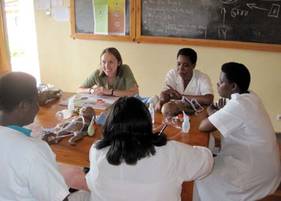
Dr. Danielle Ehret of the pediatrics residency program at Yale–New Haven Children’s Hospital has just returned from Rwanda, where she introduced the AAP’s Helping Babies Breathe (HBB) curriculum at the Centre Hospitalier Universitaire de Kigali (CHUK). Before the trip, Dani personally enrolled herself in the HBB master trainers course, paying for the course and materials out of her own pocket. She has been in direct contact with colleagues in Rwanda, and met with Rwanda’s medical school dean and a representative of the Ministry of Health in preparation for the elective. She projected that her experience in Rwanda, with its tremendous exchange of ideas and culture, was an important step taken towards her aspirations to become an academic neonatologist with career interests in education and public and international health.

