
The Current State of Advanced Practice Provider Fellowships in Hospital Medicine: A Survey of Program Directors


BACKGROUND: Postgraduate training for advanced practice providers (APPs) is a growing field in hospital medicine. As hospital programs continue to benefit from highly trained physician assistants (PAs) and nurse practitioners (NPs), fellowship programs have become more prevalent. However, little is known about the number of active programs or how they prepare trainees.
OBJECTIVES: To describe the existing APP fellowships in hospital medicine, with a focus on program characteristics, rationale, curricula, and learner assessment. METHODS: An electronic survey was distributed by e-mail to hospital medicine program directors in May 2018. The survey consisted of 25 multiple choice and short answer questions. Descriptive statistics were calculated utilizing Stata 13 for data analysis.
RESULTS: Of the 11 fellowships identified, 10 (91%) of directors responded to the survey. Eighty percent of programs accept both NPs and PAs and 80% are between 12 and 13 months long. All programs cite “training and retaining” as the main driver for their creation and 90% were founded in institutions with existing physician residencies. Ninety percent of program curricula are informed by Society of Hospital Medicine resources. Despite these similarities, there was wide variation in both curricular content and APP fellow assessment.
CONCLUSION: APP fellowships in hospital medicine are quickly growing as a means to train and retain nonphysician hospitalists. While most programs accept similar types of applicants and share a common rationale for program development, there is little standardization in terms of curriculum or assessment. Further research may be valuable to characterize the best practices to guide the future of these fellowships.
© 2019 Society of Hospital Medicine
In addition to training and retention, building an interprofessional team (50%), managing patient volume (30%), and reducing overhead (20%) were also reported as rationales for program development. The majority of programs (80%) have fellows bill for clinical services, and five of those eight programs do so after their fellows become more clinically competent.
Curricula
Of the nine adult programs, 67% teach explicitly to SHM core competencies and 33% send their fellows to the SHM NP/PA Boot Camp. Thirty percent of fellowships partner formally with either a physician residency or a local PA program to develop educational content. Six of the nine programs with active physician residencies, including the pediatric fellowship, offer shared educational experiences for the residents and APPs.
There are notable differences in clinical rotations between the programs (Figure 1). No single rotation is universally required, although general hospital internal medicine is required in all adult fellowships. The majority (80%) of programs offer at least one elective. Six programs reported mandatory rotations outside the department of medicine, most commonly neurology or the stroke service (four programs). Only one program reported only general medicine rotations, with no subspecialty electives.
There are also differences between programs with respect to educational experiences and learning formats (Figure 2). Each fellowship takes a unique approach to clinical instruction; teaching rounds and lecture attendance are the only experiences that are mandatory across the board. Grand rounds are available, but not required, in all programs. Ninety percent of programs offer or require fellow presentations, journal clubs, reading assignments, or scholarly projects. Fellow presentations (70%) and journal club attendance (60%) are required in more than half the programs; however, reading assignments (30%) and scholarly projects (20%) are rarely required.
Methods of Fellow Assessment
Each program surveyed has a unique method of fellow assessment. Ninety percent of the programs use more than one method to assess their fellows. Faculty reviews are most commonly used and are conducted in all rotations in 80% of fellowships. Both self-assessment exercises and written examinations are used in some rotations by the majority of programs. Capstone projects are required infrequently (30%).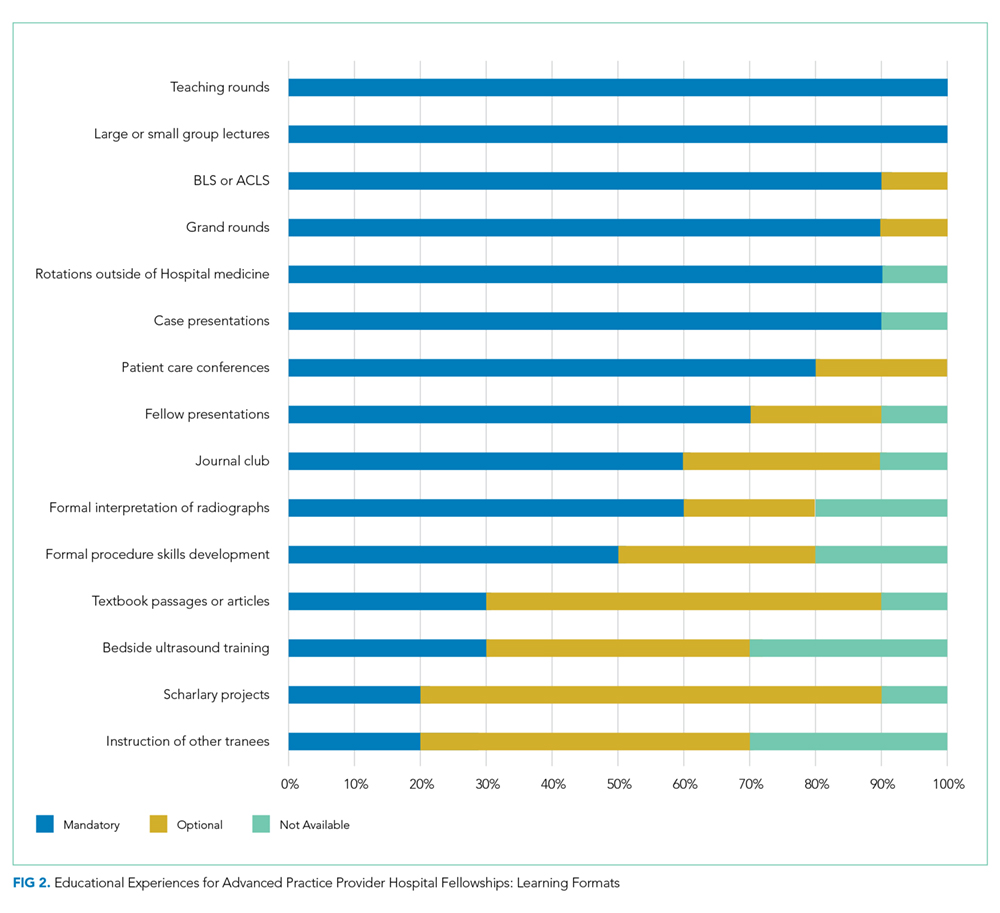
DISCUSSION
We found several commonalities between the fellowships surveyed. Many of the program characteristics, such as years in operation, salary, duration, and lack of accreditation, are quite similar. Most fellowships also have a similar rationale for building their programs and use resources from the SHM to inform their curricula. Fellows, on average, share several demographic characteristics, such as age, gender, and time out of schooling. Conversely, we found wide variability in clinical rotations, the general teaching structure, and methods of fellow evaluation.
There have been several publications detailing successful individual APP fellowships in medical subspecialties,
It is noteworthy that every program surveyed was created with training and retention in mind, rather than other factors like decreasing overhead or managing patient volume. Training one’s own APPs so that they can learn on the job, come to understand expectations within a group, and witness the culture is extremely valuable. From a patient safety standpoint, it has been documented that physician hospitalists straight out of residency have a higher patient mortality compared with more experienced providers.
Several limitations to this study should be considered. While we used multiple strategies to locate as many fellowships as possible, it is unlikely that we successfully captured all existing programs, and new programs are being developed annually. We also relied on self-reported data from PDs. While we would expect PDs to provide accurate data, we could not externally validate their answers. Additionally, although our survey tool was reviewed extensively and validated internally, it was developed de novo for this study.


