
An Advanced Practice Provider Clinical Fellowship as a Pipeline to Staffing a Hospitalist Program


BACKGROUND: Approximately 83% of hospitalist groups around the country utilize advanced practice providers; however, the demand for hospitalists continues to exceed the supply, and this has led to increased utilization of advanced practice providers in hospital medicine. Advanced practice providers receive very limited inpatient training, and there is wide variation in their clinical abilities after graduation.
OBJECTIVE: To determine if an advanced practice provider fellowship is a cost-effective pipeline for filling vacancies within a hospitalist program.
METHODS: In 2014, a one-year advanced practice providers clinical fellowship in hospital medicine was established. Working one-on-one with an experienced hospitalist faculty member, the fellows evaluate and manage patients. The program consists of 80% clinical experience, in the inpatient setting, and 20% didactic instruction. Up to four fellows are accepted each year and are eligible for hire, after training, if there are vacancies.
RESULTS: The duration of onboarding and cost to the division were significantly reduced after implementation of the program (25.4 vs 11.0 weeks, P = .017 and $361,714 vs $66,000, P = .004).
CONCLUSION: The advanced practice provider fellowship has proven beneficial for the hospitalist division by (1) reducing costs associated with having unfilled vacancies, (2) improving capacity on the hospitalist service, and (3) providing a pipeline for filling nurse practitioners (NP) and physician assistant (PA) vacancies on the hospitalist service.
© 2019 Society of Hospital Medicine
Outcomes and Analysis
Our main outcomes of interest were duration of onboarding and cost incurred by the division to (1) staff the service during a vacancy and (2) onboard new hires. Secondary outcomes included duration of vacancy and total time spent with the group. We collected basic demographic data on participants, including, age, gender, and race. Demographics and outcomes of interest were compared pre- (2009-2013) and post- (2014-2018) initiation of the APP clinical fellowship using the chi-square test, the t-test for normally distributed data, and the Wilcoxon rank-sum for nonnormally distributed data, as appropriate. The normality of the data distribution was tested using the Shapiro-Wilk W test. Two-tailed P values less than .05 were considered to be statistically significant. Results were analyzed using Stata/MP version 13.0 (StataCorp Inc, College Station, Texas).
RESULTS
Twelve fellows have been recruited, and of these, 10 have graduated. Two chose to leave the program prior to completion. Of the 10 fellows that have graduated, six have been hired into our group, one was hired within our facility, and three were hired as hospitalists at other institutions. The median time from APP school graduation to hire was also not different between the two groups (10.5 vs 3.9 months, P = .069). In addition, the total time that the new APP hires spent with the group was nonstatistically significantly different between the two periods (17.9 vs 18.3 months, P = .735). Both the mean duration of onboarding and the cost to the division were significantly reduced after implementation of the program (25.4 vs 11.0 weeks, P = .017 and $361,714 vs $66,000, P = .004; Table 2).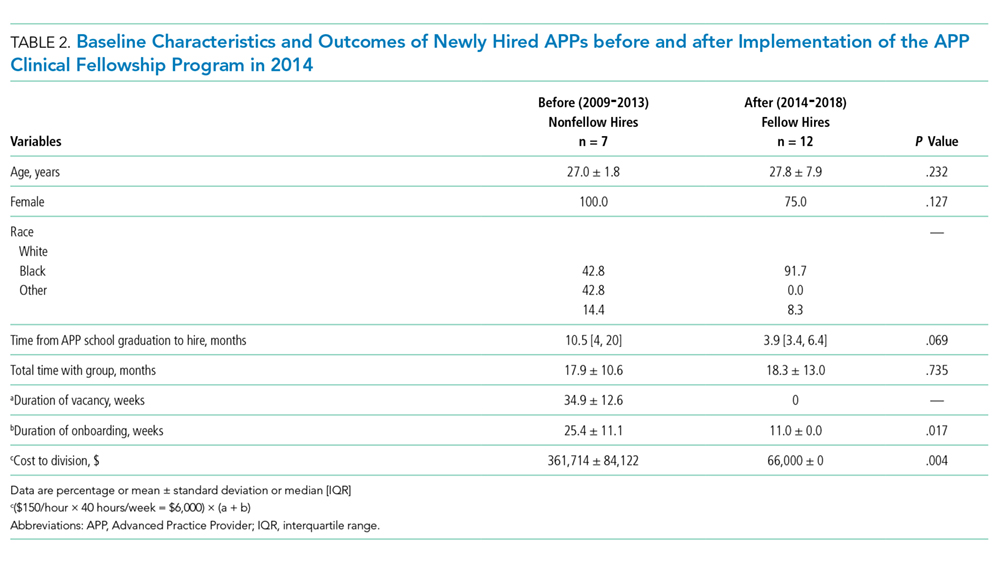
The yearly cost of an APP vacancy and onboarding is incurred by doctor moonlighting costs (at the rate of $150 per hour) to cover open shifts. The mean duration of vacancies and onboarding each year was 34.9 and 25.4 weeks, respectively, before the fellowship. The yearly cost of onboarding, after the establishment of the fellowship, is a maximum of $66,000, derived from physician moonlighting to cover the six-week ramp-up at the very beginning of the fellowship and the five weeks of orientation to the pulmonary and chemical dependency units after the fellowship (Table 3).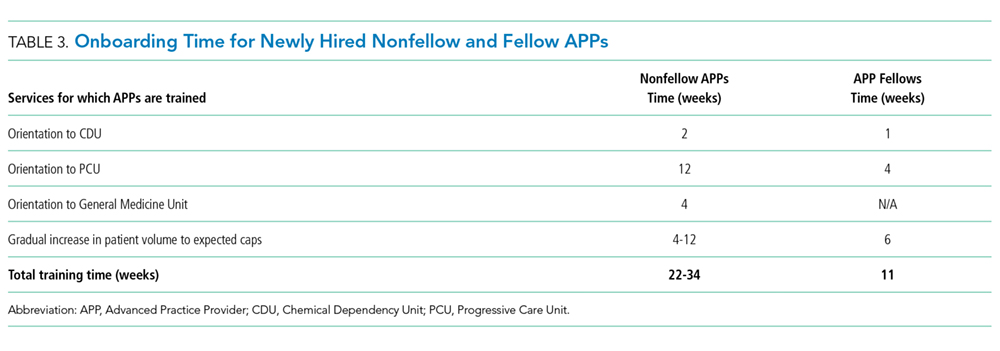
DISCUSSION
Our APP clinical fellowship in hospital medicine at JHBMC has produced several benefits. First, the fellowship has become a pipeline for filling APP vacancies within our division. We have been able to hire for four consecutive years from the fellowship. Second, the ready availability of high-functioning and efficient APP hospitalists has cut down on the onboarding time for our new APP hires. Many new APP graduates lack confidence in caring for complex hospitalized patients. Following our 12-month clinical fellowship, our matriculated fellows are able to practice at the top of their license immediately and confidently. Third, the reduced vacancy and shortened onboarding periods have reduced costs to the division. Fourth, the fellowship has created additional teaching avenues for the faculty. The medicine units at JHBMC are comprised of hospitalist and internal medicine residency services. The hospitalists spend the majority of their clinical time in direct patient care; however, they rotate on the residency service for two weeks out of the year. The majority of physicians welcome the chance to teach more, and partnering with an APP fellow provides that opportunity.


