
An Advanced Practice Provider Clinical Fellowship as a Pipeline to Staffing a Hospitalist Program


BACKGROUND: Approximately 83% of hospitalist groups around the country utilize advanced practice providers; however, the demand for hospitalists continues to exceed the supply, and this has led to increased utilization of advanced practice providers in hospital medicine. Advanced practice providers receive very limited inpatient training, and there is wide variation in their clinical abilities after graduation.
OBJECTIVE: To determine if an advanced practice provider fellowship is a cost-effective pipeline for filling vacancies within a hospitalist program.
METHODS: In 2014, a one-year advanced practice providers clinical fellowship in hospital medicine was established. Working one-on-one with an experienced hospitalist faculty member, the fellows evaluate and manage patients. The program consists of 80% clinical experience, in the inpatient setting, and 20% didactic instruction. Up to four fellows are accepted each year and are eligible for hire, after training, if there are vacancies.
RESULTS: The duration of onboarding and cost to the division were significantly reduced after implementation of the program (25.4 vs 11.0 weeks, P = .017 and $361,714 vs $66,000, P = .004).
CONCLUSION: The advanced practice provider fellowship has proven beneficial for the hospitalist division by (1) reducing costs associated with having unfilled vacancies, (2) improving capacity on the hospitalist service, and (3) providing a pipeline for filling nurse practitioners (NP) and physician assistant (PA) vacancies on the hospitalist service.
© 2019 Society of Hospital Medicine
METHODS
Design and Setting
Johns Hopkins Bayview Medical Center (JHBMC) is a 440 bed hospital in Baltimore Maryland. The hospitalist group was started in 1996 with one physician seeing approximately 500 discharges a year. Over the last 20 years, the group has grown and is now its own division with 57 providers, including 42 physicians, 11 APPs, and four APP fellows. The hospitalist division manages ~7,000 discharges a year, which corresponds to approximately 60% of admissions to general medicine. Hospitalist APPs help staff general medicine by working alongside doctors and admitting patients during the day and night. The APPs also staff the pulmonary step down unit with a pulmonary attending and the chemical dependency unit with an internal medicine addiction specialist.
The growth of the division of hospital medicine at JHBMC is a result of increasing volumes and reduced residency duty hours. The increasing full time equivalents (FTEs) resulted in a need for APPs; however, vacancies went unfilled for an average of 35 weeks due to the time it took to post open positions, interview applicants, and hire applicants through the credentialing process. Further, it took as long as 22 to 34 weeks for a new hire to work independently. The APP vacancies and onboarding resulted in increased costs to the division incurred by physician moonlighting to cover open shifts. The hourly physician moonlighting rate at JHBMC is $150. All costs were calculated on the basis of a 40-hour work week. We performed a pre- and postanalysis of outcomes of interest between January 2009 and June 2018. This study was exempt from institutional review board review.
Intervention
In 2014, a one year APP clinical fellowship in hospital medicine was started. The fellows evaluate and manage patients working one-on-one with an experienced hospitalist faculty member. The program consists of 80% clinical experience in the inpatient setting and 20% didactic instruction (Table 1). Up to four fellows are accepted each year and are eligible for hire after training if vacancies exist. The program is cost neutral and was financed by downsizing, through attrition, two physician FTEs. Four APP fellows’ salaries are the equivalent of two entry-level hospitalist physicians’ salaries at JHBMC. The annual salary for an APP fellow is $69,000.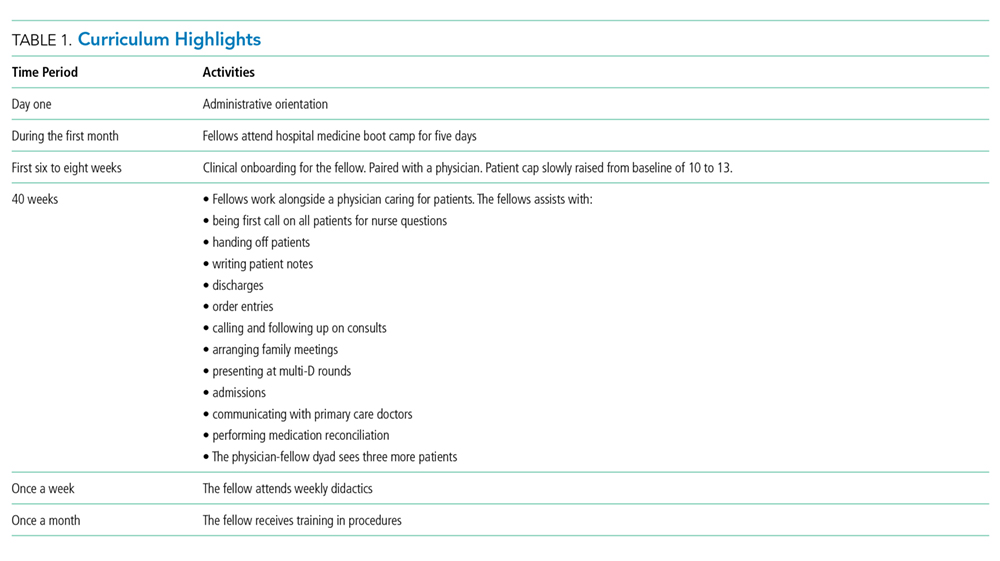
Downsizing by two physician FTEs meant that one less doctor was scheduled every day. The patient load previously seen by that one doctor (10 patients) was absorbed by the MD–APP fellow dyads. Paired with a fellow, each physician sees a higher cap of 13 patients, and it takes six weeks for the fellows to ramp-up to this patient load. When the fellow first starts, the team sees 10 patients. Every two weeks, the pair’s census increases by one patient to the cap of 13. Collectively, the four APP fellow–MD dyads make it possible for four physicians to see an additional 12 patients. The two extra patients absorbed by the service per day results in a net increase in capacity of up to 730 patient encounters a year.


