
Does Patient Experience Predict 30-Day Readmission? A Patient-Level Analysis of HCAHPS Data


BACKGROUND: Hospital-level studies have found an inverse relationship between patient experience and readmissions. However, based on typical survey response time, it is unclear if patients are able to respond to surveys before they get readmitted and whether being readmitted might be a driver of poor experience scores (reverse causation).
OBJECTIVE: Using patient-level Hospital Consumer Assessment of Healthcare Providers and Systems (HCHAPS) and Press Ganey data to examine the relationship between readmissions and experience scores and to distinguish between patients who responded before or after a subsequent readmission. DESIGN: Retrospective analysis of 10-year HCAHPS data.
SETTING: Single tertiary care academic hospital.
PARTICIPANTS: Patients readmitted within 30 days of an index hospitalization who received an HCAHPS survey linked to index admission comprised the exposure group. This group was divided into those who responded prior to readmission and those who responded after readmission. Nonreadmitted patients comprised the control group.
ANALYSIS: Multivariable-logistic regression to analyze the association between HCHAPS and Press Ganey scores and 30-readmission status, adjusted for patient factors.
RESULTS: Only 15.8% of the readmitted patients responded to the survey prior to readmission, and their scores were not significantly different from the nonreadmitted patients. The patients who responded after readmission were significantly more dissatisfied with physicians (doctors listened 73.0% vs 79.2%, aOR 0.75, P < .0001), staff responsiveness, (call button 50.0% vs 59.1%, aOR 0.71, P < .0001) pain control, discharge plan, noise, and cleanliness of the hospital.
CONCLUSION: Our findings suggest that poor patient experience may be due to being readmitted, rather than being predictive of readmission.
© 2018 Society of Hospital Medicine
METHODS
Study Design
We conducted a retrospective analysis of prospectively collected 10-year HCAHPS and Press Ganey patient survey data for a single tertiary care academic hospital.
Participants
All adult patients discharged from the hospital and who responded to the routinely sent patient-experience survey were included. Surveys were sent to a random sample of 50% of the discharged patients.
The exposure group was comprised of patients who responded to the survey and were readmitted within 30 days of discharge. After subtracting 5 days from the survey receipt date for expected delays related to mail delivery time and processing time, survey response date was calculated. The exposure group was further divided into patients who responded to the survey prior to their 30-day readmission (“Pre-readmission responders”) and those that responded to the survey after their readmission (“Postreadmission responders”). A sensitivity analysis was performed by changing the number of days subtracted from the survey receipt date by 2 days in either direction. This approach did not result in any significant changes in the results.
The control group comprised patients who were not readmitted to the hospital within 30 days of discharge and who did not have an admission in the previous 30 days as well (“Not readmitted” group). An additional comparison group for exploratory analysis included patients who had experienced an admission in the prior 30 days but were not readmitted after the admission linked to the survey. These patients responded to the patient-experience surveys that were linked to their second admission in 30 days (“2nd-admission responders” group; Figure).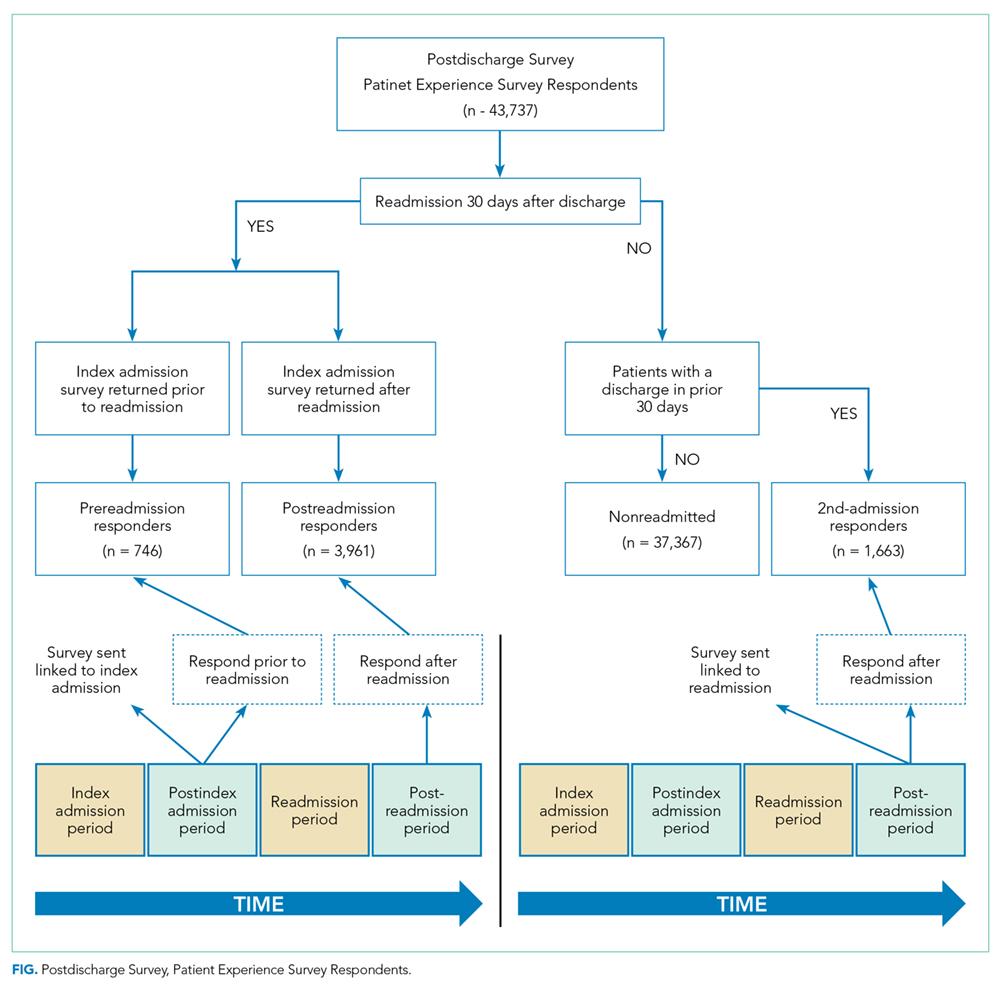
Time Periods
All survey responders from the third quarter of 2006 to the first quarter of 2016 were included in the study. Additionally, administrative data on non-responders were available from 7/2006 to 8/2012. These data were used to estimate response rates. Patient level experience and administrative data were obtained in a linked fashion for these time periods.
Instruments
Press Ganey and HCAHPS surveys were sent via mail in the same envelope. Fifty percent of the discharged patients were randomized to receive the surveys. The Press Ganey survey contained 33 items encompassing several subdomains, including room, meal, nursing, physician, ancillary staff, visitor, discharge, and overall experience.
The HCAHPS survey contained 29 CMS-mandated items, of which 21 are related to patient experience. The development, testing, and methods for administration and reporting of the HCAHPS survey have been previously described and studies using this instrument have been reported in the literature.11 Press Ganey patient satisfaction survey results have also been reported in the literature.12
Outcome Variables and Covariates
HCAHPS and Press Ganey experience survey individual item responses were the primary outcome variables of this study. Age, self-reported health status, education, primary language spoken, service line, and time taken to respond to the surveys served as the covariates. These variables are used by CMS for patient-mix adjustment and are collected on the HCAHPS survey. Additionally, the number of days to respond to the survey were included in all regression analysis to adjust for early responder effect.13-15


