
A simple algorithm for predicting bacteremia using food consumption and shaking chills: a prospective observational study


BACKGROUND
Predicting the presence of true bacteremia based on clinical examination is unreliable.
OBJECTIVE
We aimed to construct a simple algorithm for predicting true bacteremia by using food consumption and shaking chills.
DESIGN
A prospective multicenter observational study.
SETTING
Three hospital centers in a large Japanese city.
PARTICIPANTS
In total, 1,943 hospitalized patients aged 14 to 96 years who underwent blood culture acquisitions between April 2013 and August 2014 were enrolled. Patients with anorexia-inducing conditions were excluded.
INTERVENTIONS
We assessed the patients’ oral food intake based on the meal immediately prior to the blood culture with definition as “normal food consumption” when >80% of a meal was consumed and “poor food consumption” when <80% was consumed. We also concurrently evaluated for a history of shaking chills.
MEASUREMENTS
We calculated the statistical characteristics of food consumption and shaking chills for the presence of true bacteremia, and subsequently built
RESULTS
Among 1,943 patients, 223 cases were true bacteremia. Among patients with normal food consumption, without shaking chills, the incidence of true bacteremia was 2.4% (13/552). Among patients with poor food consumption and shaking chills, the incidence of true bacteremia was 47.7% (51/107). The presence of poor food consumption had a sensitivity of 93.7% (95% confidence interval [CI], 89.4%-97.9%) for true bacteremia, and the absence of poor food consumption (ie, normal food consumption) had a negative likelihood ratio (LR) of 0.18 (95% CI, 0.17-0.19) for excluding true bacteremia, respectively. Conversely, the presence of the shaking chills had a specificity of 95.1% (95% CI, 90.7%-99.4%) and a positive LR of 4.78 (95% CI, 4.56-5.00) for true bacteremia.
CONCLUSION
A 2-item screening checklist for food consumption and shaking chills had excellent statistical properties as a brief screening instrument for predicting true bacteremia. Journal of Hospital Medicine 2017;12:510-515. © 2017 Society of Hospital Medicine
© 2017 Society of Hospital Medicine
Structure of Reliability Study Procedures
Nurses in the 3 different hospitals performed daily independent food consumption ratings during each patient’s stay. Interrater reliability assessments were conducted in the morning or afternoon, and none of the raters had access to the other nurses’ scores at any time. The study nurses performed simultaneous ratings during these assessments (one interacted with and rated the patient while the other observed and rated the same patient).
Prediction Variables of True Bacteremia
1. Food consumption. Assessment of food consumption has been previously described in detail.8 Briefly, we characterized the patients’ oral intake based on the meal taken immediately prior to the BCs. For example, if a fever developed at 2
2. Chills. As done previously, the physician evaluated the patient for a history of chills at the time of BCs and classified the patients into 1 of 4 grades4,5: “no chills,” the absence of any chills; “mild chills,” feeling cold, equivalent to needing an outer jacket; “moderate chills,” feeling very cold, equivalent to needing a thick blanket; and “shaking chills,” feeling extremely cold with rigors and generalized bodily shaking, even under a thick blanket. To distinguish between those patients who had shaking chills and those who did not, we divided the patients into 2 groups: the “shaking chills group” and the combination of none, mild, and moderate chills, referred to as the “negative shaking chills group.”
3. Other predictive variables. We considered the following additional predictive variables: age, gender, axillary body temperature (BT), heart rate (HR), systolic blood pressure (SBP), respiratory rate (RR), white blood cell count (WBC), and serum C-reactive protein level (CRP). These predictive variables were obtained immediately prior to the BCs. We defined SIRS based on standard criteria (HR >90 beats/m, RR >20/m, BT <36°C or >38°C, and a WBC <4 × 10³ WBC/μL or >12 × 103 WBC/μL). Patients were subcategorized by age into 2 groups (≤69 years and >70 years). CRP levels were dichotomized as >10.0 mg/dL or ≤10.0 mg/dL. We reviewed the patients’ charts to determine whether they had received antibiotics. In the case of walk-in patients, we interviewed the patients regarding whether they had visited a clinic; if they had, they were questioned as to whether any antibiotic therapy had been prescribed.
Statistical Analysis
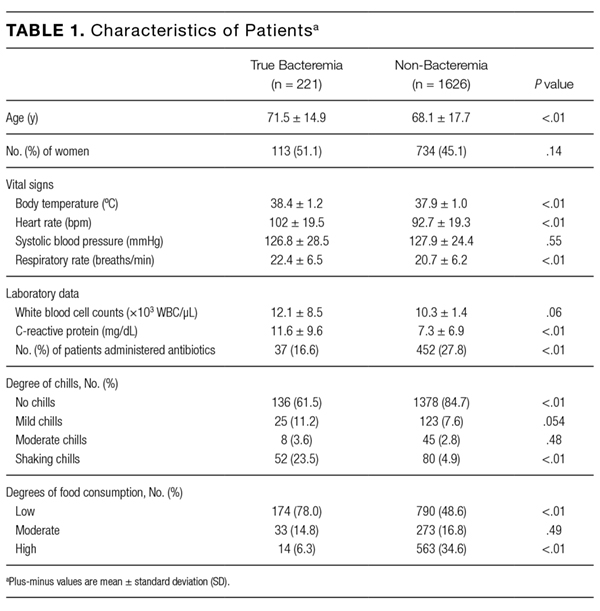
Continuous variables are presented as the mean with the associated standard deviation (SD). All potential variables predictive of true bacteremia are shown in Table 1. The variables were dichotomized by clinically meaningful thresholds and used as potential risk-adjusted variables. We calculated the sensitivity and specificity and positive and negative predictive value for each criterion. Multiple logistic regression analysis was used to select components that were significantly associated with true bacteremia (the level of statistical significance determined with maximum likelihood methods was set at P < .05). To visualize and quantify other aspects in the prediction of true bacteremia, a recursive partitioning analysis (RPA) was used to make a decision tree model for true bacteremia. This nonparametric regression method produces a classification tree following a series of nonsequential top-down binary splits. The tree-building process starts by considering a set of predictive variables and selects the variable that produces 2 subsets of participants with the greatest purity. Two factors are considered when splitting a node into its daughter nodes: the goodness of the split and the amount of impurity in the daughter nodes. The splitting process is repeated until further partitioning is no longer possible and the terminal nodes have been reached. Details on this method are discussed in Monte Carlo Calibration of Distributions of Partition Statistics (www.jmp.com).
Probability was considered significant at a value of P < .05. All statistical tests were 2-tailed. Statistical analyses were conducted by a physician (KI) and an independent statistician (JM) with the use of the SPSS® v.16.0 software package (SPSS Inc., Chicago, IL) and JMP® version 8.0.2 (SAS Institute, Cary, NC).
RESULTS
Patients Characteristics
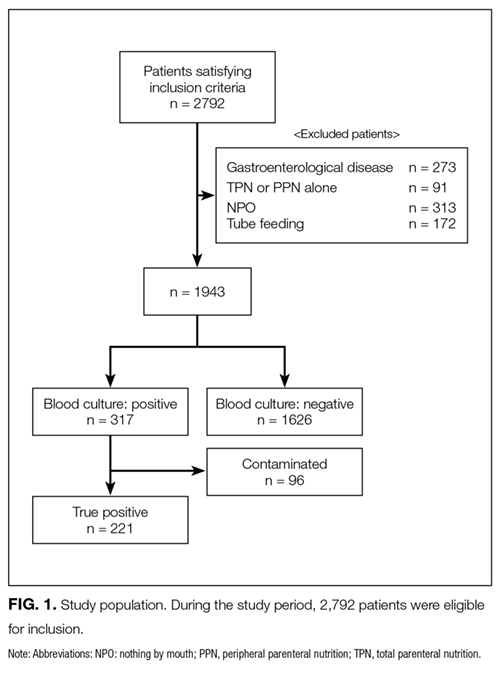
Two thousand seven hundred and ninety-two patients met the inclusion criteria for our study, from which 849 were excluded (see Figure 1 for flow diagram). Among the remaining 1,943 patients, there were 317 patients with positive BCs, of which 221 patients (69.7%) were considered to have true-positive BCs and 96 (30.3%) were considered to have contaminated BCs. After excluding these 96 patients, 221 patients with true bacteremia (true bacteremic group) were compared with 1,626 nonbacteremic patients (nonbacteremic group; Figure 1). The baseline characteristics of the subjects are shown in Table 1. The mean BT was 38.4 ± 1.2°C in the true bacteremic group and 37.9 ± 1.0°C in the nonbacteremic group. The mean serum CRP level was 11.6 ± 9.6 mg/dL in the true bacteremic group and 7.3 ± 6.9 mg/dL in the nonbacteremic group. In the true bacteremic group, there were 6 afebrile patients, and 27 patients without leukocytosis. The pathogens identified from the true-positive BCs were Escherichia coli (n = 59, 26.7%), including extended-spectrum beta-lactamase producing species, Staphylococcus aureus (n = 36, 16.3%), including methicillin-resistant Staphylococcus aureus, and Klebsiella pneumoniae (n = 22, 10.0%; Supplemental Table 1).


