
Association between radiologic incidental findings and resource utilization in patients admitted with chest pain in an urban medical center


BACKGROUND
Increasing use of testing among hospitalized patients has resulted in an increase in radiologic incidental findings (IFs), which challenge the provision of high-value care in the hospital setting.
OBJECTIVE
To understand impact of radiologic incidental findings on resource utilization in patients hospitalized with chest pain.
DESIGN
Retrospective observational cross sectional study.
SETTING
Academic medical center.
PARTICIPANTS
Adult patients hospitalized with principal diagnosis of chest pain.
MEASUREMENTS
Demographic, imaging, and length of stay (LOS) data were abstracted from the medical charts. We used multiple logistic regression to evaluate factors associated with radiologic IFs and negative binomial regression to evaluate the association between radiologic IFs and LOS.
RESULTS
1811 consecutive admissions with chest pain were analyzed retrospectively over a period of 24 months; 376 patients were included in the study after exclusion criteria were applied and readmissions removed. Of these, 197 patients (52%) had 364 new radiologic IFs on imaging; most IFs were of minor (50%) or moderate clinical significance (42%), with only 7% of major significance. Odds of finding radiologic IFs increased with age (adjusted odds ratio, 1.04; 95% confidence interval [CI], 1.01-1.06) and was associated with a 26% increase in LOS (adjusted incidence rate ratio, 1.26; 95% CI, 1.07-1.49).
CONCLUSION
Radiologic IFs were very common among patients hospitalized with chest pain of suspected cardiac origin and independently associated with an increase in the LOS. Interventions to address radiologic IFs may reduce LOS and, thereby, support high-value care. Journal of Hospital Medicine 2017;12:323-328. © 2017 Society of Hospital Medicine
© 2017 Society of Hospital Medicine
Overall, 658 diagnostic tests were performed in the study population; of these, 268 (40.7%) tests revealed 364 new radiologic IFs (Supplement Table 2). Of these radiologic IFs, 27 (7.4%) were of major clinical significance, 154 (42%) were of moderate clinical significance, and 183 (50%) were of minor clinical significance (Supplement Table 3). Computed tomography (CT) scans yielded more IFs compared to any other imaging modalities. Of the radiologic IFs of major clinical significance, 3 malignant/premalignant lesions were found. While pulmonary nodules were the most common moderate clinically significant findings, atelectasis and spinal degenerative changes were the most common radiologic IFs of minor clinical significance (Supplement Table 4).

Results of the logistic regression models testing the association between patient characteristics and radiologic IFs are displayed in Table 2. Only age and repeat admissions remained significantly associated with radiologic IFs in the fully adjusted model (adjusted odds ratio [OR], 1.04; 95% confidence interval [CI], 1.01-1.06 and 2.68; 95% CI, 1.60-4.44, respectively).
Median LOS was 2 days (IQR=1) for patients with no IFs and 2 days (IQR=2) for patient with radiologic IFs (P = 0.08). Unadjusted negative binomial regression analysis revealed that identification of any radiologic IFs during admission (vs. none) was associated with an increased LOS by 24% (unadjusted IRR, 1.24; 95% CI, 1.06-1.45). After adjustment for confounders, identification of any radiologic IFs during admission remained significantly associated with a longer LOS (adjusted IRR, 1.26; 95% CI, 1.07-1.49). Results remained significant on a sensitivity analysis excluding admissions lasting longer than 10 days (adjusted IRR, 1.21; 95% CI, 1.03-1.42; Supplement Table 5).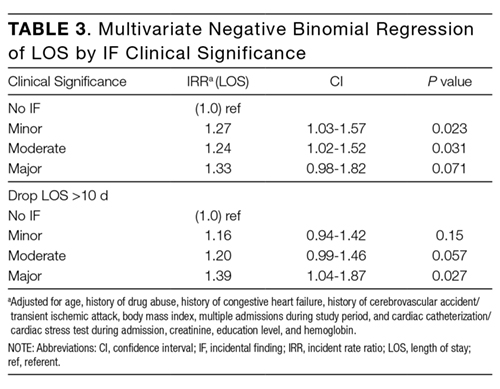
Incidental findings of minor and moderate clinical significance were associated with increase in LOS on multiple negative binomial regression (adjusted IRR, 1.27; 95% CI, 1.03-1.57 and 1.24; 95% CI, 1.02-1.52, respectively; Table 3); however, upon dropping length of hospitalization outliers, only radiologic IFs with major clinical significance were associated with increase in length of hospitalization (adjusted IRR, 1.39; 95% CI, 1.04-1.87; Table 3).
Supplemental chart review revealed that 26 patients accounted for the 27 radiologic IFs of major clinical significance. This group had 54% women, median LOS remained 2 days (IQR 2) and, on average, had about 3 diagnostic tests performed per patient. Cardiac testing was performed less on these patients compared to others (Supplement Table S6). Review also revealed that, of the 26 patients, 2 had abnormal labs, 2 had drug abuse/psychiatric issues, and another 2 had radiologic IFs that warranted further consultations, imaging, and longer LOS.DISCUSSION
Radiologic IFs in patients admitted with chest pain of suspected cardiac origin are a common occurrence as shown in our study. Similar to prior studies, 41% of all radiologic tests done in our study population revealed IFs.6 The majority of the IFs were of minor to moderate clinical significance and, as reported in the literature, were more common with older age and CT imaging.14,16 In addition, an IF diagnosed during admission for chest pain was associated with a 26% increase in length of hospital stay.
To our knowledge, we present the first study on the impact of identification of radiologic IFs in hospitalized patients on length of hospital stay and specifically in patients hospitalized with chest pain of suspected cardiac origin. Trends over the past decade have shown a decrease in LOS and hospitalizations but with an increase in health resource utilization.17,18 Association of radiologic IFs with increase in LOS is significant as this potentially increases hospital-acquired conditions such as infections and resource utilization leading to increase in costs of hospitalizations.19 This in return is a concern for patient safety.
The positive association between LOS and radiologic IFs, interestingly, continued to exist despite sensitivity analysis. Incidental findings of major clinical significance were associated with longer LOS in the sensitivity analysis. Supplemental chart review of patients with major clinical findings suggested more extra-cardiac workup compared to patients with minor/moderate radiologic IFs. This could indicate that the presence of clinically significant radiologic IFs could have led to further inpatient work-up and consultations. The downstream healthcare expenditure associated with workup of IFs in individual radiologic tests is well established.20 In case of cardiac CT, Goehler et al.21 found that the healthcare expenditure was high following incidentally detected pulmonary nodules with an overall small reduction in lung cancer mortality. Incidental findings also increase the burden of reporting and concern for medico-legal issues for providers.4 These concerns are likely valid for hospitalized patients as well.
The socioeconomic trends in the study population were consistent with data from the Bureau of Labor Statistics in that low education is associated with higher unemployment.22 Although, overall, gender, race and insurance mix were similar in both groups, we did see trends of socioeconomic differences in the patients with radiologic IFs of major clinical significance that might not have been statistically significant owing to the small sample size. Despite the population being relatively of younger age (given our cut off age was 65 years) there was still a positive association with age and presence of radiologic IFs. The higher number of patients with COPD or history of malignancy in the radiologic IF group suggests that an association with IFs could exist for these disease cohorts; however, after adjustment for multiple covariates, such an association did not transpire. Interestingly, patients with no radiologic IFs underwent cardiac catheterization or stress testing more often than patients with discovered IFs. This speaks of 2 possibilities; first, that both tests probably do not yield many extra-cardiac IFs, or, secondly, that these patients did not require further workup. More patients in the IF group had more than 1 admission during the study period, and this was associated with increased odds of detecting radiologic IFs. We hypothesize that this might have occurred because of the diagnostic dilemma in these patients who have multiple admissions for the same reason leading to wider array of diagnostic workup. Indeed, we did not note upon chart review alternative diagnoses in these patients but only more IFs. There are several study limitations to consider. First, the fact that this is a single center study sets limitations to interpretation and generalizability of the data. Second, we cannot exclude the possibility of residual confounding. Third, the small number of patients included in this study precludes definitive identification of more factors potentially associated with IFs. However, this study sheds light on a yet unidentified problem within the realm of inpatient management especially for the internists and hospitalists. We tried to limit bias to the extent possible by including only 1 presenting complaint and age-restricting the population.


