
Is Patient Satisfaction the Same Immediately After the First Visit Compared to Two Weeks Later?


Analysis
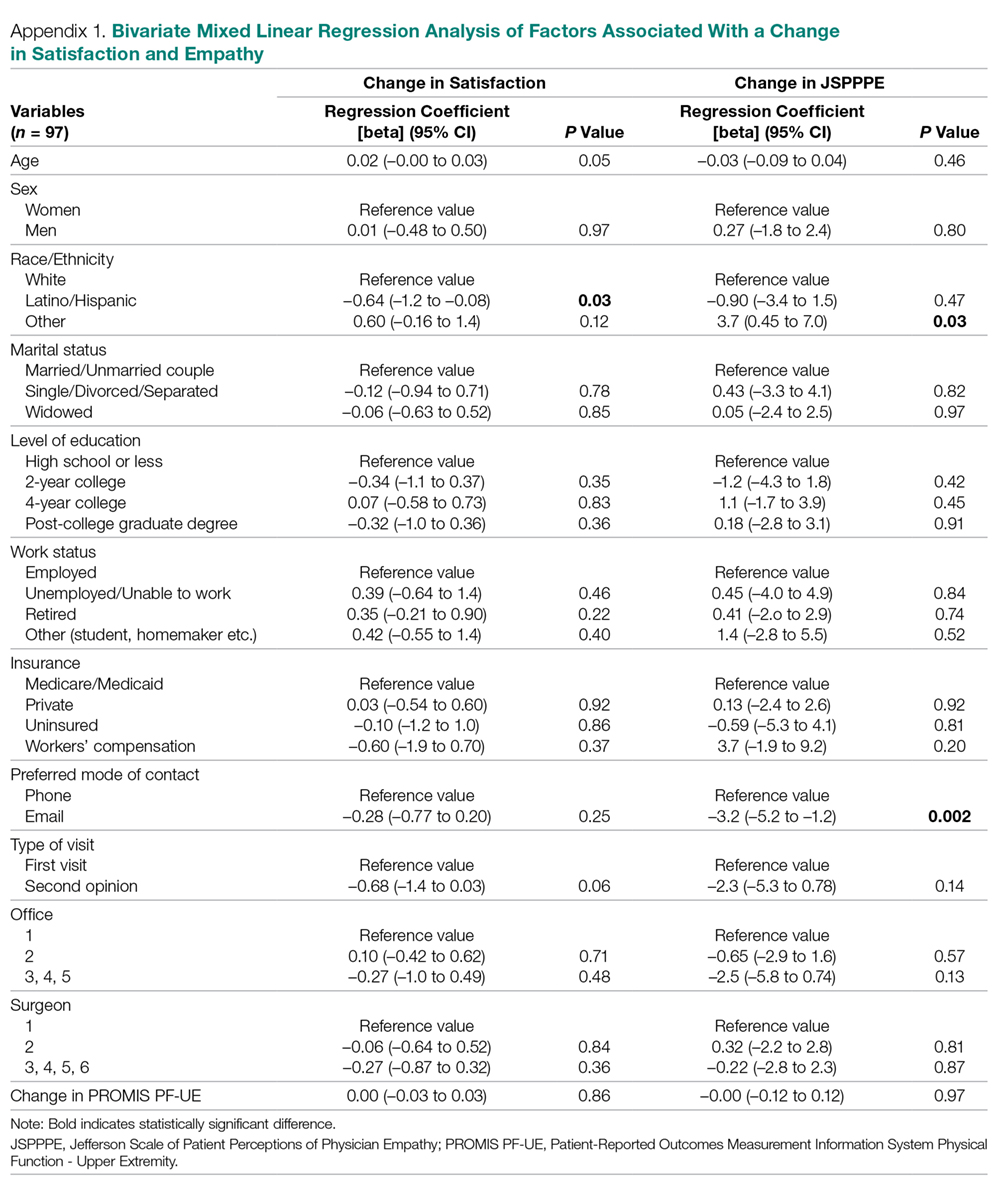
Continuous variables are presented as mean ± SD and discrete data as proportions. We used Student’s t-tests to assess baseline differences between continuous variables and Fisher’s exact tests for discrete variables. To assess differences in satisfaction and perceived empathy after 2 weeks, we used Student’s paired t-tests. We created 2 multilevel multivariable linear regression models to assess factors associated with (1) change in satisfaction with the surgeon and (2) change in perceived physician empathy. These models account for correlation of patients treated by the same surgeon. We selected variables to be included in the final models by running multilevel models with only 1 independent variable of interest (Appendix 1). Variables with P < 0.10 were included in our final models. We also included change in PROMIS PF-UE in both models because this was our variable of interest. We considered P < 0.05 significant.
We performed a power analysis for the difference in patient satisfaction immediately after the first visit compared to 2 weeks later. Based on our pilot data where we found an initial mean satisfaction score of 9.4 and mean satisfaction score after 2 weeks of 9.1 (SD of difference 1.0), a priori power analysis showed that we needed a minimum sample size of 90 patients to detect a difference with power set at 0.80 and alpha set at 0.05. In order to account for loss to follow-up as previously noted,18 we enrolled 67% more patients (total of 150).


