Delivering Bad News in the Context of Culture: A Patient-Centered Approach


The Need for Culturally Sensitive Care
The concept of one’s culture encompasses a host of components including how an individual identifies oneself as well as the language, customs, beliefs, and value system one utilizes. Culture, in turn, profoundly affects patients’ belief systems regarding health and wellness, disease and illness, and the delivery of health care services, including the use of healers and alternative providers [1].In order to provide culturally sensitive and high-quality care to diverse patient populations, it is important for providers to gain an understanding and sensitivity to the influences of culture on patients’ beliefs and behaviors [2].
The ability to provide care to people of different cultures is more important than ever before. In 2011, the number of legal and unauthorized immigrants in the United States rose to 40.4 million (13% of the population) and between 2007 and 2011 alone, this number rose by 2.4 million [3].According to a 2010 census bureau report, in the last 30 years the number of individuals over the age of 5 who spoke a language other than English in their home more than doubled, an increase that was 4 times greater than the rate of population growth [4].In addition, in 2009 the United States resettled more refugees than any other nation (60,000+) and this number reached almost 70,000 in 2013 [5,6].Patient populations in the United States are becoming increasingly diverse, and providers must have the skills to communicate effectively with these groups. A one-size-fits-all approach is not sufficient for our changing population.
The Challenges of Delivering Bad News and the Impact of Culture
Perhaps one of the most challenging communication scenarios faced by physicians is the need to deliver bad news to a patient. “Bad news” can be described as any information that adversely alters one’s expectations for the future [7].Clinicians from nearly all specialties are confronted with the task of giving bad news [8],and this is particularly true regarding cancer care. Among oncologists, 60% reported the need to break bad news to patients between 5 to 20 times per month, with 14% reporting greater than 20 times per month [9].The concept of giving bad news is often viewed as stressful by clinicians [10], and clinicians must be able to balance a myriad of elements, including patients’ emotional responses, information needs, uncertainties of disease progression and treatments, patients’ preferred level of involvement in decision making, patient expectations, involvement of family members, and how to maintain hope, among others [9,11]. Indeed, it seems that clinicians find it difficult to take into account the full spectrum of patient needs [8]. While the descriptive literature indicates that patient satisfaction and psychological well-being is improved when a patient-centered approach is utilized that attends to the emotional needs of patients [12], clinicians often focus on biomedical information, with less focus on patients’ psychosocial needs and their level of understanding [13–15].
Further, the interaction of patient culture and context with the complexity of the “bad news” interaction can be daunting, and clinicians have noted their diminished level of comfort in adjusting to these cultural preferences [16].The ability of clinicians to “match” the patient’s preferred level of involvement in decision making is associated with higher patient satisfaction with decision making and lower depression after 3 months [11],yet clinicians often find it difficult to determine which patients want to be involved in the decision making to a greater or lesser extent [12].In addition, words have different meanings when used in medical settings or in lay contexts [8],not to mention the challenges of translation when dealing with non–English-speaking patients. Yet, the manner in which clinicians deliver bad news can affect patients’ understanding of their disease, treatment options, and patients’ adjustment to the diagnosis [8],as well as patients’ expected quality of life and intentions to adhere to recommendations [17].
Information Disclosure
One of the key areas impacted by culture relates to preferred disclosure of medical information. Walsh et al noted in their review that the majority of patients in English-speaking countries wanted relatively full disclosure regarding their illness in comparison to individuals from other countries [18].As a further distinction, Blackhall et al noted that African Americans and European Americans were more likely to believe that a patient should be told of a terminal diagnosis than Mexican and Korean Americans [19].In addition, Mexican and Korean Americans were more likely to believe that clinicians should not discuss death and dying with patients, as it could be harmful. Fujimori noted that Asians are less likely to prefer discussions of life expectancy in contrast to Westerners [20].In a survey of Albanian nationals, < 50% of patients wanted to know their true diagnosis; however, individuals who were male, urban, and educated demonstrated a significantly greater preference for disclosure [21].In the Middle East, the concept of disclosure is highly variable in terms of both provider and patient preferences [22].
Involvement of Family Members
A second important area relates to the involvement of family members. Fujimori noted high variability of patient preferences for having family members present when discussing bad news. Of Japanese patients, 78% preferred to be told with family members present, with the number decreasing for Portugal (61%), Australia (53%-57%), and Ireland (40%). Eighty-one percent of the US patients did not want anyone else present. However, almost all placed high value on physician expertise and honesty [20]. Blackhall noted that Mexican and Korean Americans were more likely to favor a family-centered approach to decision making [19]. In addition, Orona indicated that Mexican-American and Chinese-American families felt it was their duty to protect their relatives from a cancer diagnosis to keep the patient’s remaining time free of worry [23]. Haggerty found mixed evidence for patient preferences regarding disclosure of cancer prognosis to family members [24].
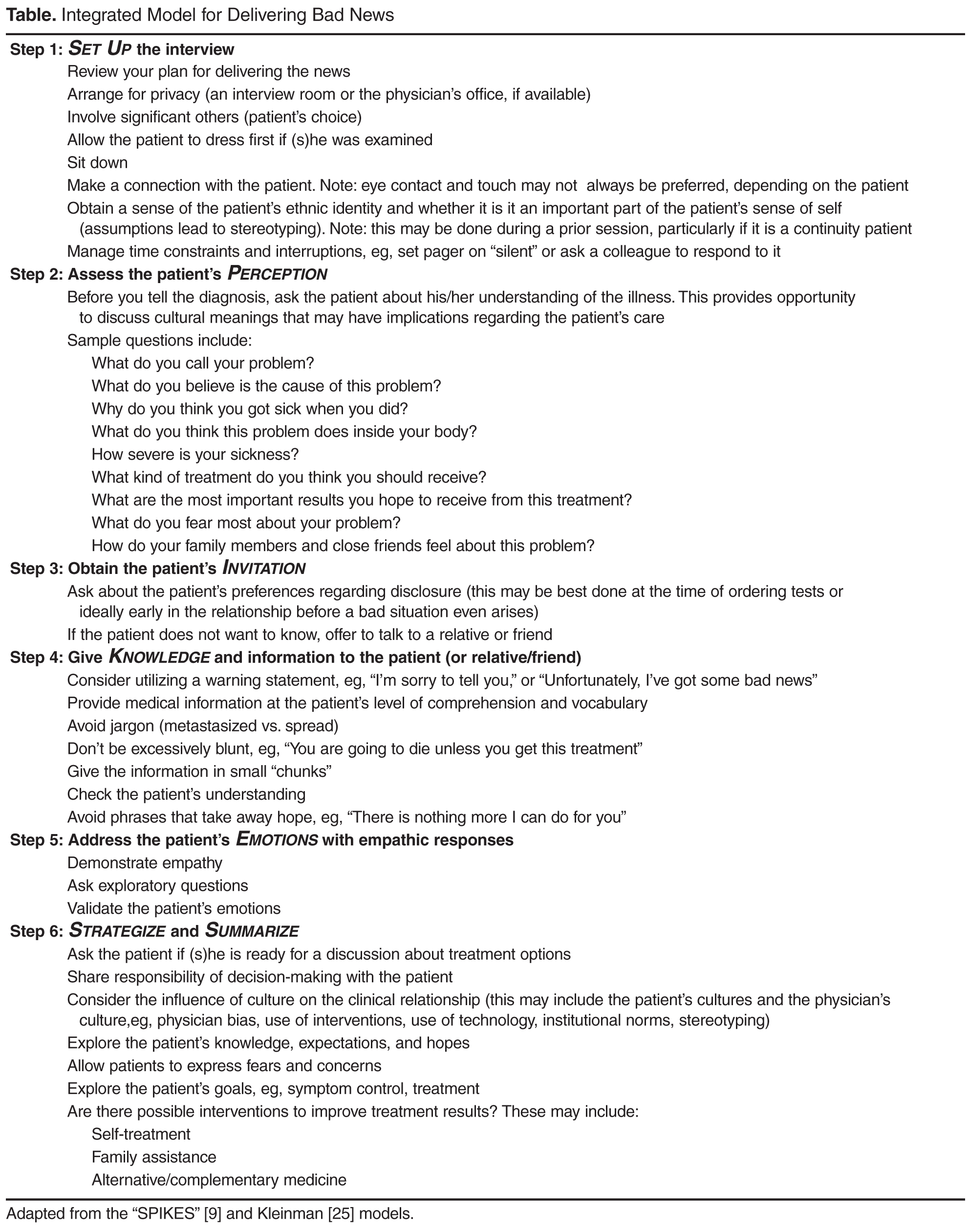
Given these variations and complexities, it is natural to try to develop a system for managing them, eg, a list of traits or attributes one can apply to certain groups. For example, patients of Asian origin prefer _______. However, there is an inherent danger in doing this, as it leads to stereotyping [25]. Cultural factors also may be given inappropriate meaning. Specifically, a well-meaning clinician might attribute certain characteristics to a patient when in fact it has little bearing on the patient’s perspective [25]. In addition, given the nature of communication, travel, and the fact that many individuals identify with more than one cultural group, it may be inappropriate to attribute a singular cultural identity to a group in contemporary society. As a result, Kleinman [25] proposed an ethnographic approach as opposed to a cultural approach. Specifically, this involves understanding a patient and his/her illness from an individual’s perspective as opposed to the cultural collective.
Communication Skills to Help Deliver Bad News