
Home Modifications for Rural Veterans With Disabilities


Background : Appropriate home modifications (HMs) can make the home environment accessible and relatively safe by reducing the risk of falls. Of special concern are individuals living alone, living in rural communities, and/or living in substandard housing. The Home Improvements and Structural Alterations (HISA) is a Veterans Health Administration (VHA) benefit program providing HMs for veterans with disabilities.
Methods: The objective of this study was to detail the profile of rural veteran (RV) HISA users and report on national HISA utilization patterns. We compare use at US Department of Veterans Affairs (VA) medical centers of varying complexity levels, and in VA regions. An examination of the relationship between travel time/distance and HISA utilization is also provided. This retrospective database study uses GeoSpatial analyses and 3 VA sources: The National Prosthetics Patient Database, the VHA Medical Inpatient Dataset, and the VHA Outpatient Dataset.
Results: From 2015 through 2018, 10,810 RVs used HISA with a mean age of 70.9 years. A majority of participants were White (79.5%), married (74.3%), and male (96.5%) veterans. They traveled a mean of 79.8 miles for 94.5 minutes to reach a facility where they received a HISA prescription. Nearly 75% of HISA users were able to receive a HISA prescription from their nearest facility, while about one-quarter traveled to a facility farther away, of which 43% travelled between 100 and 200 miles to obtain the HISA benefit. The top categories of diagnoses were musculoskeletal (19.1%), neurologic (12.5%), and cardiovascular (5.4%). There were about 11,166 HM prescriptions afforded to rural HISA users during the period, including bathroom (82.4%), doorway (4.9%), and railing (3.6%) modifications.
Conclusions: This study documents the national demographics and clinical characteristics of rural HISA users, data that may be useful to policy makers, HM service providers and advocate as well as HISA administrators in predicting future use and users.
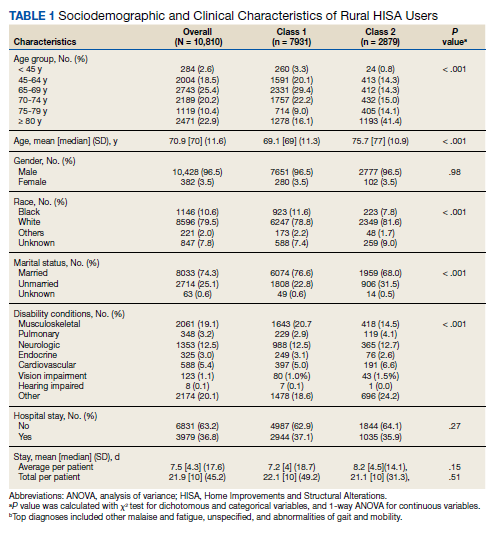
Most RHUs were male, White, and married. Class 1 and Class 2 RHUs differed significantly by age, race, marital status, and disability conditions: Class 1 RHUs were aged 6.6 years younger with a mean age of 69.1 years compared with 75.7 years for Class 2 users. For Class 1 RHUs, a plurality (29.4%) were aged 65 to 69 years; while a plurality (41.4%) of Class 2 users were aged ≥ 80 years. Musculoskeletal was the most common identified type of condition for all RHUs (Table 1).
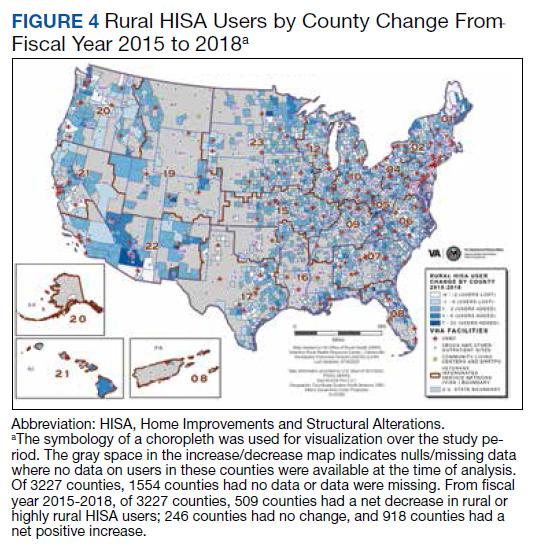
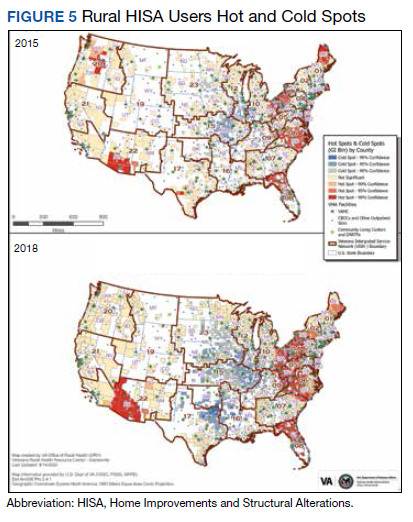
To better understand HISA utilization patterns and net RHUs per county, we used a map to detail RHUs by county and change over time (Figure 4). Additionally, we compared US counties by RHUs from FY 2015 to FY 2018 and determined how clusters of high numbers of RHUs (hot spots) and low numbers of RHUs (cold spots) shifted over this period (Figure 5). While HISA utilization grew over the study period, the net count of RHUs per county varied by 9 to 20 persons/county. The population of RHUs increased over time in the Southwest, Southeast, and over much of the East/Northeast, while in the Central and Midwest regions, number of RHUs seems to decrease in population and/or use of the system. The cold spots in the Midwest and South Central US seem to increase with a significant relationship to neighboring counties having a low number of RHUs.
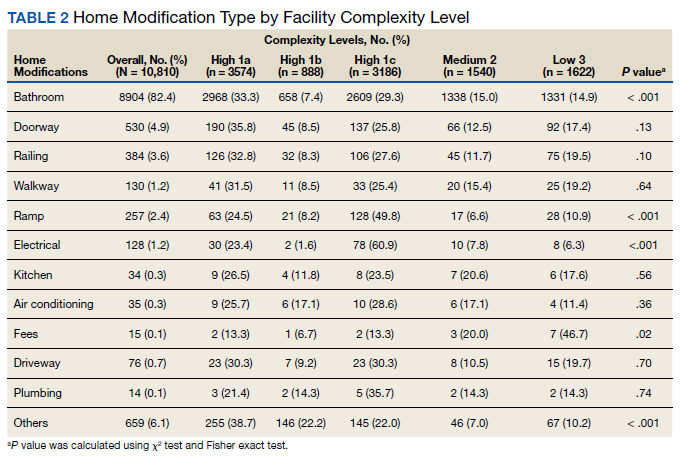
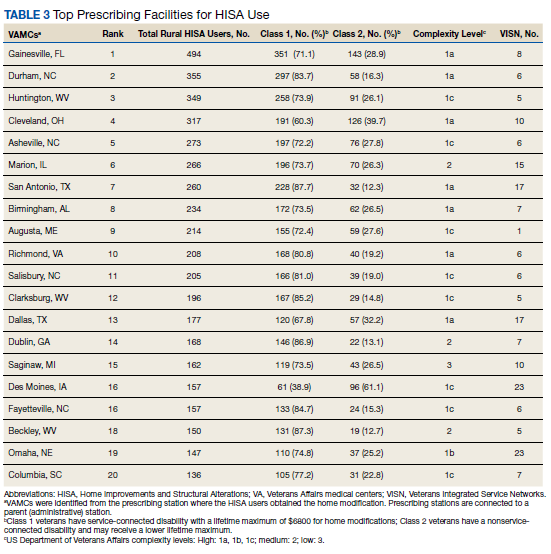
There were 11,166 HM prescribed to RHUs (Table 2). Bathroom HMs also were the dominant HM type for all facilities regardless of complexity levels (Table 3). The San Antonio, Texas, VAMC demonstrated the highest Class 1 vs Class 2 difference in HISA use (Class 1: 87.7% and Class 2: 12.3%). Except for the Des Moines VAMC, all other VAMCs showed HISA use > 60% by Class 1.
Cost Data
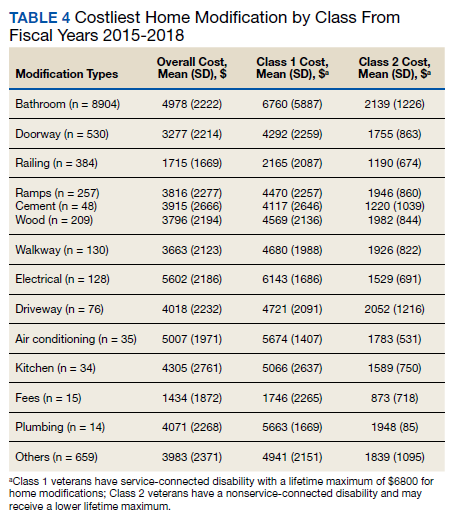
Air-conditioning installation ($5007) was the costliest HM overall (Table 4), closely followed by bathroom ($4978) and kitchen modifications ($4305). Bathroom renovations were the costliest HM type for both Class 1 and Class 2, closely followed by electrical repair and air-conditioning installation for Class 1 and driveway reconstruction and wooden ramp construction for Class 2.
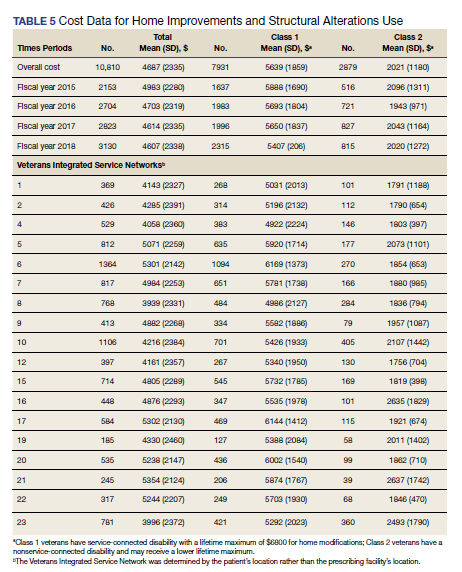
The mean award received for HM was $4687 (Table 5). While the number of RHUs increased from FY 2015 to FY 2016, the average cost decreased, both overall ($280) and for Class 1 ($195) and Class 2 ($153). Except for a small decline in the number of Class 2 HISA recipients from FY 2017 to FY 2018, overall, the number of RHUs continuously grew from FY 2015 to FY 2018: 977 for the overall cohort, 678 for Class 1 and 299 for Class 2. Despite the obvious gain in the number of RHUs, the average costs did not notably change over time. VISN 21 had the highest mean cost, followed by VISNs 17, 6, 22, and 20.
Travel
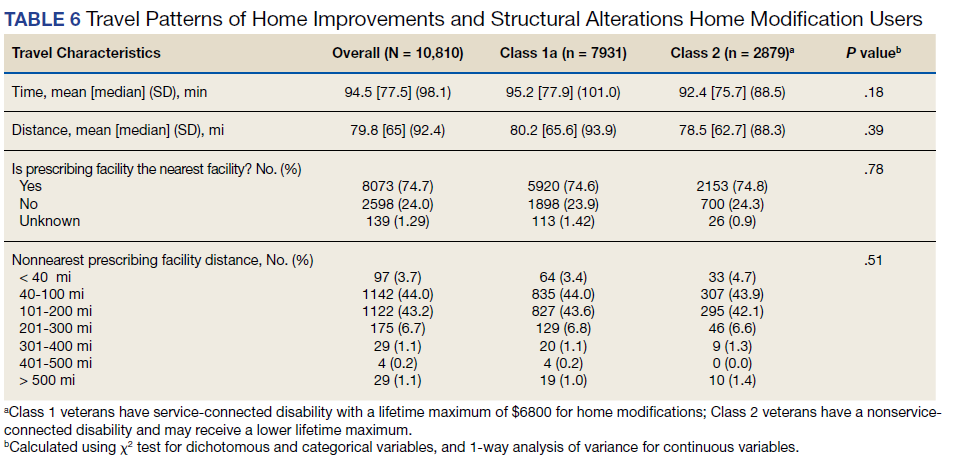
Travel time and distance to the HISA prescribing facility differed significantly between Class 1 and Class 2 HISA users. RHUs had to travel about 95 minutes from their place of residence to access the HISA benefits program. There were no statistically significant differences between Class 1 and 2 users with respect to travel time and distance traveled (Table 6).


