
Deep Space Infections of the Neck: Considerations in Diagnosis and Management


Despite the decreased incidence of deep space neck infections since the advent of antibiotics, preventive healthcare, and improved hygiene, this condition still carries a high rate of complications and morbidity.
Mouth. Visually assess the uvula, tonsils, and posterior pharynx for symmetry, color, edema, and presence of exudate. Poor oral intake is the norm for these patients. Comment on whether the oral mucosa is moist or dry, and assess for sublingual edema, tongue elevation, and pooling of oral secretions. Closely inspect gums and teeth for gingival disease, dental caries, fractures, and purulent drainage, with extra consideration for lower molars as a frequent source. Palpate to assess fluctuance, induration, or draining sinuses; crepitus may signal involvement of a gas-producing organism. Percussion of teeth may elicit pain from the involved nerve root. Trismus and limited mouth opening should give one pause in attempting orotracheal intubation, as this finding is associated with a difficult airway.
Neck. Examine the skin for swelling, erythema, ecchymosis, pustules, or “pointing” infection. Palpate the anterior and posterior triangles. Hesitation with range of motion may indicate retro-involvement. Auscultate for bruits and note the appearance of unilateral jugular venous distension; jugular vein thrombosis is associated with infections in these spaces. Palpate the trachea to assess whether the position is midline or deviated. Consider additional causes for the patient’s clinical condition such as branchial cyst, thyroid carcinoma, and aneurysm.
Chest. Observe the patient’s respiratory rate, use of accessory muscles, presence of retractions, and overall work of breathing. Auscultate, as descending infections leading to mediastinitis have been associated with pleural effusion, empyema, and pneumonia.
,Laboratory Studies
As in the case of most infections, no single laboratory test provides definitive diagnosis of deep space neck infection. Consensus recommendations advise obtaining a complete blood count, basic metabolic panel, blood cultures, and coagulation studies, while considering measures of inflammatory markers.
A study by Bakir et al6 found that 56% of patients with diagnosed deep space neck infection had white blood cell counts higher than 10,000 cells/mm3. Although the erythrocyte sedimentation rate (ESR) and C-reactive protein (CRP) are typically elevated, specificity of both is lacking. In a review by Boscolo-Rizzo, et al20 of patients with deep space neck infections, 100% had a “pathologic” elevation in the ESR, with an average value of 48.3 mm/h. In this study, CRP was also consistently elevated.20
In patients with diabetes, glycemic control is important in the treatment of infection. Impaired neutrophil bactericidal function is associated with poor blood glucose control and neutrophil bactericidal function will likely improve as blood glucose control improves.1 Although blood cultures are typically obtained in patients with critical illness, the value of cultures has been questioned. Some reports indicate that culture and sensitivity data do not lead to change in antibiotic selection or treatment. Therefore, the data clearly are not comprehensive enough for a formal recommendation.8,9
Imaging
The literature supports radiologic evaluation to identify the location, extension, and characteristics of deep space neck infections.6 Although computed tomography (CT) is by far the modality of choice and the one most widely used for diagnosing these infections, ultrasonography has gained acceptance as the sole imaging procedure. While CT is less expensive than magnetic resonance imaging (MRI) and is more readily available, quickly acquired, and useful to localize abscesses in the head and neck, as well as other structural abnormalities,4 it is not as effective as ultrasound in differentiating abscesses from cellulitis.
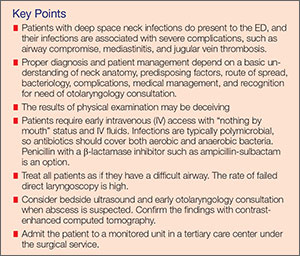
A combination of clinical evaluation and CT findings led to 89% accuracy in identifying drainable collections of pus, with high sensitivity (95%) and specificity (80%).4,16 Yet even with contrast enhancement, the false-positive rate of CT in evaluating surgical drainage remains above 10%. In patients with deep space abscess, enhanced-contrast CT results were useful for determining which patients might avoid surgical drainage. Nearly half of patients who met defined criteria responded well to medical therapy alone and had rapid improvement.21
Ultrasound can be performed at the bedside, which may improve time to diagnosis, initiation of medical management, and admission.22 Furthermore, ultrasound can be used to direct an aspirating needle, and involves no radiation. This modality is particularly useful in pediatric patients and in peritonsillar-upper parapharyngeal infections to avoid incision and drainage. While ultrasound is more accurate than CT in differentiating drainable abscesses, it can rarely discern deeper neck spaces.16
Soft tissue definition is better visualized with MRI than CT and avoids radiation exposure to the patient. However, MRI requires patient participation and often has a longer acquisition time. In a patient with a potential airway obstruction, the use of MRI in the acute setting is limited. Once the patient is stabilized and the airway is secured, MRI may be advantageous for those with a high suspicion of neurovascular involvement.4,16

