
These Patients Knee’d Your Help


Knee pain, fracture, and dislocation are common consequences of car accidents and falls, but differentiating between x-rays can be an obstacle of its own. Four patients, four diagnoses—can you identify the problem represented in each radiograph?
Match the primary diagnosis to the photo by letter
a. Medially dislocated distal femur
b. Nondisplaced proximal fibula fracture
c. Lateral dislocation of the patella
d. Comminuted and depressed fracture of the lateral tibial plateau
For answers, see next issue; for discussion, go to https://www.mdedge.com/clinicianreviews/picture
4. A 28-year-old man is brought to you by EMS for evaluation after a motor vehicle accident. The patient was an unrestrained driver in a truck that went off the road into a ditch. The paramedics state that he was partially ejected, with his left leg caught in the window. He complains of back and left leg pain. Primary survey shows no obvious injury. Secondary survey reveals moderate swelling and decreased range of motion in the left knee. Good distal pulses are present.
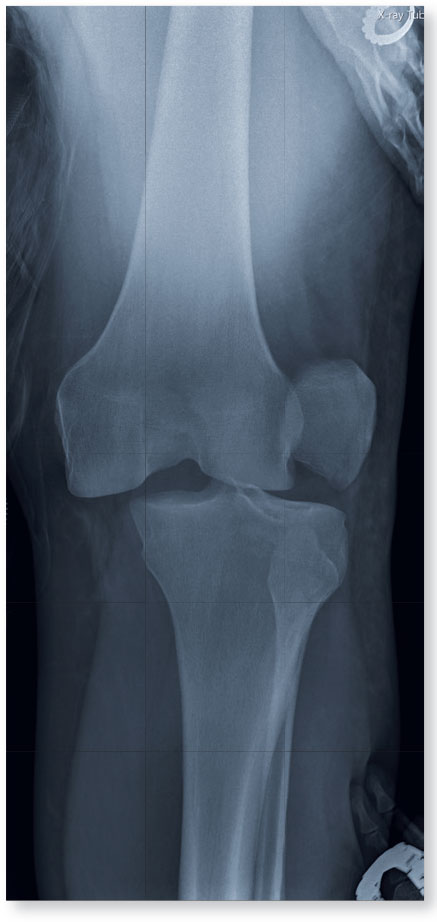
Diagnosis: The radiograph shows that the distal femur is medially dislocated relative to the tibial plateau. In addition, the patella is laterally dislocated. No obvious fractures are evident. Such injuries are typically associated with significant ligament injuries, especially of the medial collateral ligament (MCL), lateral collateral ligament (LCL), and anterior cruciate ligament (ACL). Orthopedics was consulted for reduction of the dislocation and further workup (including MRI of the knee).
For more information, see “Driver Partially Ejected From Vehicle.” Clinician Reviews. 2015;25(7):20,27.


