
Shingles Strikes With a Vengeance


Herpes zoster (HZ) is usually a straightforward clinical diagnosis. It can, however, be more difficult to identify in those likely to have atypical presentations—children, younger adults, and the immunocompromised. Can you tell which is HZ?
Match the diagnosis to the photo by letter
a. Irritant contact dermatitis
b. Impetigo
c. Herpes zoster ophthalmicus
d. Poison ivy
For answers, see next issue; for discussion, go to www.mdedge.com/clinicianreviews/articles/picture
4. A 58-year-old man seeks care for burning in his right eye and a skin eruption on his forehead and scalp with progressive worsening over the past 10 days. The patient has decreased vision in his right eye, as well as fever, chills, photophobia, and headache. A physical exam reveals vesicles on an erythematous base on his right scalp, forehead, upper and lower eyelids, dorsum of his nose, and cheek distributed along the ophthalmic branch of the trigeminal nerve.
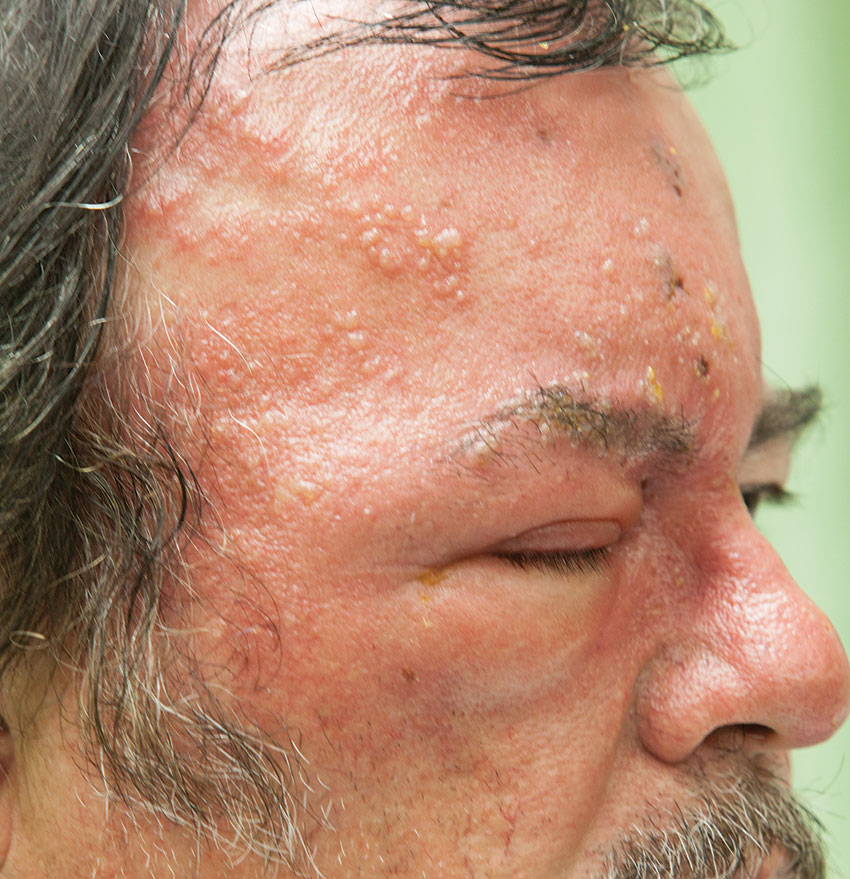
Diagnosis: Herpes zoster ophthalmicus, confirmed by an ophthalmologic exam. This serious condition has been linked to reactivation of the varicella-zoster virus (VZV) within the trigeminal ganglion. Primary infection with VZV results in varicella (chickenpox), whereas reactivation of a latent VZV infection within the sensory ganglia is known as herpes zoster.
For more information, see “Painful rash on face.” J Fam Pract. 2015;64(11):E1-E3.
RELATED ARTICLE
Jacobsen E, Hull CE. “Herpes Zoster Infection.” Clinician Reviews. 2013;23(8):42-49.


