
Ideas, but no easy way to ease intensivist shortage


The shortage of intensivists in the critical care game isn't shrinking. What's the best strategy to cope with the shortfall?
Alter the playing field and encourage more players, speakers suggested at a session at the recent Critical Care Congress in San Francisco.
A paper submitted for review by the journal Critical Care Medicine will propose that the Accreditation Council for Graduate Medical Education (ACGME) relax some "very restrictive mandates" on internal medicine-based critical care medicine training programs.
One hurdle requires the critical care medicine program's primary site to offer at least three out of five key fellowship programs. "That can be very difficult for many of the smaller programs that are not major academic centers, where they may not have things like fellowships in infectious diseases, nephrology, pulmonary, et cetera," said Dr. Stephen M. Pastores, FCCP, a lead author of the paper. Dr. Pastores is director of the critical care fellowship program at Memorial Sloan-Kettering Cancer Center, New York, and a board-certified internist, pulmonologist, and intensivist there.
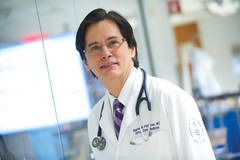
He cochaired a 20-person committee to create proposals for the Critical Care Societies Collaborative's task force on critical care educational pathways in internal medicine.
Another barrier excludes physicians who are not certified in internal medicine from being counted as key faculty in internal medicine-based critical care training programs. "In my program, we have anesthesiologists and surgeons who are teaching our fellows, and there's no good reason they shouldn't be counted as key faculty," Dr. Pastores said at the congress, sponsored by the Society for Critical Care Medicine.
He and Dr. Brian Wessman, who also spoke at the meeting, cited another ACGME barrier, this one blocking the pipeline of emergency medicine physicians. Internal medicine-based critical care medicine training programs must limit the proportion of emergency medicine trainees to 25% of their programs.
However, because their training already includes exposure to undifferentiated critical care patients and development of a "robust procedural acumen applicable to critical care," emergency medicine physicians are the ideal candidates for critical care medicine, Dr. Wessman, an emergency medicine physician and codirector of the critical care fellowship program at Washington University, St. Louis, said at the meeting.
The hospitalist option
Hospitalists are another logical option, particularly because often they are already performing critical care duties. "Even if not hired primarily for that, they're doing it anyway," said Dr. Andrew D. Auerbach, a hospitalist and researcher at the University of California, San Francisco. A 2010 study found that 34 of 72 open intensive care units in Michigan had hospitalists as ICU attending physicians (J. Hosp. Med. 2010;5:4-9). These included smaller hospitals outside major population centers, not just small community hospitals, he said at the meeting.
Intensivists could benefit by forging clinical partnerships with hospitalists to tap hospitalists' expertise in sepsis care, patient monitoring, antimicrobial stewardship, comanaging surgical patients, and transitioning patient care, he suggested.
"Hospitalists want to go into critical care medicine but have been at times in limbo because there is no pathway for them except to do the 2 years of fellowship training," Dr. Pastores agreed in a separate presentation. "We need to help our hospitalists get to the promised land of the ICU," either by creating a shortened training pathway or by offering new incentives.
Community hospitals that want more intensivists could pay for hospitalists to pursue fellowship training and guarantee intensivist jobs when training is finished, said Dr. Pastores.
Hospitals that are determined to have intensivists run the ICU might consider that approach, which could offset the hassle of leaving one's job and taking a temporary pay cut in order to pursue a critical care fellowship, Dr. Franklin A. Michota agreed in an interview. Or, they simply could offer higher salaries to recruit intensivists. "It's a supply-and-demand phenomenon," said Dr. Michota, director of academic affairs in the department of hospitalist medicine at the Cleveland Clinic.
Two years ago, the Society of Hospital Medicine and Society of Critical Care Medicine (SCCM) proposed a 1-year expedited training pathway for "experienced" hospitalists to achieve CCM certification through the ABIM, Dr. Pastores and associates noted in a recent viewpoint article (Crit. Care Med. 2013;41:2754-61).
The proposal was met with deep skepticism by many in the chest physician community. Today, the concept is held by SCCM as a stepping stone toward a much-needed solution to a well-acknowledged problem.
In an interview, SCCM president Dr. Chris Farmer spoke to the issue broadly and with care: "There are not enough intensivists to fill the gap. Many hospitalists currently work in this capacity, and we need to work for longer-term solutions."

