
Biomechanical Evaluation of a Novel Suture Augment in Patella Fixation


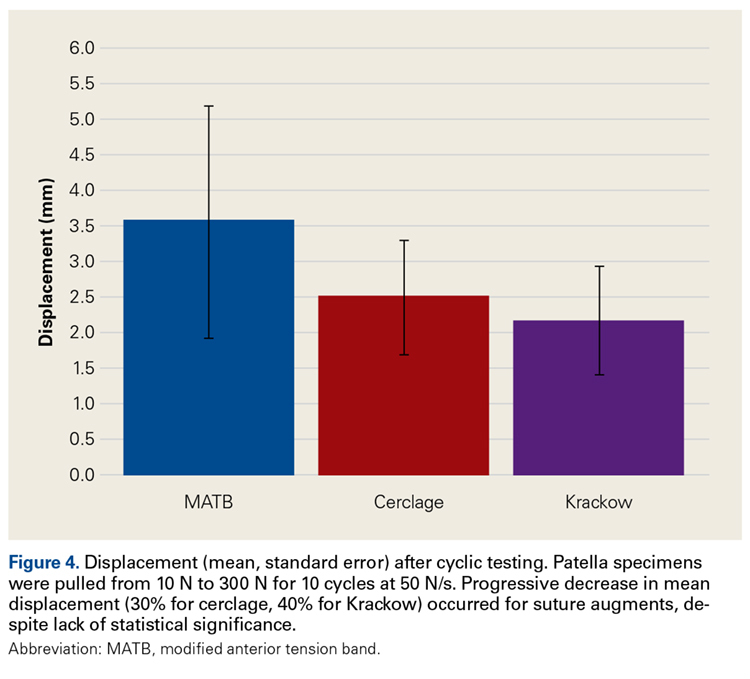
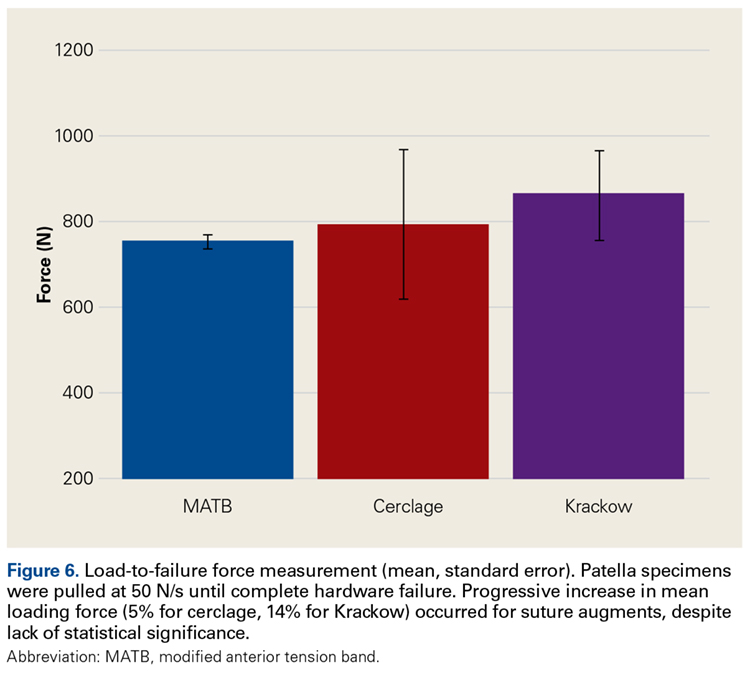
Patella fractures, although uncommon in the context of corresponding long bone fractures, carry a disproportionately high degree of morbidity, and are often challenging to treat. As such, this study sought to evaluate the efficacy of a Krackow suture augment when compared to standard tension band fixation and cerclage suture augment in patella fracture repair. Cadaveric patella extensor mechanisms were used for biomechanical testing. Specimens were divided among 3 groups, each with a different repair technique: modified anterior tension band (MATB), MATB plus cerclage suture, and MATB plus Krackow suture. Specimens were biomechanically tested in both cyclic and maximum load settings. Mean displacement and load-to-failure forces were measured for cyclic and maximum load testing, respectively. Data was then analyzed with both one-way analysis of variance and independent t-testing. Both augmentation techniques showed improved strength in both cyclic and maximum load testing, with the Krackow suture augment showing the greatest strength. In cyclic testing, cerclage augment showed a 30% decrease in mean displacement while Krackow suture augment showed a 40% decrease when compared to the MATB repair group. Likewise, in maximum load testing, cerclage repair showed a 5% increase and Krackow a 14% increase in load-to-failure force when compared to MATB. Likely due to small sample size, the increases in repair strength did not reach statistical significance. This study provides support for the use of a Krackow suture augment in patella fracture repair, and we suggest this technique may be most useful in the setting of poor bone quality where conventional repair techniques are limited. Although failing to reach statistical significance, these results are encouraging and warrant further investigation in both biomechanical and clinical settings.
Results
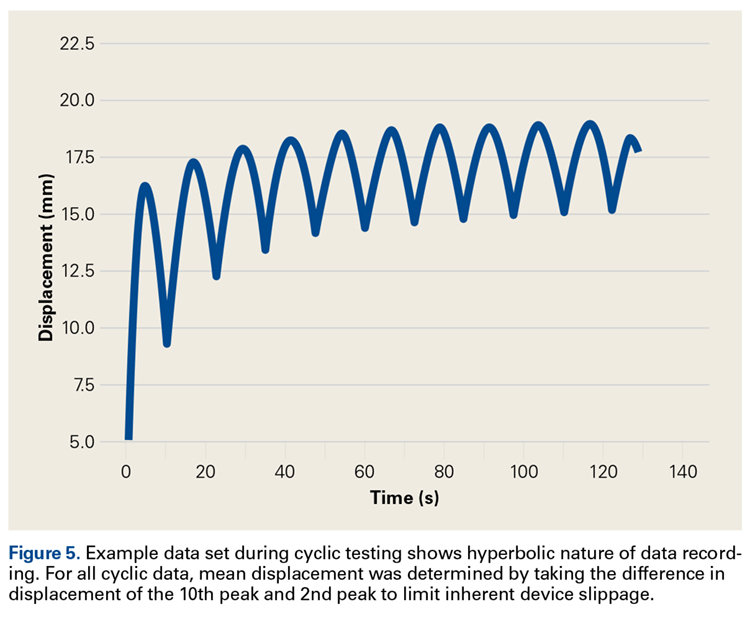
For cyclic testing, mean total displacement was measured over 10 cycles for each group. Again, displacement was determined by taking the difference between 10th cycle and 2nd cycle values, allowing for system stabilization.
Discussion
Our main objective was to compare the efficacy of a novel suture augment technique with that of other patella fracture repair techniques. Our hypothesis—that adding a Krackow suture augment would increase strength in both cyclic and maximum loading—was supported. Although testing results were not statistically significant because of the small sample size, we think this novel technique has clinically relevant descriptive significance and warrants further investigation.
Proper anatomical reduction and postoperative stabilization are of utmost importance in clinical approaches to patella fractures. In addition, regardless of which technical procedure is used, open reduction should also allow for early range of motion to prevent joint arthrofibrosis. Ever since the ATB technique was first described by the AO group, postoperative outcomes have improved significantly. In a retrospective study by Levack and colleagues,17 30 of 64 patients with patella fractures underwent internal fixation. Mean follow-up was 6.2 years. By both objective and subjective measures, the best functional outcomes were associated with internal tension band fixation (vs cerclage repair). Lotke and Ecker18 also documented the efficacy of the tension band technique. Sixteen patients with patella fractures underwent anterior tension banding; those with a comminuted fracture also underwent cerclage repair for patella stabilization during tension banding. At 6-week follow-up, all patients had good range of motion (≥90° flexion), relatively few symptoms, and no implant failures. Results were similar to those of Levack and colleagues.17
Although it improves stability and functional outcomes over conventional patellectomy and cerclage wiring, the ATB technique has been associated with subcutaneous irritation caused by the K-wires used to secure the band. Hung and colleagues9 followed up 68 patients with patellar fractures. Five of these patients underwent tension banding. Although there was a high level of adequate functional outcomes, implant irritation was found to be “quite frequent.”
To address this issue, Carpenter and colleagues11 evaluated an ATB technique that uses K-wires instead of cannulated screws. Biomechanical testing in a cadaver model revealed less fracture displacement and overall more repair strength through cyclic and maximum load testing. Clinically, these results were supported by Berg,10 who followed up 10 patients with transverse patella fractures repaired with the MATB technique. At a mean follow-up of 24 months, 7 of the 10 patients had good to excellent outcomes, and there were no implant failures.


