
Acute Bacterial Sinusitis in Children: Evaluation and Treatment


Frequently encountered in primary care, acute bacterial sinusitis (ABS) occurs in about 6% to 7% of children with upper respiratory symptoms. Challenging to accurately diagnose and appropriately treat, this condition can be costly in terms of direct health care and patient comfort. Our expert provides an update on the management of ABS in children ages 1 year and older.
PHYSICAL FINDINGS
Physical exam findings are not sufficient to distinguish between viral URI and ABS.1,3,5 Typical findings on examination may include nasal congestion, postnasal drip, erythematous turbinates, and/or injected posterior oropharynx. Malodorous breath may be present but is not diagnostic.3,5 The tympanic membranes should be examined for signs of concomitant acute otitis media (AOM) or otitis media with effusion. Swelling of the eyelids may be present. Facial pain may also be noted on physical exam.3
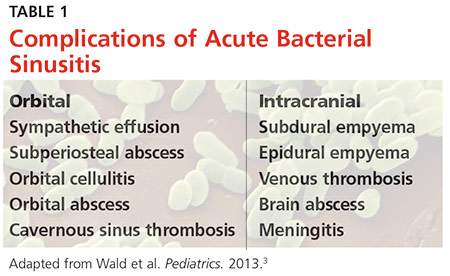
Clinicians should be mindful of the complications of sinusitis when performing the physical examination (see Table 1). The most common complications of ABS are orbital and may manifest with eyelid swelling, proptosis, or decreased extraocular movements. Patients with intracranial complications may present with headache, photophobia, seizure, meningeal signs, or focal neurologic signs.3
Continue to making the diagnosis >>


