
Preoperative evaluation of the lung resection candidate


ABSTRACTLung resection provides the greatest likelihood of cure for patients with localized lung cancer, but is associated with a risk of mortality, decreased postoperative lung function, and other complications. Lung function testing using spirometry, diffusing capacity of the lung for carbon monoxide, and peak oxygen consumption helps predict the risk of postoperative complications including mortality. Predicting postoperative lung function using the proportion of lung segments to be resected, radionuclide scanning, or other methods is important for assessing surgical risk. The American College of Chest Physicians, the European Respiratory Society/European Society of Thoracic Surgeons and the British Thoracic Society guidelines provide detailed algorithms for preoperative risk assessment, but their recommended approaches differ somewhat. Smoking cessation and pulmonary rehabilitation are perioperative measures that can improve patients’ the short- and long-term outcomes.
PREDICTING POSTOPERATIVE LUNG FUNCTION
Several methods have been used to predict postoperative lung function.
Segment method
The segment method estimates postoperative lung function by multiplying baseline function by the percentage of lung sections that will remain after resection.30 For example, if preoperative FEV1 is 1 L and surgery will result in the loss of 25% of lung segments, the predicted postoperative FEV1 is 750 mL. In a study using 19 lung segments in the calculation, the predicted postoperative lung function correlated well with actual postoperative lung function for patients undergoing lobectomy, but only modestly for patients undergoing pneumonectomy.30 Another method using 42 subsegments for the calculation, and correcting for segments that were obstructed by tumor, produced very similar results.31
Radionuclide scanning
In other studies, quantitative radionuclide scanning to identify the proportion of lung with poor perfusion produced fair to good correlations between predicted and actual postoperative FEV1.32–35 Techniques that are used less often include quantitative computed tomography (CT) and measurement of airway vibration during respiration.
Studies comparing different methods for predicting postoperative pulmonary function have found that perfusion imaging outperformed other approaches, and that the segment method is not a good predictor of outcome for patients undergoing pneumonectomy.17,36
Additional testing needed
For potential lung resection patients, the ACCP guidelines recommend that if either the FEV1 or Dlco is less than 80% of the predicted value, postoperative lung function should be predicted through additional testing.27 The ERS recommends that predicted postoperative FEV1 should not be used alone to select lung cancer patients for lung resection, especially those with moderate to severe COPD.28 These guidelines also recommend that the first estimate of residual lung function should be calculated based on segment counting, that only segments not totally obstructed should be counted, and that the patency of bronchus and segment structure should be preserved. In addition, patients with borderline function should undergo imaging-based calculation of residual lung function, including ventilation or perfusion scintigraphy before pneumonectomy, or quantitative CT scan before either lobectomy or pneumonectomy.28 The BTS recommends the use of segment counting to estimate postoperative lung function as part of risk assessment for postoperative dyspnea. Ventilation or perfusion scintigraphy should be considered to predict postoperative lung function if a ventilation or perfusion mismatch is suspected. Quantitative CT or MRI may be considered to predict postoperative lung function if the facility is available.29
Predicting mortality and complications: FEV1 and Dlco
The predicted postoperative FEV1 value is an independent predictor of postoperative mortality and other complications. Although there is no absolute cut-off value, studies identify an increased risk of complications below predicted postoperative FEV1 values ranging from 30%37 to 40%.38,39 Predicted postoperative Dlco is another outcome measure that can independently identify increased mortality risk in lung cancer resection patients. Dlco less than 40% has been associated with increased risk of postoperative respiratory complications even in those with predicted postoperative FEV1 values above 40%.26,39 One study stated that a combination of the two values, predicted postoperative FEV1 and predicted postoperative Dlco—called the predicted postoperative product (PPP)—is the best predictor of surgical mortality.40 Another study examined the utility of a prediction rule for pulmonary complications after lung surgery using a point system in which points were assigned based on predicted postoperative Dlco (1 point for each 5% decrement below 100%) plus 2 points for preoperative chemotherapy.41 The risk of complications was 9% for those with scores less than 11, 14% for those with scores of 11 to 13, and 26% for those with scores greater than 13.
When surgery is considered, ACCP guidelines state an increased risk of perioperative mortality in those lung cancer patients with either a PPP less than 1,650, or a predicted postoperative FEV1 less than 30%.27 These patients should be counseled about nonstandard surgery and nonsurgical treatment options. The ERS guidelines consider a predicted postoperative FEV1 value less than 30% to be a high-risk threshold when assessing pulmonary reserve before surgery.28
EXERCISE TESTING
In general, standardized cardiopulmonary exercise testing using VO2 peak has been shown to predict postoperative complications, including perioperative and long-term morbidity and mortality.42,43 Lower values are associated with a greater risk of poor outcome. Peak VO2 may not add significantly to the risk stratification of patients who have both FEV1 and Dlco values greater than 80%.44
According to ACCP recommendations for exercise testing in patients who are being evaluated for surgery, either an FEV1 or Dlco less than 40% of predicted postoperative (PPO) indicates increased risk for perioperative death and cardiopulmonary complications with standard lung resection. Preoperative exercise testing is recommended for these patients.27 Maximal oxygen consumption (VO2 max) less than 10 mL/kg/min, or the combination of VO2 max less than 15 mL/kg/min with both FEV1 and Dlco less than 40% PPO, also indicates increased risk for death and complications; these patients should be counseled about nonstandard surgery or nonsurgical treatment options. Guidelines from the ERS recommend exercise testing for all patients undergoing lung cancer surgery who have FEV1 or Dlco less than 80% of normal values.28 The VO2 peak measured during incremental exercise on a treadmill or cycle should be regarded as the most important parameter.
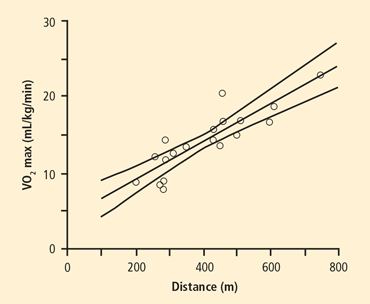
Several studies have found that distance traveled during walking tests predicts postoperative complications and can be related to VO2 max (Figure).45 According to ACCP guidelines, lung cancer patients who are potential candidates for standard lung resection are at increased risk for perioperative death and cardiopulmonary complications if they walk less than 25 shuttles on 2 shuttle walk tests or less than 1 flight of stairs. These patients should be counseled about nonstandard surgery and nonsurgical treatment options.27
Conversely, ERS/ESTS guidelines state that the shuttle walk test distance underestimates exercise capacity at the lower range, and does not discriminate between patients with and without complications.28 These guidelines state that shuttle walk test distance should not be used alone to select patients for resection. It may be used as a screening test, since patients walking less than 400 m are likely to also have VO2 peak less than 15 mL/kg/min. A standardized symptom-limited stair climbing test can be a cost-effective screening method to identify those who need more sophisticated exercise tests in order to optimize their perioperative management. The 6-minute walk test is not recommended.
British Thoracic Society guidelines recommend the use of the shuttle walk test as a functional assessment in patients with moderate to high risk of postoperative dyspnea.29 A distance walk of more than 400 m is recommended as a cutoff for acceptable pulmonary function. These guidelines recommend against using pulmonary function and exercise tests as the sole surrogates for a quality of life evaluation.


