Hazem Antar Mashaly, MD Neuroinflammation Research Center, Lerner Research Institute, and Department of Neurosurgery, Neurological Institute, Cleveland Clinic, Cleveland, OH
J. Javier Provencio, MD Neuroinflammation Research Center, Lerner Research Institute; Cerebrovascular Center, Neurological Institute; and Associate Director for Research, Bakken Heart-Brain Institute, Cleveland Clinic, Cleveland, OH
Correspondence: J. Javier Provencio, MD, Cerebrovascular Center, Neurological Institute, Cleveland Clinic, 9500 Euclid Avenue, S90, Cleveland, OH 44195; provenj@ccf.org
*This article is based on an adaptation and update of Dr. Provencio’s lecture at the 2006 Heart-Brain Summit; accordingly, this article is an updated adaptation of his publication in the proceedings of the 2006 Heart-Brain Summit (Provencio JJ. Subarachnoid hemorrhage: A good model for heart-brain interactions. Cleve Clin J Med 2007; 74[Suppl 1]:S86–S90.).
Both authors reported that they have no financial relationships that pose a potential conflict of interest with this article.
ABSTRACT
Subarachnoid hemorrhage (SAH) serves as a good model for the study of heart-brain interactions because it is associated with both a high incidence of arrhythmia and a low prevalence of coronary heart disease. The pathophysiology of cardiac abnormalities in SAH is unsettled. Initial theories focused on sustained stimulation of cardiomyocytes at sympathetic nerve endings, but recent data suggest that dysfunction of the parasympathetic nervous system may contribute as well. We believe that the coupling of catecholamine release with parasympathetic dysfunction may allow unchecked inflammation that leads to myocardial dysfunction and cell death. We have developed a novel murine model of SAH to explore these potential inflammatory underpinnings of cardiac damage in SAH.
A MODEL FOR SUBARACHNOID HEMORRHAGE
A murine model of SAH offers a number of advantages for studying the inflammatory underpinnings of cardiomyopathy. First, many of the immunological reagents needed to evaluate this problem are more easily available in mouse than in other species. Second, there are genetic manipulations of the inflammatory system that are more readily possible in mouse than in other species. Finally, at our institution, we have normative echocardiographic data that are better developed in the mouse than in other species.
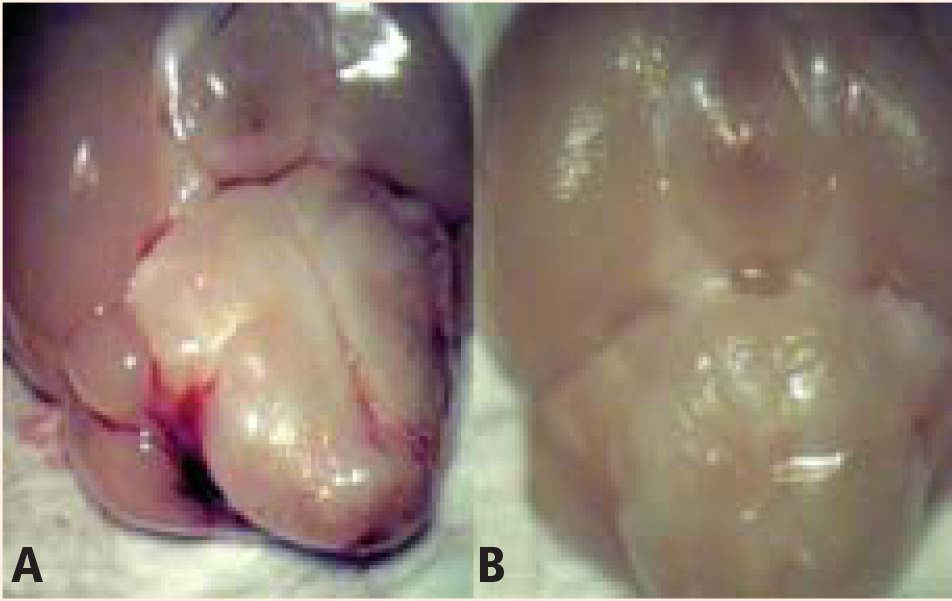
Figure 2. Development of subarachnoid hemorrhage in the mouse. Panel A shows the ventral view of the brain of an animal with a subarachnoid hemorrhage; note the blood in the pontocerebellar angle. Panel B shows an animal given a saline injection to the subarachnoid space.
We are in the process of developing a murine model of SAH and characterizing the cardiac effects. Our hope is that this model will allow us to investigate the mechanism of cardiac damage in SAH. Our preliminary work shows that we can develop consistent SAH in mice with low mortality (Figure 2).
A NEW MODEL FOR BRAIN-HEART INTERACTION
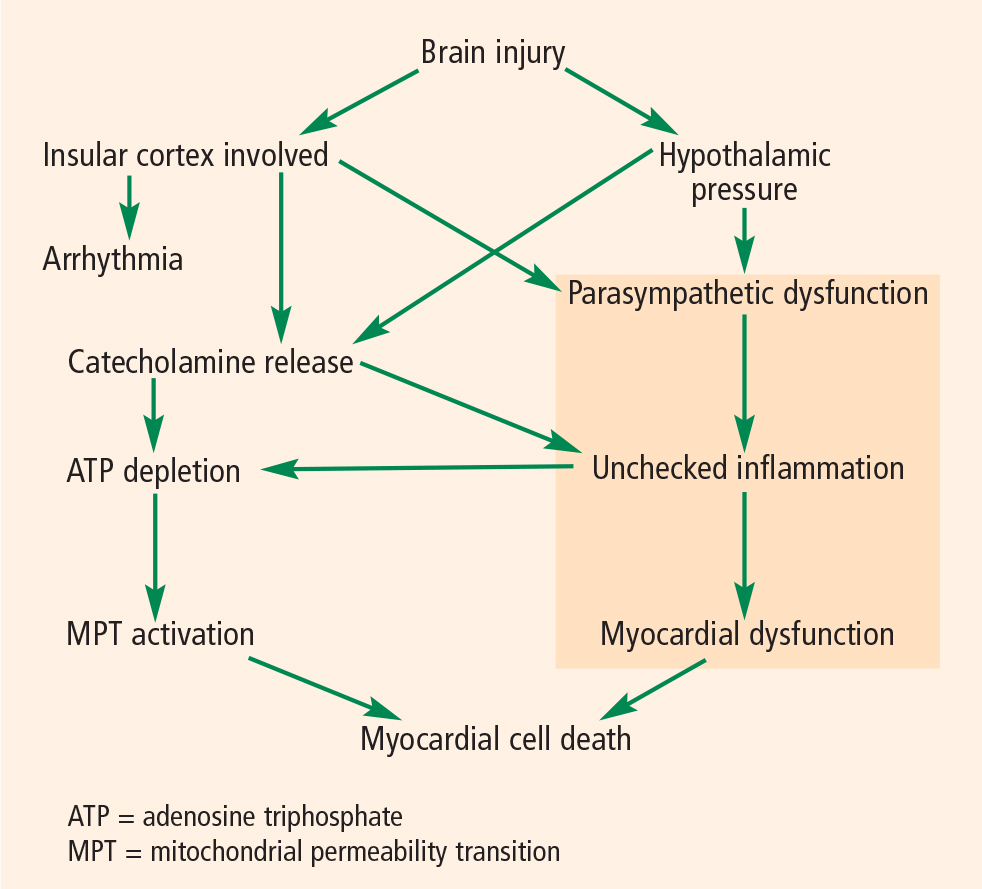
Figure 3. A new model of heart-brain interaction based on combined sympathetic hyperactivity and parasympathetic dysfunction (shaded area).
Recent data have prompted us to rethink the previous model of the mechanisms of cardiac injury from SAH. We believe that parasympathetic dysfunction may also play a role and, coupled with catecholamine release, may allow unchecked inflammation, which leads to myocardial dysfunction and cell death (Figure 3).
We hope that with better understanding of these two processes—ie, parasympathetic dysfunction and catecholamine release—we will be able to mitigate harm to the heart. If agents can be found that suppress sympathetic activation or heighten parasympathetic activation, it might be possible to improve outcomes in patients with SAH. This line of research will likely shape future efforts to further understand the pathophysiology of cardiac damage after brain injury and identify targets for clinical intervention.