
Update on constipation: One treatment does not fit all


ABSTRACTConstipation is a common clinical problem that can be difficult to manage. It has a variety of identifiable causes, but even idiopathic constipation has different possible mechanisms. Often, the key to improvement and patient satisfaction is to understand the mechanism and the patient.
KEY POINTS
- A high-fiber diet often improves functional constipation, but it may worsen slow-transit constipation or dyssynergia (a failure of the pelvic floor muscles to relax). Nevertheless, fiber remains a mainstay of treatment for its ability to provide homogeneous stool consistency.
- Drugs approved for treating constipation increase fluid in the lumen, speed intestinal transit, and improve stool consistency, while tegaserod (Zelnorm) additionally acts as a serotonin agonist.
- Colonoscopy and other tests are reserved for patients with refractory constipation and those with symptoms suggesting colon cancer.
- Prebiotics (short-chain carbohydrates that stimulate activity of beneficial colonic bacterial flora) and probiotics (live bacterial preparations) are under evaluation as treatments for chronic constipation.
NEUROTRANSMITTERS MAY PLAY A ROLE
Among the mechanisms thought to cause chronic constipation are impaired gastrointestinal motility,19–22 reduced intestinal secretions,21–23 and inadequate reflex relaxation of the pelvic floor muscles.22,24
Neurotransmitters such as serotonin, somatostatin, peptide YY, and vasoactive intestinal peptide affect intestinal secretion and motility.25,26 Hyperactivity of these neurotransmitters associated with increased secretion and motility results in diarrhea, whereas hypoactivity leads to decreased secretion, delayed transit, and constipation.23
Serotonin has a role in regulating visceral pain perception and intestinal motility, as well as secretion.26–28 Clinical trials have shown that activation of serotonin receptors in the gut enhances gastrointestinal motility, inhibits visceral sensitivity, and stimulates intestinal secretion.26,27,29
A hypothesis has recently been proposed that degeneration of enteric neurons may also play a role in the development of severe idiopathic constipation.30
DIAGNOSIS IS MOSTLY CLINICAL
The history and physical examination remain the cornerstones in the diagnosis and subsequent treatment of chronic constipation.
History
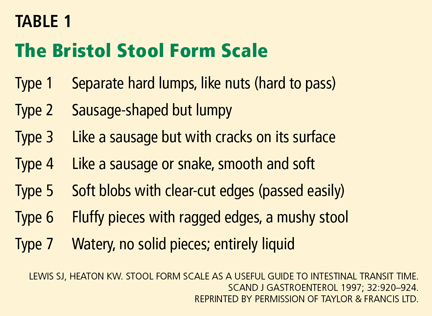
Risk factors for primary and secondary constipation to note during the interview include age (< 4 years, > 65 years); low-fiber diet; female sex; lack of physical activity; history of childhood constipation, endocrine and neuromuscular disorders, abuse, depression, or anxiety; family history of cancer; and personal history of pelvic surgery.
Since drugs can also cause chronic constipation, especially in elderly or immobile patients, medication lists should be reviewed and adjustments should be made if necessary (or possible) before recommending laxatives or invasive testing, if no alarm signs are present.
Alarm signs such as weight loss, hematochezia, melena, change in bowel habits, and symptoms refractory to therapy may represent colon cancer and indicate the need for early diagnostic testing.
Physical examination
Physical examination should always include inspection of the perianal area for evidence of hemorrhoids or fissures. Digital rectal examination may reveal a contracted sphincter or a puborectalis muscle that contracts with the Valsalva maneuver, suggesting dysfunction.
Laboratory testing
If the history and physical examination suggest that the constipation may be secondary, or if the patient is 50 years of age or older, then laboratory studies such as a complete blood cell count, serum electrolyte levels, blood sugar level, and thyroid function studies may help rule out a metabolic, endocrine, or organic cause.
Colonoscopy, other tests
At present, little evidence suggests that routine testing is warranted in patients without evidence of secondary constipation and without alarm signs. However, diagnostic studies are indicated in patients 50 years of age and older, as well as in those with alarm symptoms such as hematochezia, anemia, a positive fecal occult blood test, unintentional loss of more than 10 pounds, family history of colon cancer or inflammatory bowel disease, fever, nausea, vomiting, acute onset (especially in the elderly), and lack of improvement with conventional therapies regardless of age.2
The full length of the colon should be inspected by colonoscopy or by flexible sigmoidoscopy paired with a barium enema study to rule out structural disease. Of note, all patients 50 years of age or older should be screened for colon cancer.
If the patient does not respond to therapy, further tests such as colonic transit studies, anorectal manometry with balloon expulsion, and, possibly, defecating proctography or dynamic pelvic magnetic resonance imaging may be considered. These patients would likely also benefit from referral to a gastroenterologist for further management
DIET AND LIFESTYLE AS TREATMENT
For many years, health care providers have provided reassurance and recommended diet and lifestyle modifications as treatment for constipation. Increased water intake, increased activity, and a scheduled attempt at defecation when motor activity in the colon is highest, ie, in the morning or after eating, have all been recommended.
Data on the efficacy of these recommendations are scarce and often contradictory. Studies have shown that increasing water intake or daily exercise is not always helpful.32–34 Nevertheless, many patients who comply with dietary and exercise recommendations have improvement in symptoms. Eating fewer meals per day (and hence taking in fewer calories) has been shown to be associated with constipation in the elderly. However, no relationships between fiber or fluid intake and constipation were noted.35
In a study in which chronically constipated patients were fed a standardized diet that contained 25 g of fiber a day, stool frequency increased significantly and laxative use decreased.36 While on a high-fiber diet, the patients were divided into two groups, one that drank 1.1 L of fluid per day and one that drank 2.1 L of mineral water per day. Both groups experienced further improvements in stool frequency and decreases in laxative use, with the mineral-water group benefiting the most.36
Recently, Murakami and others37 found, in a cross-sectional study in young Japanese women with low daily fiber intake (6.4 g/day), that low water intake from foods and low magnesium intake were associated with an increasing prevalence of functional constipation as defined by the Rome III criteria. Constipation was also found to be significantly associated with low intake of fruits and vegetables in a study from Singapore.38
Moderate physical activity and high fiber intake may be associated with a lower prevalence of constipation in women. In the Nurses’ Health Study, more than 62,000 women between the ages of 36 and 61 were surveyed, and those who said they engaged in daily physical activity had a lower prevalence of constipation (prevalence ratio [PR] = 0.56, 95% confidence interval [CI] 0.44–0.70), as did those with a median fiber intake of 20 g/day (PR = 0.64, 95% CI 0.57–0.73).39


