
Implementing Pediatric Asthma Pathways in Community Hospitals: A National Qualitative Study


BACKGROUND: Pathways can improve the quality of care and outcomes for children with asthma; however, we know little about how to successfully implement pathways across diverse hospital settings. Prior studies of pathways have focused on determining clinical effectiveness and the majority were conducted in children’s hospitals. These approaches have left crucial gaps in our understanding of how to successfully implement pathways in community hospitals, where most of the children with asthma are treated nationally.
OBJECTIVE: The aim of this study was to identify the key determinants of successful pediatric asthma pathway implementation in community hospitals.
METHODS: We conducted a qualitative study of healthcare providers that served as project leaders in a national collaborative to improve pediatric asthma care. Data were collected by recording semi-structured discussions between project leaders and external facilitators (EF) from December 2017 to April 2018. Using inductive thematic analysis, we identified the themes that describe the key determinants of pathway implementation.
RESULTS: Project leaders (n = 32) from 18 hospitals participated in this study. The key determinants of pathway implementation in community hospitals included (1) building an implementation infrastructure (eg, forming a team of local champions, modifying clinical workflows, delivering education/skills training), (2) engaging and motivating providers (eg, obtaining project buy-in, facilitating multidisciplinary collaboration, handling conflict), (3) addressing organizational and resource limitations (eg, support for electronic medical record integration), and (4) devising implementation solutions with EFs (eg, potential workflow modifications).
CONCLUSIONS: Our identification of the key determinants of pathway implementation may help guide pediatric quality improvement efforts in community hospitals. EFs may play an important role in successfully implementing pathways in community settings.
© 2020 Society of Hospital Medicine
Building an Implementation Infrastructure
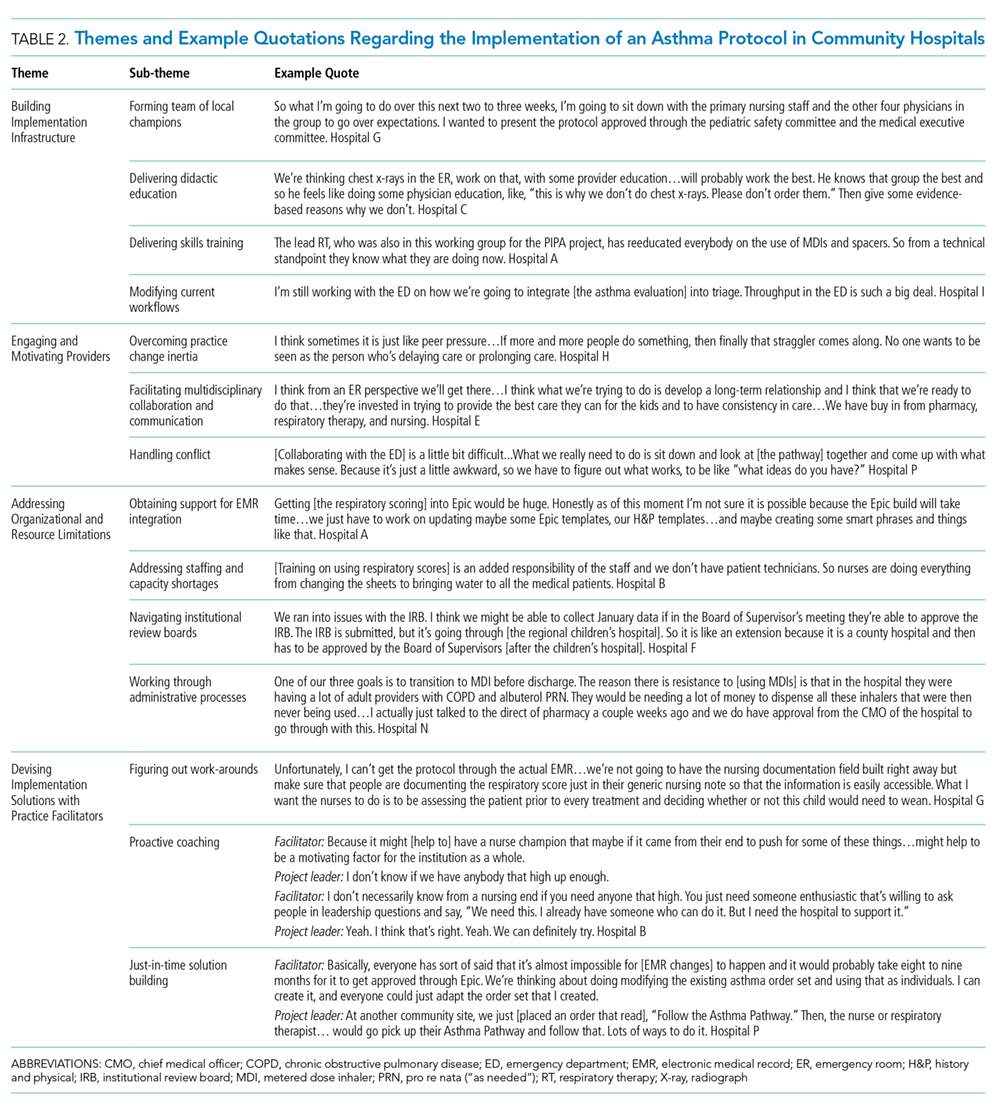
“So, I’m going to sit down with the primary nursing staff and the other four physicians in the group to go over the expectations…We’re not going to have the actual EMR [changes] and we’re not going to have the nursing documentation field built right away but [we want to] make sure that people are documenting the respiratory score in their generic nursing note so that the information is easily accessible.” (Physician leader, Hospital G)
Participants also described the need to deliver education on the evidence supporting changes in practice and skills training specific to pediatric asthma care:
“Once we realized that we were going to be doing this pathway, we started training our nurses on the inpatient side on [pediatric respiratory scoring].” (Nursing leader, Hospital P)
In addition, pathway implementation required modification of clinical workflows via changes to hospital policies or guidelines, electronic medical records (EMR), and/or the physical environment (eg, placing supplies in proximity to care delivery):
“I think it can help if we could get an order set or a nursing protocol where asthmatics over a certain severity can just get steroids in triage.” (Physician leader, Hospital A)
Engaging and Motivating Providers
Another crucial step in pathway implementation was engaging and motivating providers. This included overcoming inertia to practice change, facilitating multidisciplinary collaboration, and handling conflicts regarding practice changes. Participants discussed the excitement of participating in a national collaborative as especially motivating to help drive engagement and overcome barriers to change, particularly the ability to compare local hospital performance to national peers.
“I think everyone is a little competitive. So I think that when we see how we compare to other institutions—both our group and the ER—I think it also adds a little oomph…I think for our nurses too; we’re able to say, ‘[look how we compare to] most of the other hospitals.’ I think that helps.” (Physician leader, Hospital B)
Multidisciplinary collaboration across a wide variety of frontline pediatric and nonpediatric providers was key to understanding current workflows and identifying needed modifications for pathway implementation:
“I do think clearly our biggest obstacles are the fact that we have adult ED providers. We have the opportunity on the inpatient side [with nursing and respiratory therapy], who really do awesome with pediatric changes, to take our wins where we can and make the changes with the ED. In the ED we have an RN educator. She’s very on board with doing the respiratory scoring and getting this whole thing started.” (Physician leader, Hospital L)


