
Screening for Humoral Immunodeficiency in Patients with Community-Acquired Pneumonia


BACKGROUND: Immunodeficiency is an underrecognized risk factor for infections, such as community-acquired pneumonia (CAP).
OBJECTIVE: We evaluated patients admitted with CAP for humoral immunodeficiency.
DESIGN: Prospective cohort study.
SETTING: Inpatients
PATIENTS, INTERVENTION, AND MEASUREMENTS: We enrolled 100 consecutive patients admitted with a diagnosis of CAP from February 2017 to April 2017. Serum IgG, IgM, IgA, and IgE levels were obtained within the first 24 hours of admission. CURB-65 score and length of hospital stay were calculated. The Wilcoxon rank-sum test, Kruskal-Wallis test, and simple linear regression analysis were used in data analysis.
RESULTS: The prevalence of hypogammaglobinemia in patients with CAP was 38% (95% CI: 28.47% to 48.25%). Twenty-seven of 100 patients had IgG hypogammaglobinemia (median: 598 mg/dL, IQ range: 459-654), 23 of 100 had IgM hypogammaglobinemia (median: 38 mg/dL, IQ range: 25-43), and 6 of 100 had IgA hypogammaglobinemia (median: 36 mg/dL, IQ range: 18-50). The median hospital length of stay for patients with IgG hypogammaglobinemia was significantly higher when compared to patients with normal IgG levels (five days, IQ range [3-10] vs three days, IQ range [2-5], P = .0085). Fourteen patients underwent further immune evaluation, resulting in one diagnosis of multiple myeloma, three patients diagnosed with specific antibody deficiency, and one patient diagnosed with selective IgA deficiency.
CONCLUSION: There is a high prevalence of hypogammaglobinemia in patients hospitalized with CAP, with IgG and IgM being the most commonly affected classes. IgG hypogammaglobinemia was associated with an increased length of hospitalization. Screening immunoglobulin levels in CAP patients may also uncover underlying humoral immunodeficiency or immuno-proliferative disorders.
© 2018 Society of Hospital Medicine
RESULTS
Baseline Characteristics
There were 100 patients with CAP enrolled in this study with a median age of 65.04 ± 18.8, and 53% were female. Forty-seven patients reported a previous history of pneumonia and 18 reported a history of recurrent sinusitis or otitis media. Of the 100 enrolled patients, 46 had received pneumococcal polysaccharide vaccine (PPV23), 26 had received the 13-valent pneumococcal conjugate vaccine (PCV13), and 22 had received both (Table 1). The mean white blood cell count on admission was 12.9 ± 7 × 10³/uL with 75 ± 12.5% neutrophils. Total protein (6.5 ± 0.8) and albumin (3.7 ± 0.5) were within the normal range for the study population.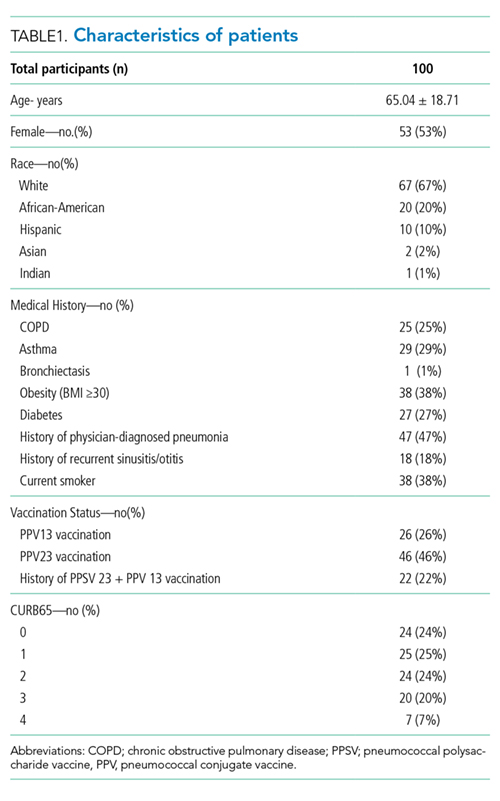
Immunoglobulin Analyses
The prevalence of hypogammaglobinemia in the study was 38% (95% CI: 28.47% to 48.25%). The median values of Ig levels for the entire study population and in patients with hypogammaglobinemia are summarized in Table 2.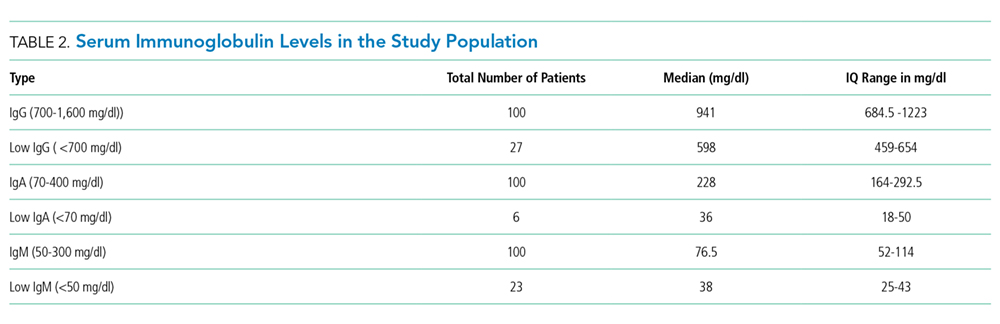
- IgG hypogammaglobinemia (<700 mg/dl) was found in 27/100 patients, with a median level of 598 mg/dL, IQ range: 459-654. The median age in this group was 76.5 years, and 13 were female. Of these 27 patients, 10 had low IgM, four had low IgA, and four had an elevated IgE. In this group, 11 patients had received PPSV23, nine had received PCV13, and six had received both PPV23 and PCV13 before the index hospital admission.
- IgG hypergammaglobinemia (>1,600 mg/dl) was found in 9/100 patients, with a median level of 1,381 mg/dL, IQ range: 1,237-1,627. The median age was 61 years, and six were female. Of these nine patients, three had low IgM, one had low IgA, and four had elevated IgE.
- IgM hypogammaglobinemia (<50 mg/dl) was found in 23/100 patients with a median level of 38 mg/dL, IQ range: 25-43. In this group, the median age was 69 years, and 10 were female. Of these 23 patients, 10 had low IgG, and three had an elevated IgG.
- IgM hypergammaglobinemia (>300 mg/dl) was noted in two patients, with a median level of 491 mg/dL, IQ range: 418-564. Both patients were female, and one had elevated IgG.
- IgA hypogammaglobinemia (<70 mg/dl) was discovered in six patients, with a median level of 36 mg/dL, IQ range: 18-50. In this group, four patients had low IgG, four had low IgM, one had elevated IgE, and one had elevated IgG.
- IgA hypergammaglobinemia (>400 mg/dl) was noted in five patients, with a median level of 561 mg/dL, IQ range: 442-565: Two patients were female. Of these five patients, one had high IgG, and one had low IgG.
Length of Stay and Severity of Pneumonia
The median length of stay in the hospital for the entire study population was three days (IQ range: 2-5.5 days). Among patients with IgG hypogammaglobinemia, the median length of stay was two days longer as compared with patients who had IgG levels in the normal range (5 days, IQ range [3-10] vs 3days, IQ range [2-5], P = .0085).


