The Pipeline From Abstract Presentation to Publication in Pediatric Hospital Medicine


BACKGROUND: The annual Pediatric Hospital Medicine (PHM) conference serves as a venue for the dissemination of research in this rapidly growing discipline. A measure of research validity is subsequent publication in peer-reviewed journals.
OBJECTIVE: To identify the publication rate of abstracts submitted to the 2014 PHM conference and determine whether presentation format was associated with subsequent journal publication or time to publication.
METHODS: We identified abstracts submitted to the 2014 PHM conference. Presentation formats included rejected abstracts and poster and oral presentations. Abstracts subsequently published in journals were identified by searching the author and abstract title in PubMed, MedEdPORTAL, and Google Scholar. We used logistic regression and Cox proportional hazards models to determine if presentation format was associated with publication, time to publication, and publishing journal impact factor.
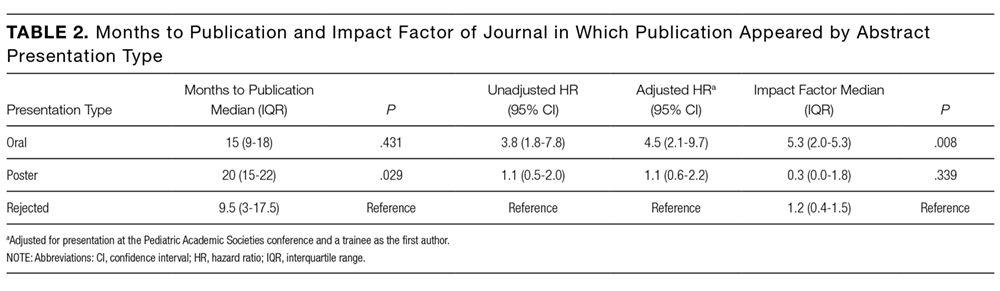
RESULTS: Of 226 submitted abstracts, 19.0% were rejected, 68.0% were selected for posters, and 12.8% were selected for oral presentations; 36.3% were subsequently published within 30 months after the conference. Abstracts accepted for oral presentation had more than 7-fold greater odds of publication (adjusted odds ratio 7.8; 95% confidence interval [CI], 2.6-23.5) and a 4-fold greater likelihood of publication at each month (adjusted hazard ratio 4.5; 95% CI, 2.1-9.7) compared with rejected abstracts. Median journal impact factor was significantly higher for oral presentations than other presentation formats (P < 0.01).
CONCLUSIONS: Abstract reviewers may be able to identify methodologically sound studies for presentation; however, the low overall publication rate may indicate that presented results are preliminary or signify a need for increased mentorship and resources for research development in PHM.
© 2018 Society of Hospital Medicine
Main Outcome Measures
All submissions were assessed for subsequent publication in peer-reviewed journals through January 2017 (30 months following the July 2014 PHM conference). To identify abstracts that went on to full publication, 2 authors (JC and LEH) independently searched for the lead author’s name and the presentation title in PubMed, Google Scholar, and MedEdPORTAL in January 2017. PubMed was searched using both the general search box and an advanced search for author and title. Google Scholar was added to capture manuscripts that may not have been indexed in PubMed at the time of our search. MedEdPORTAL, a common venue for the publication of educational initiatives that are not currently indexed in PubMed, was searched by lead author name via the general search box. If a full manuscript was published discussing similar outcomes or results and was written by the same authors who had submitted a PHM conference abstract, it was considered to have been published. The journal, month, and year of publication were recorded. For journals published every 2 months, the date of publication was recorded as falling between the 2 months. For those journals with biannual publication in the spring and fall, the months of March and October were used, respectively. The impact factor of the publication journal was also recorded for the year preceding publication. A journal’s impact factor is frequently used as a quantitative measure of journal quality and reflects the frequency with which a journal’s articles are cited in the scientific literature.21 Journals without an impact factor (eg, newer journals) were assigned a 0.
Data Analysis
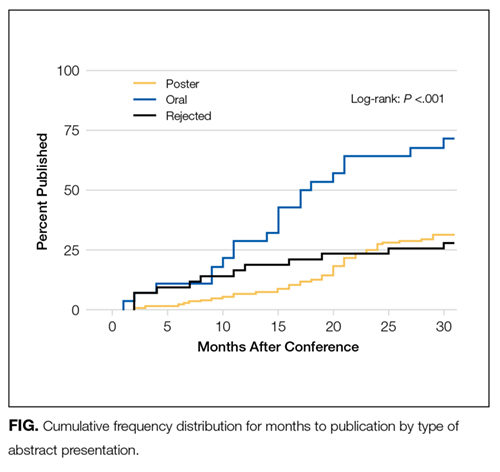
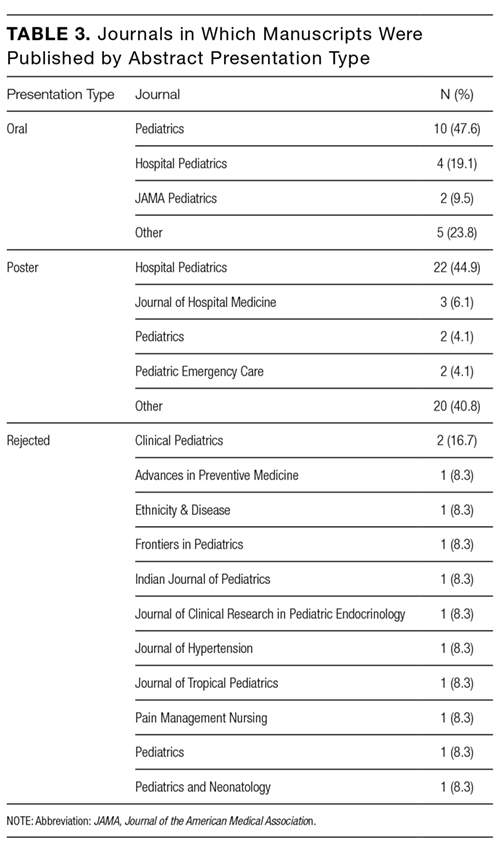
All abstracts submitted to the PHM conference were analyzed based on content area and presentation format. The proportion of all abstracts subsequently published was determined for each format type and content area, and the odds ratio (OR) for publication after abstract submission was calculated using logistic regression. We calculated an adjusted OR for subsequent publication controlling for PAS presentation and the trainee status of the primary author. The journals most frequently publishing abstracts submitted to the PHM conference were identified. Median time to publication was calculated using the number of months elapsed between the PHM conference and publication date and compared across all abstract formats using Cox proportional hazards models adjusted for PAS presentation and trainee status. Kaplan-Meier survival curves were also generated for each of the 3 formats and compared using log-rank tests. The median impact factor was determined for each abstract format and compared using Wilcoxon rank-sum tests. Median impact factor by content area was compared using a Kruskal-Wallis test. All statistical analyses were performed using SAS version 9.2 (SAS Institute, Cary, NC). P values < 0.05 were considered statistically significant. In accordance with the Common Rule22 and the policies of the Cincinnati Children’s Hospital Medical Center Institutional Review Board, this research was not considered human subjects research.

RESULTS
For the 2014 PHM meeting, 226 abstracts were submitted, of which 183 (81.0%) were selected for presentation, including 154 (68.0%) as poster presentations and 29 (12.8%) as oral presentations. Of all submitted abstracts, 82 (36.3%) were published within 30 months following the meeting. Eighty-one of these (98.8%) were identified via PubMed, and 1 was found only in MedEdPORTAL. No additional publications were found via Google Scholar. The presenting author for the PHM abstract was the first author for 87.8% (n = 72) of the publications. A trainee was the presenting author for only 2 of these abstracts. For the publications in which the first author was not the presenting author, the presenting author was the senior author in 2 of the publications and the second or third author on the remaining 8. Of the abstracts accepted for presentation, 70 (38.3%) were subsequently published. Abstracts accepted for oral presentation had almost 7-fold greater odds of subsequent publication than those that were rejected (Table 1; OR 6.8; 95% confidence interval [CI], 2.4-19.4). Differences in the odds of publication for rejected abstracts compared with those accepted for poster presentation were not statistically significant (OR 1.2; 95% CI, 0.5-2.5).