
Improving the readability of pediatric hospital medicine discharge instructions


Background
Readable discharge instructions may help caregivers understand and implement care plans following hospitalization. Many caregivers of hospitalized children, however, have limited literacy. We aimed to increase the percentage of discharge instructions written at 7th grade level or lower for hospital medicine patients from 13% to 80% in 6 months.
Methods
Quality improvement efforts targeted a 42-bed unit at the community satellite of our large, urban academic hospital. A multidisciplinary team of physicians, nurses, and parents focused on key drivers: family engagement in discharge process, standardization of discharge instructions, staff engagement in discharge preparedness, and audit and feedback of data. Improvement cycles included 1) education and implementation of a general discharge instruction template in the electronic health record (EHR); 2) visible reminders and tips for writing readable discharge instructions; 3) implementation of disease-specific discharge instruction templates in the EHR; and 4) individualized feedback to staff on readability and content of their written discharge instructions. Instructions were individually scored for readability using an online platform. An annotated control chart assessed the impact of interventions over time.
Results
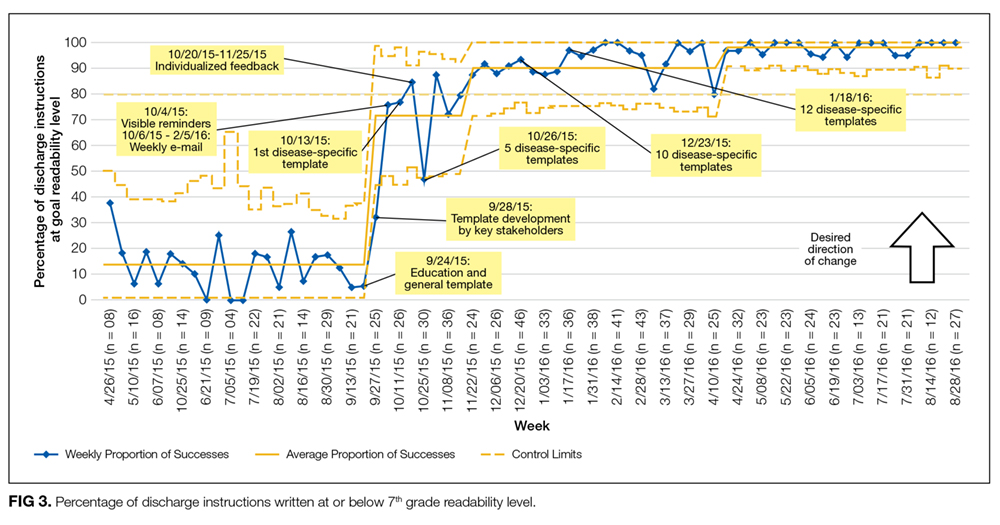
Through sequential interventions over 6 months, the percentage of discharge instructions written at 7th grade or lower readability level increased from 13% to 98% and has been sustained for 4 months. The reliable use of the EHR templates was associated with our largest improvements.
Conclusion
Use of standardized discharge instruction templates and rapid feedback to staff improved the readability of instructions. Next steps include adaptation and spread to other patient populations. Journal of Hospital Medicine 2017;12:551-557. © 2017 Society of Hospital Medicine
© 2017 Society of Hospital Medicine
Medical Staff Engagement
Previously described tests of change also aimed to enhance staff engagement. These included frequent e-mails, discussion of the QI efforts at specific team meetings, and the creation of visual cues posted at computer work stations, which prompted staff to begin to work on discharge instructions soon after admission.
Audit and Feedback of Data
Weekly phone calls. One team updated clinicians through a regularly scheduled bi-weekly phone conference. The phone conference was established prior to our work and was designed to relay pertinent information to attendings and NPs who work at the satellite hospital. During the phone conferences, clinicians were notified of current performance on discharge instruction readability and specific tests of change for the week. Additionally, providers gave feedback about the improvement efforts. These updates continued for the first 6 months of the project until sustained improvements were observed.
E-mails. Weekly e-mails were sent to all providers scheduled for clinical time at the satellite campus. The e-mail contained information on current tests of change, a list of discharge instruction templates that were available in the EHR, and the annotated run chart illustrating readability levels over time.
Additionally, individual e-mails were sent to each provider after review of the written discharge instructions for the week. Providers were given information on the number of discharge instructions they personally composed, the percentage of those instructions that were written at or below 7th grade level, and specific feedback on how their written instructions could be improved. We also encouraged feedback from each provider to better identify barriers to achieving our goal.
Study of the Interventions
Baseline data included a review of all instructions for patients discharged from the satellite campus from the end of April 2015 through mid-September 2015. The time period for testing of interventions during the fall and winter months allowed for rapid cycle learning due to higher patient census and predictability of admissions for specific diagnosis (ie, asthma and bronchiolitis). An automated report was generated from the EHR weekly with specific demographics and identifiers for patient discharged over the past 7 days, including patient age, gender, length of stay, discharge diagnosis, and insurance classification. Data was collected during the intervention period via structured review of the discharge instructions in the EHR by the principal investigator or a trained research coordinator. Discharge instructions for medically cleared mental health patients admitted to hospital medicine while awaiting psychiatric bed availability and patients and parents who were non-English speaking were excluded from review. All other instructions for patients discharged from the HM service at our Liberty Campus were included for review.
Measures
Readability, our primary measure of interest, was calculated using the mean score from the following formulas: Flesch Kincaid Grade Level,23 Simple Measure of Gobbledygook Index,24 Coleman-Liau Index,25 Gunning-Fog Index,26 and Automated Readability Index27 by means of an online platform (https://readability-score.com).28 This platform was chosen because it incorporated a variety of formulas, was user-friendly, and required minimal data cleaning. Each of the readability formulas have been used to assesses readability of health information given to patients and families.29,30 The threshold of 7th grade is in alignment with our institutional policy for educational materials and with recommendations from several government agencies.5,12
Analysis
A statistical process control p-chart was used to analyze our primary measure of readability, dichotomized as percent discharge instructions written at or below 7th grade level. Run charts were used to follow mean reading level of discharge instructions and our process measure of percent of discharge instruction written with a general or disease-specific standardized template. Run chart and control chart rules for identifying special cause were used for midline shifts.31
RESULTS
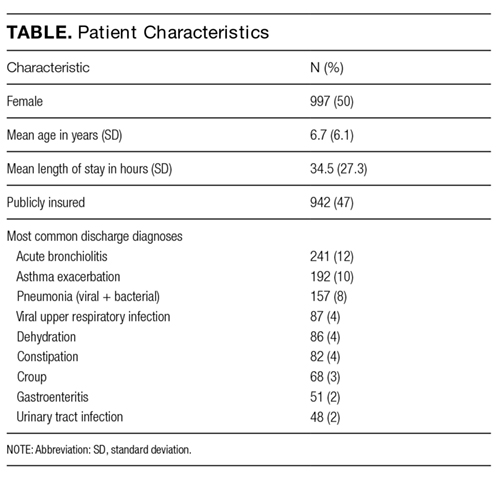
The Table includes the demographic and clinical information of patients included in our analyses. Through sequential interventions, the percentage of discharge instructions written at or below 7th grade readability level increased from a mean of 13% to more than 80% in 3 months (Figure 3). Furthermore, the mean was sustained above 90% for 10 months and at 98% for the last 4 months. The use of 1 of the 13 EHR templates increased from 0% to 96% and was associated with the largest impact on the overall improvements (Supplemental Figure 1). Additionally, the average reading level of the discharge instructions decreased from 10th grade to 6th grade level (Supplemental Figure 2).
Qualitative comments from providers about the discharge instructions included:
“Are these [discharge instructions] available at base?? Great resource for interns.”
“These [discharge] instructions make the [discharge] process so easy!!! Love these...”
“Also feel like they have helped my discharge teaching in the room!”
Qualitative comments from families postdischarge included:
“I thought the instructions were very clear and easy to read. I especially thought that highlighting the important areas really helped.”
“I think this form looks great, and I really like the idea of having your child’s name on it.”


