Techniques and behaviors associated with exemplary inpatient general medicine teaching: an exploratory qualitative study


BACKGROUND
Clinician educators face numerous obstacles to their joint mission of facilitating high-quality learning while also delivering patient-centered care. Such challenges necessitate increased attention to the work of exemplary clinician educators, their respective teaching approaches, and the experiences of their learners.
OBJECTIVE
To describe techniques and behaviors utilized by clinician educators to facilitate excellent teaching during inpatient general medicine rounds.
DESIGN
An exploratory qualitative study of inpatient teaching conducted from 2014 to 2015.
SETTING
Inpatient general medicine wards in 11 US hospitals, including university-affiliated hospitals and Veterans Affairs medical centers.
PARTICIPANTS
Participants included 12 exemplary clinician educators, 57 of their current learners, and 26 of their former learners.
MEASUREMENTS
In-depth, semi-structured interviews of exemplary clinician educators, focus group discussions with their current and former learners, and direct observations of clinical teaching during inpatient rounds.
RESULTS
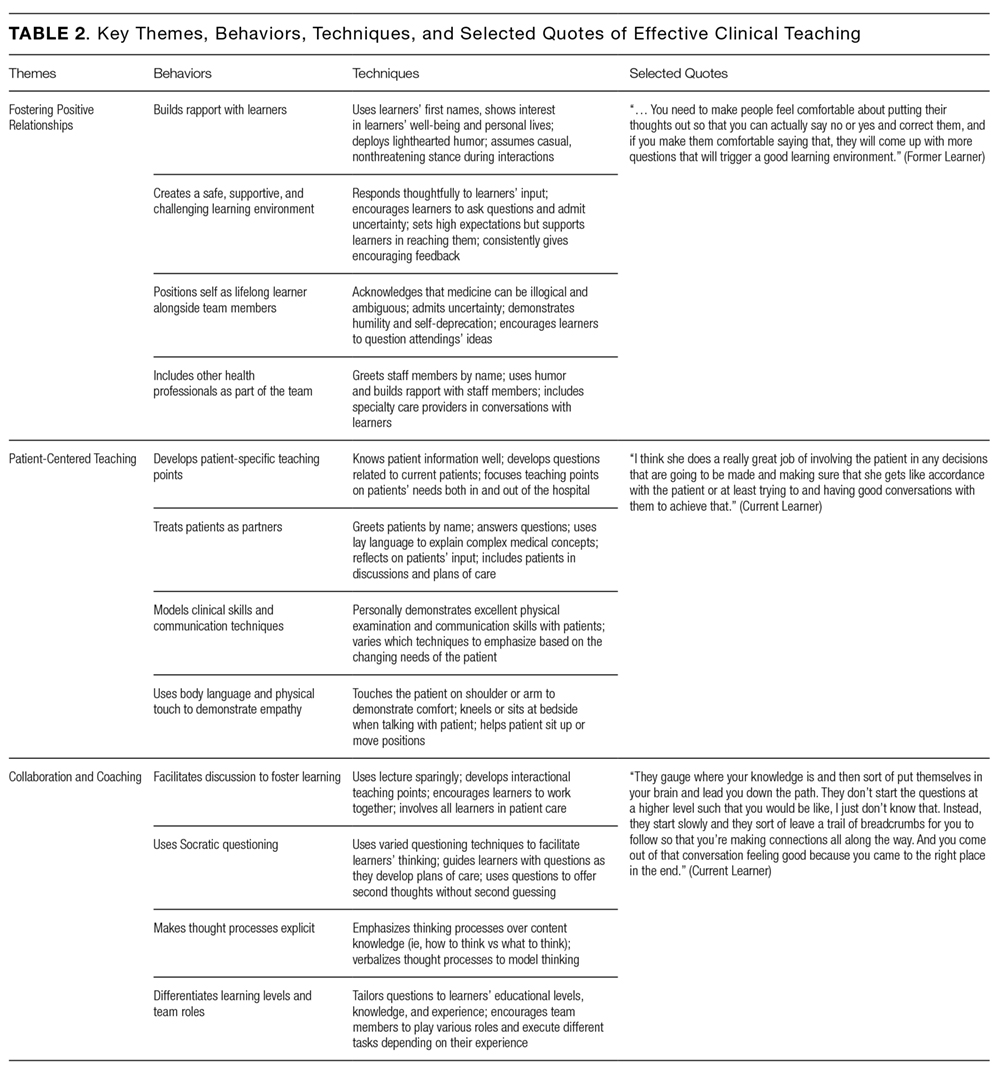
Interview data, focus group data, and observational field notes were coded and categorized into broad, overlapping themes. Each theme elucidated a series of actions, behaviors, and approaches that exemplary clinician educators consistently demonstrated during inpatient rounds: (1) they fostered positive relationships with all team members by building rapport, which in turn created a safe learning environment; (2) they facilitated patient-centered teaching points, modeled excellent clinical exam and communication techniques, and treated patients as partners in their care; and (3) they engaged in coaching and collaboration through facilitation of discussion, effective questioning strategies, and differentiation of learning among team members with varied experience levels.
CONCLUSION
This study identified consistent techniques and behaviors of excellent teaching during inpatient general medicine rounds. Journal of Hospital Medicine 2017;12:503-509. © 2017 Society of Hospital Medicine
© 2017 Society of Hospital Medicine
By using this sampling method, 59 potential participants were identified. An internet search was conducted to obtain information about the potential participants and their institutions. Organizational characteristics such as geographic location, hospital size and affiliation, and patient population, as well as individual characteristics such as gender, medical education and training, and educational awards received were considered so that a diversity of organizations and backgrounds was represented. The list was narrowed down to 16 attendings who were contacted via e-mail and asked to participate. Interested participants were asked for a list of their current team members and 6 to 10 former learners to contact for interviews and focus groups. Former learners were included in an effort to better understand lasting effects on learners from their exemplary teaching attendings. A total of 12 attending physicians agreed to participate (Table 1). Literature on field methods has shown that 12 interviews are found to be adequate in accomplishing data saturation.15 Although 2 attendings were located at the same institution, we decided to include them given that both are recognized as master clinician educators and were each recommended by several individuals from various institutions. Hospitals were located throughout the US and included both university-affiliated hospitals and Veterans Affairs medical centers. Despite efforts to include physicians from historically black colleges and universities, only one attending was identified, and they declined the request to participate.
Data Collection
Observations. The one-day site visits were mainly conducted by two research team members, a physician (SS) and a medical anthropologist (MH), both of whom have extensive experience in qualitative methods. Teams were not uniform but were generally comprised of 1 attending, 1 senior medical resident, 1 to 2 interns, and approximately 2 medical students. Occasionally, a pharmacist, clinical assistant, or other health professional accompanied the team on rounds. Not infrequently, the bedside nurse would explicitly be included in the discussion regarding his or her specific patient. Each site visit began with observing attendings (N = 12) and current learners (N = 57) during rounds. Each research team member recorded their own observations via handwritten field notes, paying particular attention to group interactions, teaching approach, conversations occurring within and peripheral to the team, patient-team interactions, and the physical environment. By standing outside of the medical team circle and remaining silent during rounds, research team members remained unobtrusive to the discussion and process of rounds. Materials the attendings used during their teaching rounds were also documented and collected. Rounds generally lasted 2 to 3 hours. After each site visit, the research team met to compare and combine field notes.
Interviews and Focus Groups. The research team then conducted individual, semi-structured interviews with the attendings, focus groups with their current team (N = 46), and interviews or focus groups with their former learners (N = 26; Supplement 1). Eleven of the current team members observed during rounds were unable to participate in the focus groups due to clinical duties. Because the current learners who participated in the focus groups were also observed during rounds, the research team was able to ask them open-ended questions regarding teaching rounds and their roles as learners within this environment. Former learners who were still at the hospital participated in separate focus groups or interviews. Former learners who were no longer present at the hospital were contacted by telephone and individually interviewed by one research team member (MH). All interviews and focus groups were audio-recorded and transcribed.
This study was determined to be exempt by the University of Michigan Institutional Review Board. All participants were informed that their participation was completely voluntary and that they could terminate their involvement at any time.
Data Analysis
Data were analyzed using a thematic analysis approach.16 Thematic analysis entails reading through the data to identify patterns (and create codes) that relate to behaviors, experiences, meanings, and activities. Once patterns have been identified, they are grouped according to similarity into themes, which help to further explain the findings.17
After the first site visit was completed, the research team members that participated (SS and MH) met to develop initial ideas about meanings and possible patterns. All transcripts were read by one team member (MH) and, based on review of the data, codes were developed, defined, and documented in a codebook. This process was repeated after every site visit using the codebook to expand or combine codes and refine definitions as necessary. If a new code was added, the previously coded data were reviewed to apply the new code. NVivo® 10 software (QSR International; Melbourne, Australia) was used to manage the data.
Once all field notes and transcripts were coded (MH), the code reports, which list all data described within a specific code, were run to ensure consistency and identify relationships between codes. Once coding was verified, codes were grouped based on similarities and relationships into salient themes by 3 members of the research team (NH, MH, and SM). Themes, along with their supporting codes, were then further defined to understand how these attendings worked to facilitate excellent teaching in clinical settings.