
Psychosocial factors and treatment satisfaction after radical prostatectomy


Background Sexual and urinary side effects of prostate cancer treatment have been well described in the literature, but less is known about the psychosocial effects of prostate cancer treatment.
Objective To prospectively evaluate physical and psychosocial functioning after diagnosis of prostate cancer and factors associated with treatment satisfaction after prostate cancer treatment.
Methods Patients diagnosed with prostate cancer at a university-based urology department were invited to participate in this internet-based study. Validated questionnaires were used to evaluate health-related quality of life (HRQoL) domains at pretreatment baseline following diagnosis and at 1, 3, 6, and 12 months after treatment. Domains of HRQoL included sexual, urinary, and bowel functioning; anxiety and depression; and sleep disturbance, pain, and fatigue. Linear repeated measures models were used to examine changes in self-reported measures at each time point.
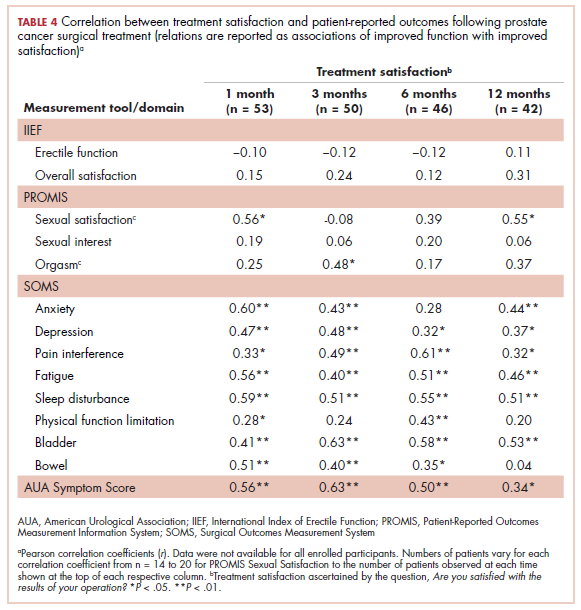
Results Of 105 men diagnosed with prostate cancer enrolled in the study, 54 completed assessments through 12 months. Decreased erectile function and sexual HRQoL following treatment were not significantly associated with worse treatment satisfaction over time. Instead, treatment satisfaction was significantly associated (P < .01) with anxiety (r, .28-.60), depression (r, .32-.48), fatigue (r, .40-.56), pain (r, .32-.61), sleep disturbance (r, .51-.59), and bladder problems (r, .41-.63).
Limitations Not all patients were enrolled or completed all longitudinal questionnaires, which may bias the results because of unmeasurable factors. We were not able to identify improvements or declines in HRQoL more than 12 months after treatment.
Conclusions Despite declines in erectile function and sexual domains, treatment satisfaction was more closely related to emotional, psychosocial, and nonsexual effects. The findings underscore the importance of assessing HRQoL outcomes beyond physical functioning, which can yield opportunities to improve satisfaction.
Accepted for publication April 20, 2018
Correspondence Shilajit D Kundu, MD; s-kundu@northwestern.edu
Disclosures The authors report no disclosures/conflicts of interest.
Citation JCSO 2018;16(3):e130-e137
©2018 Frontline Medical Communications
doi https://doi.org/10.12788/jcso.0401
Related articles
Repeated measures analysis of patient-reported outcomes in prostate cancer after abiraterone acetate
Supportive medications and interventions received by prostate cancer survivors: results from the PiCTure study
Submit a paper here
Results
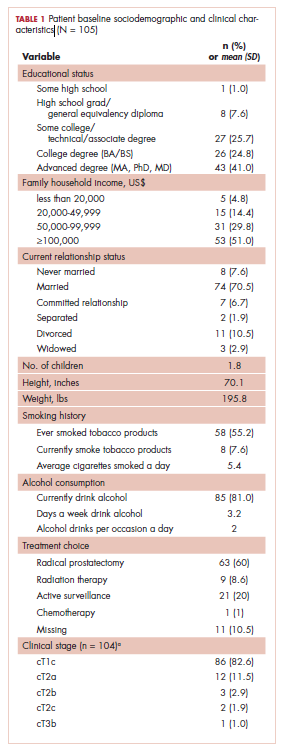
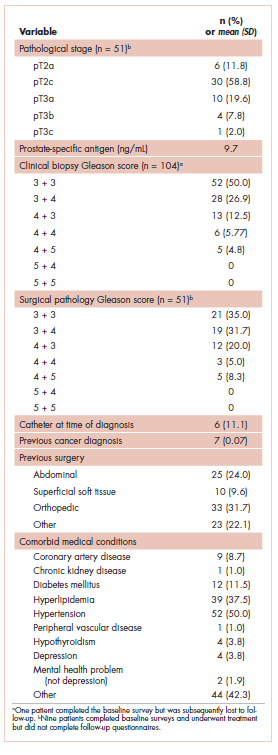
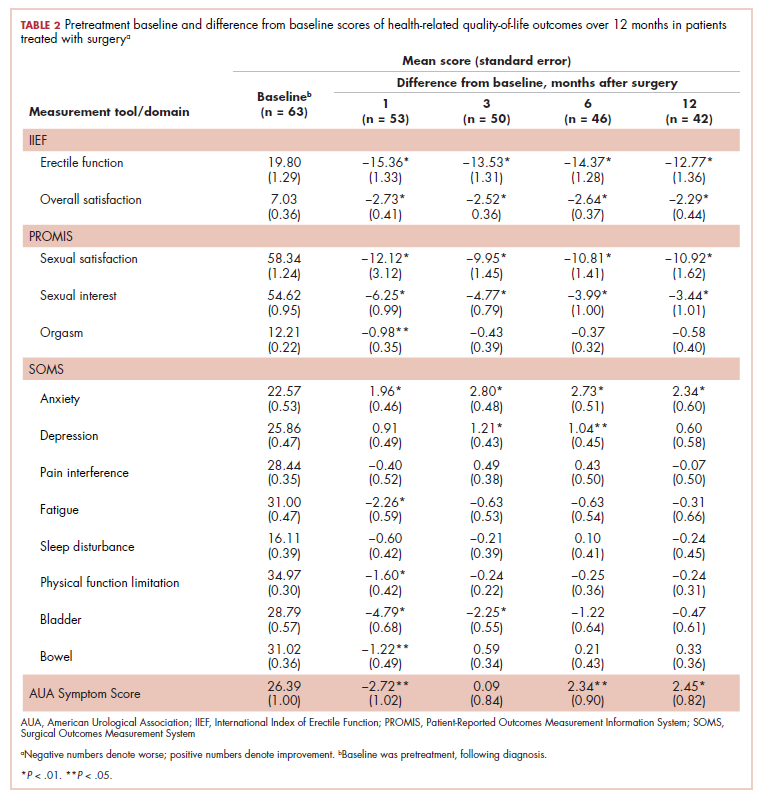
A total of 105 patients diagnosed with prostate cancer were enrolled in the study. Response rates decreased throughout the study (n = 75 at 1 month; n = 71 at 3 months; n = 64 at 6 months; n = 54 at 12 months). Sociodemographic and clinical characteristics of participants are shown in Table 1. The mean change from pretreatment (baseline) scores for each measure in patients treated with surgery is shown in Table 2, and the mean change from pretreatment scores in patients who elected active surveillance is shown in Table 3 (in both tables, a negative score denotes worsened function, and a positive change denotes improvement).
After surgery, patients reported significantly lower erectile function and sexual satisfaction scores. These included statistically significant decreases for IIEF Erectile Function, IIEF Overall Satisfaction, PROMIS Sexual Satisfaction, PROMIS Sexual Interest, and PROMIS Orgasm. In patients treated with surgery, there were significant improvements in anxiety observed for patients at each follow-up time, whereas significantly worse bladder problems were observed on SOMS Bladder at 1 and 3 months but returned to baseline by 12 months after surgery. AUASS was worse at 1 month but significantly improved at 6 and 12 months. Fatigue scores significantly worsened at 1 month but were no longer significant at 6 and 12 months. Physical Function was worsened at 1 month but not throughout the rest of the study. Bowel Problems (SOMS) were significantly worse at 1 month, but changes became nonsignificant on subsequent assessments. The only 2 domains that did not demonstrate any significant changes o
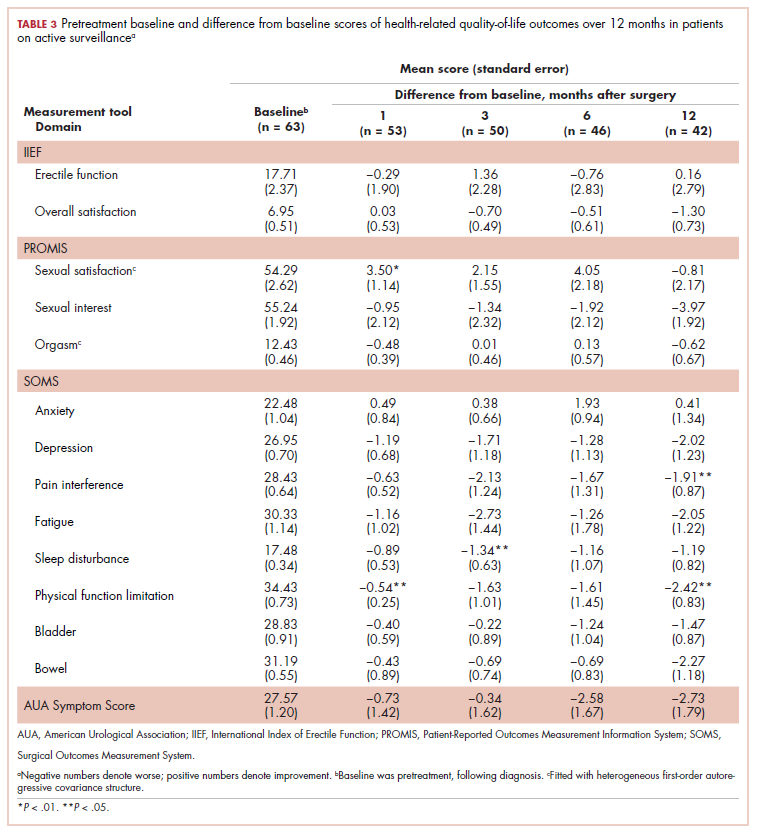
In active surveillance patients, sexual function domains were generally unchanged over the course of the study. However, unlike treated patients, there was no significant improvement in anxiety, depression, pain, fatigue, or sleep. In fact, most of these domains demonstrated worsened functioning, although these were not statistically significant. Urinary domains generally remained unchanged.
Pearson correlation coefficients between HRQoL measures and overall treatment satisfaction (assessed by the question, Are you satisfied with the results of your operation?) at each follow-up time point in patients treated with surgery are shown in Table 4. Relations between treatment satisfaction and sexual outcomes were generally statistically insignificant (r, .08-.56). However, sleep disturbance, depression, pain interference, fatigue, embarrassment, and bladder problems all demonstrated statistically significant positive associations with treatment satisfaction, with coefficients ranging from small to medium in magnitude (r, .32-.61). Other outcomes such as anxiety, physical function, and bowel problems demonstrated small to medium statistically significant associations with treatment satisfaction (r, .04-.60) but not at every time point. We performed t tests to examine treatment satisfaction in patients with detectable initial posttreatment prostate-specific antigen (PSA; >0.01 ng/mL). We found no difference in treatment satisfaction between patients with detectable PSA values and those with undetectable PSA at each time point.
When the patients were asked, Compared with what you expected, how do you rate the results of your operation?, most of those treated with surgery reported that the results of their operation were better than they had expected (Figure 1A; p. e137). More than 75% of the patients had results that were as expected or better than expected. When asked, Compared with what you expected, how do you rate your side effects of the operation?, almost 70% of patients reported side effects no worse than expected (Figure 1B). When asked, Are you satisfied with the results of your operation?, most patients reported that overall, they were satisfied with the results of their operation (Figure 1C).
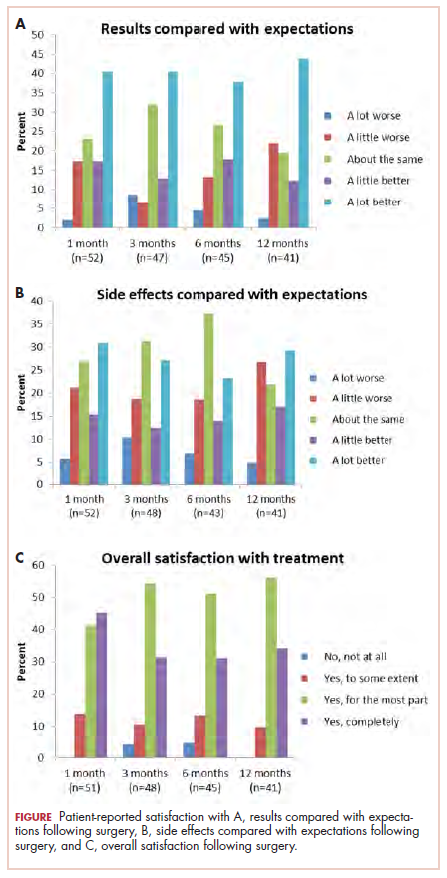
At 12 months, none of the patients reported overall dissatisfaction with their treatment choice. More than 90% of patients were mostly or completely satisfied with the results of their operation.
Discussion
This prospective study assessed the HRQoL from pretreatment through 12 months posttreatment in men diagnosed with clinically localized prostate cancer that had been treated with surgery. Although the indicators of sexual function significantly decreased over time, they were not meaningfully associated with overall treatment satisfaction. Instead, a host of other factors, including psychosocial (eg, anxiety, depression, body image dissatisfaction, embarrassment), nonurological physical symptoms (pain interference, physical function, sleep disturbance, fatigue), and bladder problems, were significantly related to overall treatment satisfaction. Although this may not be surprising in other clinical oncology paradigms, the sheer surfeit of focus and attention on sexual function has overshadowed aspects of HRQoL that many men report are important to them, despite worsened sexual function outcomes.


