
Alectinib active in ALK-positive, crizotinib-refractory NSCLC



AT THE EUROPEAN CANCER CONGRESS 2013
AMSTERDAM – The investigational second-generation ALK inhibitor alectinib produced objective responses in 54.5% of patients with ALK-positive non–small cell lung cancer refractory to crizotinib in a phase I dose-finding study.
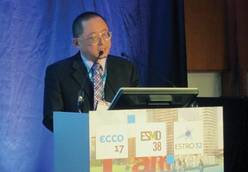
Alectinib had consistent clinical activity in patients with symptomatic brain metastases, including two cases of leptomeningeal carcinomatosis. One of those patients, a 29-year-old woman with a 7-year history of anaplastic lymphoma kinase (ALK)–positive lung cancer, cleared malignant brain cells within 4 weeks after starting oral alectinib, Dr. Sai-Hong Ou said at the multidisciplinary European cancer congresses.
Alectinib, which is being developed by study sponsor Roche/Chugai Pharmaceutical, has already demonstrated an objective response rate of 93.5% in crizotinib (Xalkori)-naive ALK-positive non–small cell lung cancer. Among those patients, a previously untreated 2.5-cm brain lesion decreased in size by 47% in about 3 weeks and the patient continues to have a confirmed response to alectinib, he said.
Based on the new data, alectinib was granted a breakthrough therapy designation by the Food and Drug Administration to expedite its development and review.
Crizotinib is the only approved ALK-inhibitor for use in ALK-rearranged non–small cell lung cancer; it is available for use in any line therapy in the United States and as second-line therapy only in Europe.
A total of 47 patients were enrolled in the phase I study and treated with twice-daily alectinib at doses ranging from 300 mg to 900 mg. All patients had adenocarcinoma histology, an ECOG performance status of 0-2, and no prior exposure to other ALK inhibitors.
Two dose-limiting toxicities occurred at the 900-mg dose – a grade 3 headache and grade 3 neutropenia requiring dose interruption for 7 days. No patient had to be dose reduced at 600 mg twice daily, which was identified as the recommended phase II dose.
Overall, there were very few grade 3/4 treatment-emergent adverse events, said Dr. Ou of the Chao Family Comprehensive Cancer Center at the University of California Irvine Medical Center, Orange. Most were increased gamma-glutamyl transpeptidase, neutrophil decrease, and hypophosphatemia.
The most common toxicities were fatigue (30%), myalgia and peripheral edema (17%), elevated creatine phosphokinase (15%), and photosensitivity (13%).
Among the 21 patients with brain metastases at baseline, 13 had partial responses to alectinib at varying doses, 6 had stable disease, 1 had progressive disease, and 1 had a pending evaluation.
Dr. Ou said that a new 150-mg capsule has been formulated to reduce the number of capsules needed each day and that a phase II study (Accalia G2L) of alectinib is underway in crizotinib-resistant ALK-positive non–small cell lung cancer. A phase III head-to-head comparison between alectinib and crizotinib is also planned, with the protocol to be completed by January 2014, he said.
Roche/Chugai Pharmaceuticals sponsored the trial. Dr. Ou reported consulting for Chugai, Genentech, and Pfizer and serving on speakers bureaus for Boehringer Ingelheim, Genentech, and Pfizer.