
Integrating Bispecific Antibodies Into VA Oncology Care: A VISN 20 Multidisciplinary Protocol and Education Model


Background: Bispecific antibodies (BsAbs) are an established treatment modality for patients with multiple myeloma, but their adoption within the Veterans Health Administration is limited. Facility-level challenges include limited prescriber familiarity with BsAbs, insufficient specialized staffing and resources to support BsAb implementation, and the absence of specific protocols or processes for BsAb surveillance and toxicity management. Patient-level barriers include geographic burdens, inadequate transportation or caregiver support, and comorbidities that affect treatment candidacy.
Observations: To improve facility readiness and facilitate BsAb implementation, the Veterans Affairs (VA) Puget Sound Health Care System (VAPSHCS) led a Veterans Integrated Service Network 20 education initiative consisting of an 8-session, faculty-led series called Project ECHO (Extension for Community Healthcare Outcomes). The program engaged multidisciplinary clinicians, outlined system- and patient-specific barriers to care, and identified VA-focused solutions. Participants reported that the ECHO sessions helped them overcome barriers in practice and increased their commitment to making practice changes. Multidisciplinary engagement from the series informed the development of institutional BsAb protocols and order sets at VAPSHCS.
Conclusions: This educational initiative demonstrates that structured education, targeted knowledge dissemination, and multidisciplinary coordination can support improved BsAb implementation and facility readiness within Veterans Integrated Service Networks.
Multiple myeloma (MM) is a malignant plasma cell neoplasm designated as a presumptive condition for service connected benefits across a wide range of exposures for veterans.1 Veterans have a disproportionately high occurrence of MM, likely related to exposures during military service, including Agent Orange, burn pit smoke, ionizing radiation, and other potential toxins.2-4 This risk extends to atomic veterans, Vietnam War veterans, and Gulf War and post-9/11 veterans. Survival among patients with MM has improved markedly over the past 2 decades, with 5-year relative survival reported as 62.4% from 2015 through 2021 by the National Cancer Institute Surveillance, Epidemiology, and End Results Program.5,6 This improvement reflects advances in diagnosis, novel therapies, and supportive care.5,7
Unfortunately, despite improvements in upfront therapies, patients with MM may experience relapsed or refractory disease, necessitating the development of novel treatment approaches. Although prior analyses have demonstrated improved survival rates in Military Health System beneficiaries with MM compared with patients with MM from the general US population, more research is warranted to better understand whether veterans diagnosed with MM have equally benefited from recent treatment advances.4
Bispecific antibodies (BsAbs) are engineered T cell–redirecting immunotherapies that bind 2 distinct targets simultaneously: a myeloma- associated antigen—such as B-cell maturation antigen (BCMA) or G protein-coupled receptor, class C, group 5 (GPRC5D)—on malignant plasma cells, and CD3 on T cells, thereby inducing targeted cytotoxicity. BsAbs represent a breakthrough therapy for patients with relapsed/ refractory MM (R/R MM).8,9
Currently approved BsAbs include teclistamab, elranatamab, and linvoseltamab (all BCMA×CD3 BsAbs), as well as talquetamab (a GPRC5D×CD3 BsAb). These agents are approved by the US Food and Drug Administration (FDA) with an indication for adult patients with R/R MM who have received ≥ 4 prior therapies, including a proteasome inhibitor, an immunomodulatory agent, and an anti-CD38 monoclonal antibody. Meta-analyses involving patients with heavily pretreated R/R MM reported an overall response rate of about 69%, with about 42% achieving complete response or better, and 1-year progression-free and overall survival rates of about 56% and 72%, respectively.10 US Department of Veterans Affairs (VA) clinical pathways have now incorporated the use of BsAbs and allow consideration of earlier access for patients.
BsAbs are an important therapeutic option for veterans with R/R MM, but patient-specific and facility barriers remain. Veterans have unique risk factors related to prior military service, including higher rates of skeletal fracture, neck and back problems, traumatic brain injury, and posttraumatic stress disorder.11-13 Toxic exposures increase the risk of a number of medical conditions beyond MM, including other cancer diagnoses, which may influence candidacy or tolerability for treatment.14 In addition, veterans may encounter disproportionate challenges in accessing resource-intensive treatments such as BsAb therapy. These difficulties can be due to absence of a local VA medical center (VAMC) with hematology specialist care or lack of travel and lodging benefits to support treatment at a regional VAMC capable of providing BsAb therapy.15 Understanding these factors, BsAb adoption within the VA presents unique challenges for cancer care clinicians.16
The safety profile of BsAbs includes significant adverse events (AEs), including boxed FDA warnings that require vigilant monitoring and management. BsAbs require risk management, product labeling for mandated step-up dosing, and enhanced monitoring during initial doses. The most common and clinically significant AEs observed with BsAbs are cytokine release syndrome (CRS) and immune effector cell-associated neurotoxicity syndrome (ICANS). Additional AEs can include cytopenias, infections, and hypogammaglobulinemia. 17,18 CRS occurs due to immune activation and release of inflammatory cytokines, and typically manifests as fever, hypotension, and other systemic symptoms, often early in the treatment course. Although neurotoxicity manifests mainly as low-grade ICANS, patients require close neurologic monitoring with regular assessments and timely intervention, as neurotoxicity can become life-threatening and may be associated with potential long-term sequelae that remain poorly defined.19
Due to the risks, BsAb agents are distributed with risk evaluation and mitigation strategies or manufacturer programs that require clinician/patient education and documentation of readiness to manage CRS/ICANS. Immunosuppression related to leukopenia, hypogammaglobulinemia, and T-cell redirection can be severe and predispose patients to infections. Evidence has also been documented of a potential risk for second primary malignancies with BsAb therapy, necessitating ongoing surveillance.20 These considerations underscore the importance of a structured system for safe and deliberate delivery of BsAbs in a population with a high rate of comorbidity and toxic exposure histories.
To support safe and consistent implementation across the region, a VA Puget Sound Health Care System Institutional Review Board (VAPSHCS IRB)–approved educational initiative was developed and implemented to increase institutional readiness and clinical capacity for BsAb use within the VA Northwest Health Network (VISN 20). The program leveraged VAPSHCS as a specialty care hub through a structured educational series and development of standardized clinical protocols. A faculty-led series called Project ECHO (Extension for Community Healthcare Outcomes) was delivered in 8 sessions over 12 months to educate VISN 20 clinicians, targeting hematology/ oncology focused physicians, allied health professionals, and pharmacists on the mechanism of action, safety, efficacy, and use of BsAbs for MM.
Project Echo
An ECHO-based learning model series was developed and presented to a multidisciplinary audience. The ECHO model is a collaborative telementoring approach that connects specialty care experts at an academic hub with clinicians in community settings (spokes) through regular virtual clinics.21 This model also allows for multidisciplinary knowledge dissemination within facilities. ECHO empowers spoke sites and hub facility team members to manage complex health conditions by facilitating case-based learning, guided practice, and knowledge-sharing.
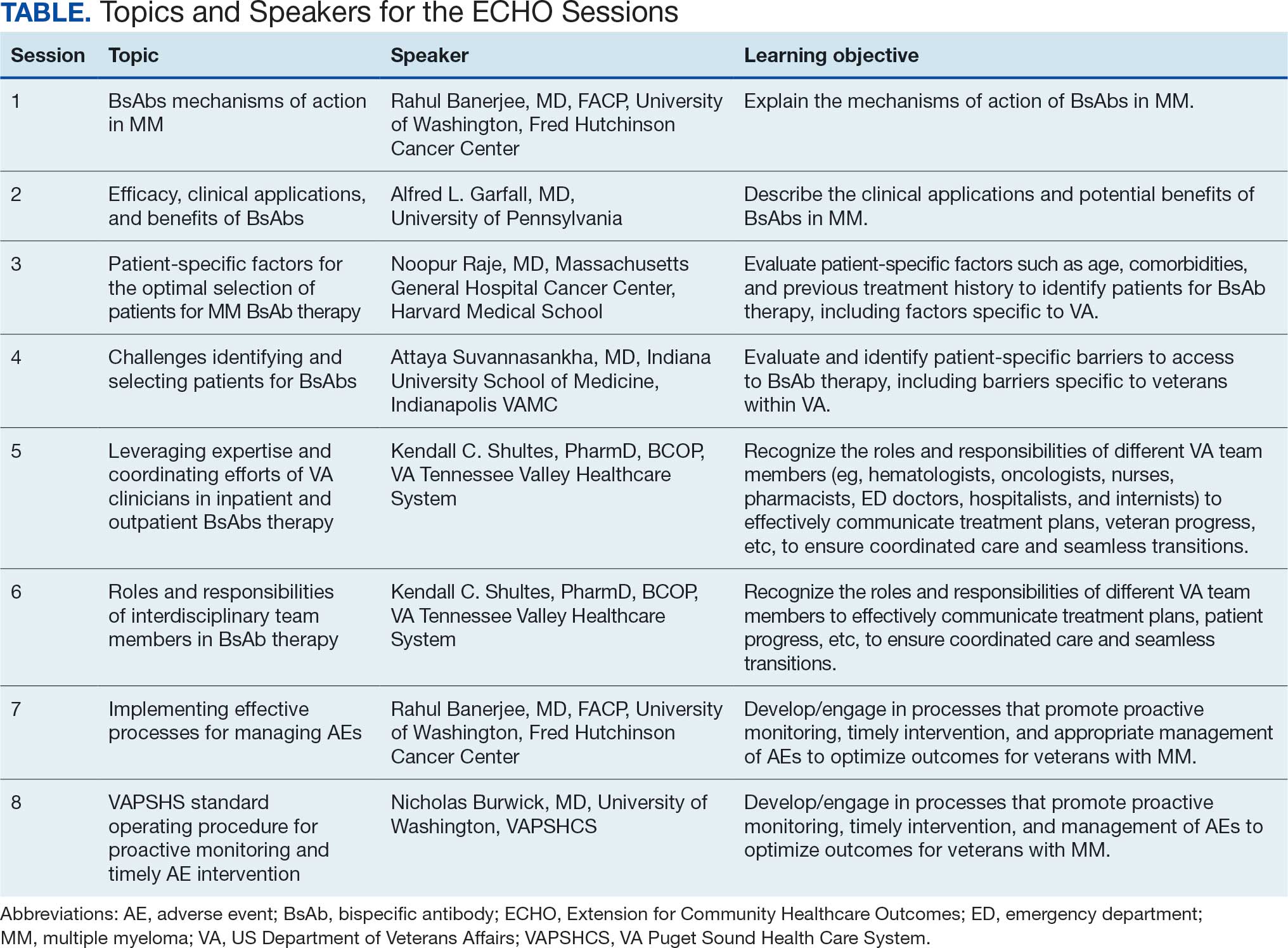
This educational program was based at VAPSHCS and focused on strategies to address VISN-level and site-specific needs. Key areas included staff education, coordination with pharmacy services for medication acquisition and preparation, and the development of processes and protocols for BsAb implementation, surveillance, and toxicity management. Eight ECHO sessions were completed with multidisciplinary clinician recruitment and engagement, which included physicians, pharmacists, and allied health professionals (physician assistants, nurse practitioners). The topics and speakers for each ECHO session are described in the Table and a slide deck for each session is included in the Appendix.
Educational Impact
Self-reported gains in knowledge and skills were assessed as a subjective outcome measure. Measures of knowledge and perceived competence (ie, confidence) are widely used and accepted in continuing education (CE) and continuing professional development. The CE outcomes framework identifies knowledge and competence as key educational outcomes, with competence often assessed through learner self-report and confidence ratings.22 Systematic reviews further demonstrate that CE interventions improve clinician knowledge and competence, with many studies using self-reported confidence and intent to change as indicators of learning and anticipated behavior change.23
These approaches are supported by Bandura’s social cognitive theory, which defines self-efficacy as an individual’s belief in their capability to perform specific tasks. According to Bandura, self-efficacy is inherently task- and context-specific and is most appropriately assessed using focused, behaviorally anchored self-report measures. Bandura’s work further demonstrates that these task-specific judgments are predictive of performance and behavior change, whereas global self-assessments are less reliable.24,25
Discussion
Specific barriers to BsAb care within the Veterans Health Administration (VHA) were identified, and veteran-focused solutions were examined. Facility-level barriers within VISN 20 included lack of clinician knowledge and familiarity with BsAbs, and limited specialized staff and infrastructure in place to deliver treatment and manage AEs safely. Patient-level barriers included access challenges related to geographical burden such as distance to a VAMC that has the ability to prescribe BsAbs, as well as lack of transportation assistance or outpatient lodging benefits. These barriers could result in excess burden for veterans who live far from VA facilities and require close outpatient monitoring or short intervals between admissions. Conversely, several strengths of the VHA were identified, including equitable access to care, potential for service-connected benefits, copay exemption or capped copays for medications, and the availability of local housing provisions for patients and caregivers in some locations.
Multidisciplinary learners reported that engagement in the ECHO sessions helped them overcome barriers in practice and improve their commitment to making practice changes that would affect patient care. While preliminary in nature, changes to patient care after attending ECHO sessions included remaining current on available BsAbs for the treatment of MM; reviewing how BsAbs are used for treating MM; evaluating patient-specific factors to identify eligible patients for BsAbs; working with care teams to identify patient barriers that could limit BsAb implementation; implementing processes that promote proactive monitoring, timely intervention, and appropriate management of AEs to optimize patient outcomes; recognizing the roles and responsibilities of other team members involved in the care of patients who have received BsAbs; and working with care team members to effectively communicate treatment plans to ensure coordinated care and seamless transitions.
Along with the ECHO education program, order sets and clinical protocols for BsAb prescribing and toxicity management were implemented, aligning with VA Oncology Field Advisory Board and VHA National Formulary Committee guidance for CRS and ICANS toxicity monitoring and intervention, manufacturer recommendations as dictated by prescription inserts, and input from our multidisciplinary expert panel, including VA and non-VA members. These protocols were designed to allow for safe and consistent care delivery of BsAb therapy and improve facility readiness for BsAb dosing.26
BsAb implementation required resource investment in staff training, coordination, and infrastructure, which may not be available at other VHA facilities. VAPSHCS is a well-resourced hub site with experience in caring for patients with hematologic malignancies, including the management of patients undergoing bone marrow transplantation. Accordingly, VAPSHCS may be particularly well suited to benefit from this educational initiative.
Use of the ECHO education model to improve clinician knowledge and facility readiness remains exploratory, and ongoing collaboration with other VHA hub facilities is necessary to determine its generalizability. Long-term sustainability of BsAb use will depend on continued institutional buy-in, system integration of evolving national guidelines, and educational outreach to VISN 20 partners to troubleshoot barriers to care. Broader adoption of BsAb therapies across the VHA will be essential to ensure veterans have equitable access to state-of-the-art myeloma care.
Conclusions
This education initiative provided a structured framework for knowledge dissemination regarding appropriate BsAb use and proactive surveillance and toxicity management, while also informing the development of processes and protocols for BsAb implementation at VAPSHCS. Access to BsAb therapies at the VHA has the potential to improve timely intervention for veterans with MM and reduce dependence on academic and community partners, helping veterans remain connected to their established VA care teams. Multidisciplinary coordination and management protocols help promote safe prescribing and improve patient outcomes.
