
My Kidney Is Fine, Can’t You Cystatin C?


Background: Independent of age, sex, and body composition, individuals of African American race and individuals with high muscle mass have elevated serum creatinine (sCr) levels on average that may result in overestimation of chronic kidney disease (CKD). We present a misdiagnosed case of CKD based on sCr levels, illustrating the utility of cystatin C (CysC) confirmation testing to answer the question: Can confirmation screening of kidney function with CysC in African American patients and patients with high muscle mass reduce the misdiagnosis of CKD?
Case Presentation: A 35-year-old African American man with a history of well-controlled HIV was found to have consistently elevated creatinine (Cr). We diagnosed CKD stage 3A based on the estimated glomerular filtration rate (eGFR). Further evaluation showed isolated elevation of sCr with unremarkable urinalysis and other laboratory tests. sCr elevation predated diagnosis and HIV treatment. A CysC-based eGFR (eGFRcys) test confirmed the absence of CKD.
Conclusions: The 2009 CKD Epidemiology Collaboration calculation of eGFR based on sCr concentration uses age, sex, and race, with an updated recommendation in 2021 to exclude race. Both equations are less accurate in African American patients, individuals taking medications that interfere with sCr secretion and assay, and patients taking creatine supplements or high protein intake. These clinical scenarios decrease sCr-based eGFR (eGFRCr) but do not change measured eGFR or eGFRCys. Using sCr and serum cystatin C (eGFRCr-Cys) yields better concordance to measured eGFR across all races than does eGFR estimation based on Cr alone. Confirmation with CysC can avoid misdiagnosis, incorrect dosing of drugs, and inaccurate representation of the fitness for duty.
Case Presentation
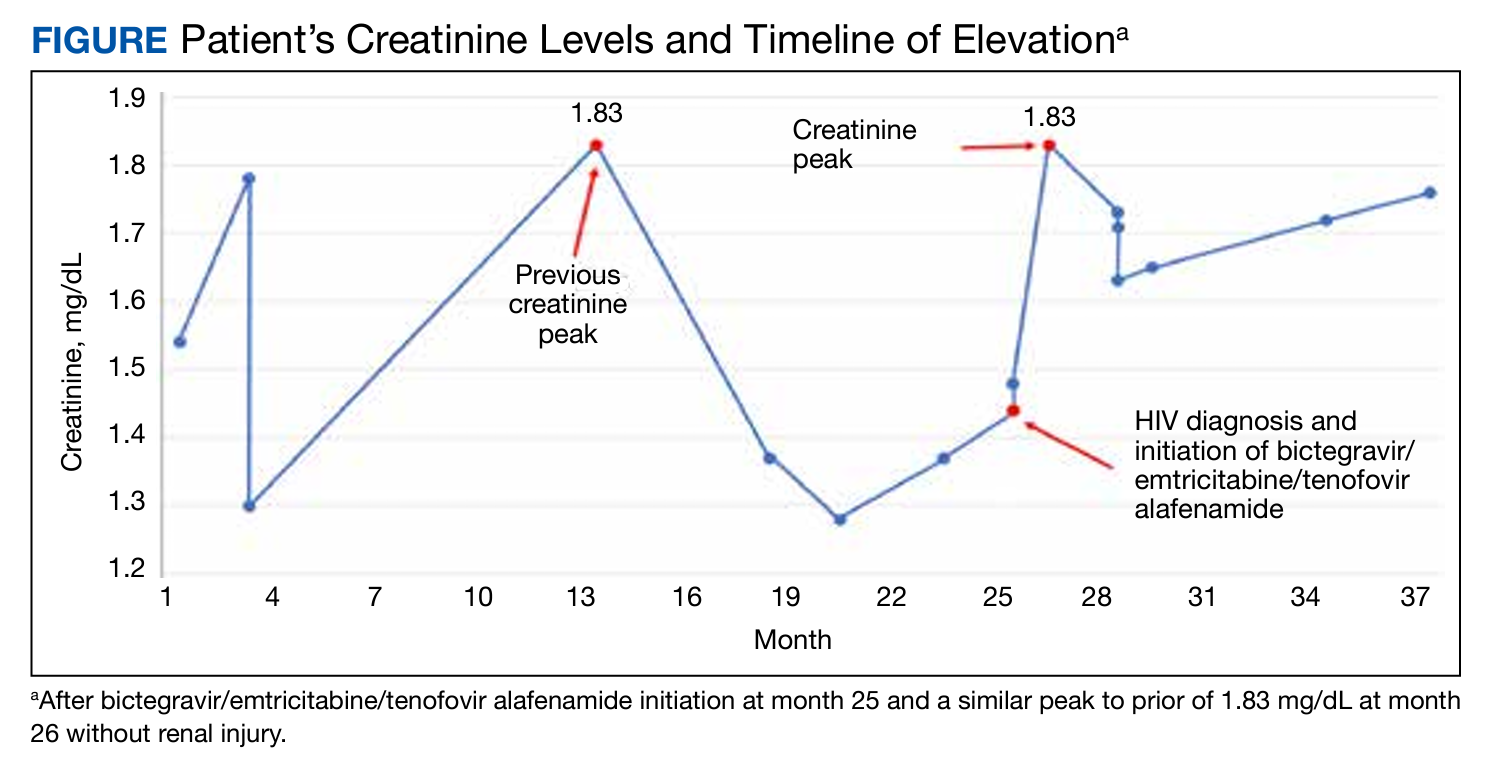
A 35-year-old African American man serving in the military and recently diagnosed with HIV was referred to a nephrology clinic for further evaluation of an acute elevation in sCr. Before treatment for HIV, a brief record review showed a baseline Cr of about 1.3 mg/dL, with an eGFRCr of 75 mL/min/1.73 m2.20 In the same month, the patient was prescribed bictegravir/emtricitabine/tenofovir alafenamide, an HIV drug with nephrotoxic potential.21 The patient's total viral load remained low, and CD4 count remained > 500 after initiation of the HIV treatment. He was in his normal state of health and had no known contributory history before his HIV diagnosis. Cr readings peaked at 1.83 mg/dL after starting the HIV treatment and remained elevated to 1.73 mg/dL over the next few months, corresponding to CKD stage 3A. Because bictegravir/emtricitabine/tenofovir alafenamide is cleared by the kidneys and has a nephrotoxic profile, the clinical care team considered dosage adjustment or a medication switch given his observed elevated eGFRCr based on the CKD-EPI 2021 equation for Cr alone. It was also noted that the patient had a similar Cr spike to 1.83 mg/dL in 2018 without any identifiable renal insult or symptoms (Figure).
Diagnostic Evaluation
The primary care team ordered a renal ultrasound and referred the patient to the nephrology clinic. The nephrologist ordered the following laboratory studies: urine microalbumin to Cr ratio, basic metabolic panel (BMP), comprehensive metabolic panel (CMP), urinalysis, urine protein, urine Cr, parathyroid hormone level, hemoglobin A1c, complement component 3/4 panels, antinuclear and antineutrophil cytoplasmic antibodies titers, glomerular basement membrane antibody titer, urine light chains, serum protein electrophoresis, κ/λ ratio, viral hepatitis panel, and rapid plasma reagin testing. Much of this laboratory evaluation served to rule out any secondary causes of kidney disease, including autoimmune disease, monoclonal or polyclonal gammopathies, diabetic nephropathy or glomerulosclerosis, and nephrotic or nephritic syndromes.
All laboratory studies returned within normal limits; no proteinuria was discovered on urinalysis, and no abnormalities were visualized on renal ultrasound. Bictegravir/emtricitabine/tenofovir alafenamide nephrotoxicity was highest among the differential diagnoses due to the timing of Cr elevation coinciding with the initiation of the medications. The patient's CysC level was 0.85 mg/dL with a calculated eGFRCys of 125 mL/min/1.73 m2. The calculated sCR and serum cystatin C (eGFRCr-Cys) using the new 2021 equation and when adjusting for body surface area placed his eGFR at 92 mL/min/1.73 m2.20
The patient’s eGFRCys reassured the care team that the patient’s renal function was not acutely or chronically impacted by bictegravir/emtricitabine/tenofovir alafenamide, resulting in avoidance of unnecessary dosage adjustment or discontinuation of the HIV treatment. The patient reported a chronic habit of protein and creatine supplementation and bodybuilding, which likely further compounded the discrepancy between eGFRCr and eGFRCys and explained his previous elevation in Cr in 2018.
Follow-up
The patient underwent serial monitoring that revealed a stable Cr and unremarkable eGFR, ruling out CKD. There has been no evidence of worsening kidney disease to date, and the patient remained on his initial HIV regimen.


