
Community Nursing Home Program Oversight: Can the VA Meet Increased Demand for Community-Based Care?


Background: The US Department of Veterans Affairs (VA) Community Nursing Home (CNH) program provides in-person oversight monitoring the quality of care of veterans in VA-contracted community-based skilled nursing homes. The number of veterans receiving CNH care is projected to increase by 80% by 2037.
Methods: Retrospective observational data describing the distance between contracted facilities and VA medical centers (VAMCs) were linked to Centers for Medicare and Medicaid monthly Nursing Home Compare and Brown University Long Term Care: Facts on Care in the US data. Qualitative interviews with CNH-based staff and VA-based CNH program oversight team members were conducted using a semistructured interview guide. Quantitative and qualitative data were analyzed independently and integrated during the interpretation of results.
Results: The number of CNHs per VAMC ranged from 1 to 68 (mean, 18). One in 4 CNHs were > 70 miles from the associated VAMC; among CNHs with 2 to 5 veterans, 44% were located > 50 miles away. Four qualitative themes emerged regarding VA CNH oversight: (1) benefits of VA CNH team engagement/visits, including quality assurance and care coordination; (2) burden of VA CNH oversight due to geographic dispersion with too few or too many veterans at each to achieve efficiency; (3) oversight burdens and limited staffing restricted ability to add CNHs; and (4) remote access and interoperability of electronic health records and balancing the number of CNH veterans with staffing could facilitate successful oversight.
Conclusions: The success of the CNH program will depend on the exchange of information and matching available resources to veterans’ needs. At a time when strategies to ease the burden on NHs and VA CNH coordinators are needed, the VA needs to improve to properly scale the program.
NH staff noted benefits to monthly VA staff visits, including having an additional person coordinating care and built-in VA liaisons. “It’s nice to have that extra set of eyes, people that you can care plan with,” an NH administrator shared. “It’s definitely a true partnership, and we have open and honest conversations so we can really provide a good service for our veterans.”
Distance & High Veteran Census Burdens

VA participants described oversight components as burdensome. Specifically, several VA participants mentioned that the charting they completed in the facility during each visit proved time consuming and onerous, particularly for distant NHs. To accommodate veterans’ preferences to receive care in a facility close to their homes and families, VAMCs contract with NHs that are geographically spread out. “We’re just all spread out… staff have issues driving 2 and a half hours just to review charts all day,” a VA CNH coordinator explained. In 2019, the mean distance between VAMC and NH was 48 miles, with half located > 32 miles from the VAMC. One-quarter of NHs were > 70 miles and 44% were located > 50 miles from the VAMC (Figure 1).
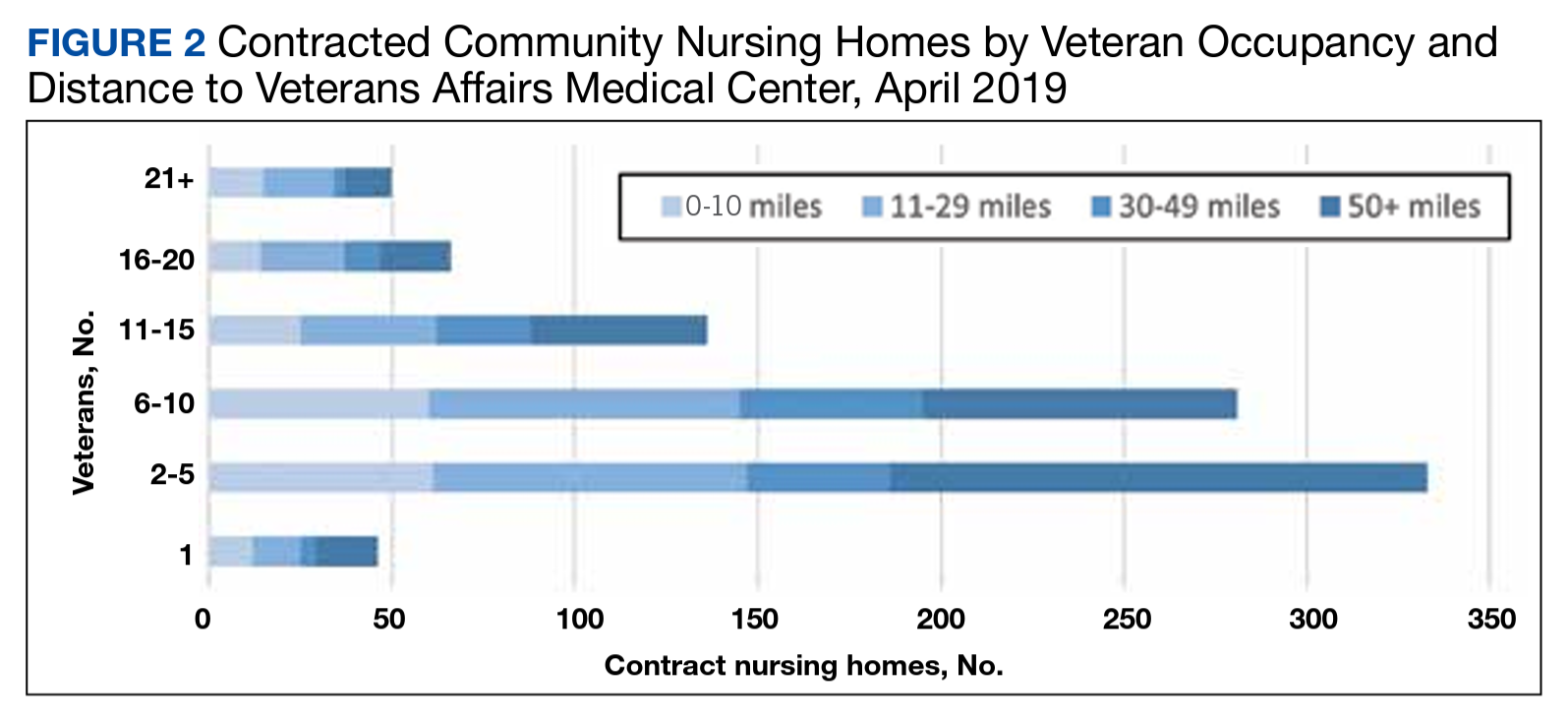
Participants highlighted how regular oversight visits were particularly time consuming at CNHs with a large contracted population. VA nurses and SWs spend multiple days and up to a week conducting oversight visits at facilities with large numbers of veterans. Another VA nurse highlighted how charting requirements resulted in several days of documentation outside of the NH visit for facilities with many contracted veteran residents. Multiple VA participants noted that having many veterans at an NH exacerbated the oversight burdens. In 2019, 252 (28%) of VA CNHs had > 10 contracted veterans and 1 facility had 34 veterans (Figure 2). VA participants perceived having too many veterans concentrated at 1 facility as potentially challenging for CNHs due to the complex care needs of veterans and the added need for care coordination with the VA. One VA NH coordinator noted that while some facilities were “adept at being able to handle higher numbers” of veterans, others were “overwhelmed.” Too many veterans at an NH, an SW explained, might lead the “facility to fail because we are such a cumbersome system.”
Oversight & Staffing Burden

While several participants described wanting to contract with more NHs to avoid overwhelming existing CNHs and to increase choice for veterans, they expressed concerns about their ability to provide oversight at more facilities due to limited staffing and oversight requirements. Across VAMCs, the median number of VA CNHs varied substantially (Figure 3). One VA participant with about 35 CNHs explained that while adding more NHs could create “more opportunities and options” for veterans, it needs to be balanced with the required oversight responsibilities. One VA nurse insisted that more staff were needed to meet current and future oversight needs. “We’re all getting stretched pretty thin, and just so we don’t drop the ball on things… I would like to see a little more staff if we’re gonna have a lot more nursing homes.”


